The Community Baboon Sanctuary
A voluntary conservation agreement between seven villages and hundreds of landowners that brought black howler monkeys back.
Updated 18 October 2026
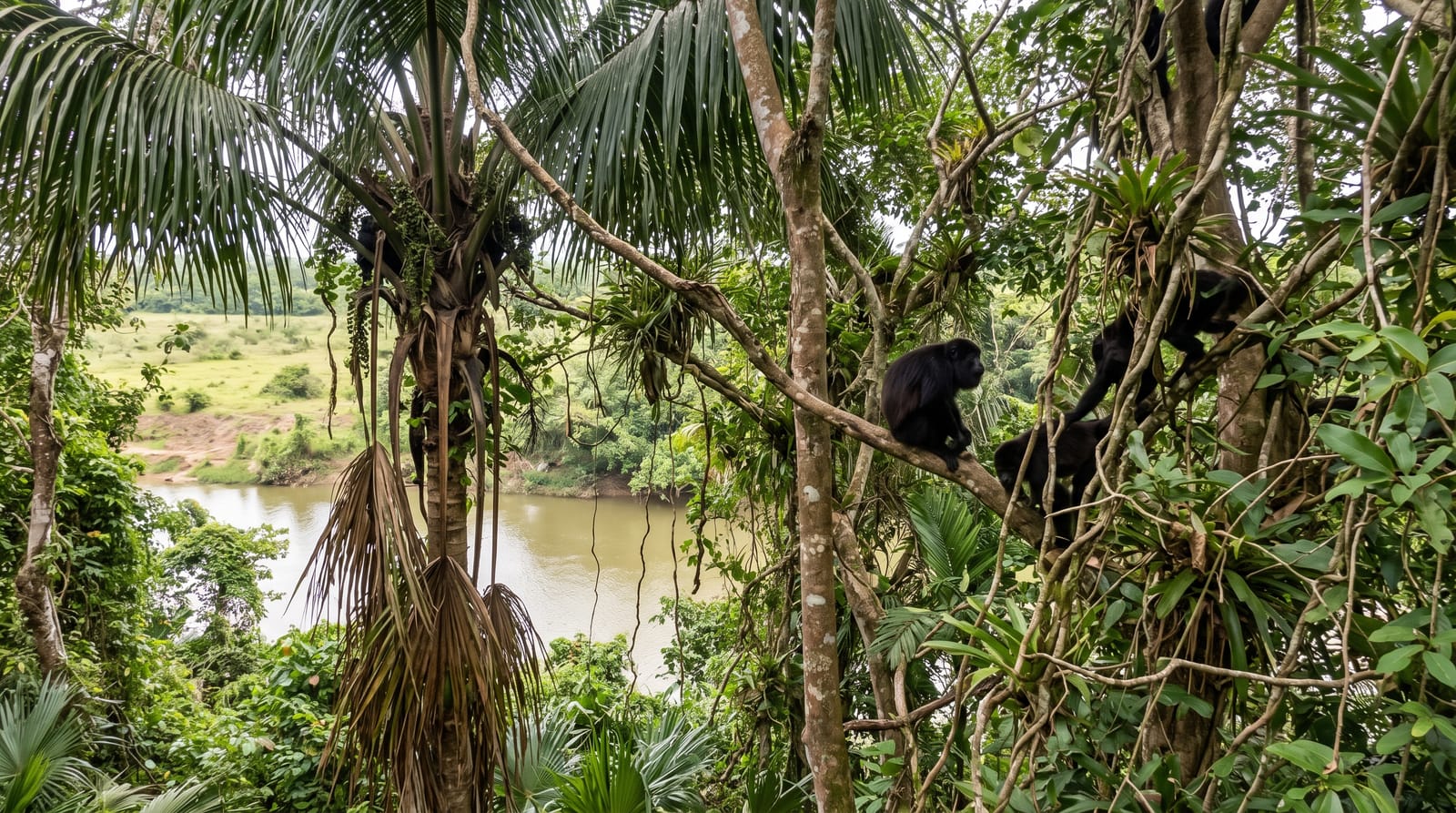
AI illustration
In 1985 a biologist persuaded twelve landowners along the Belize River to sign a voluntary pledge to leave forest corridors along the riverbank and field edges rather than clear them, so that black howler monkeys, called baboons in Belizean Creole, could move between patches. It grew to hundreds of landowners across seven villages and it worked: the population recovered strongly and animals from here were translocated to restock Cockscomb. It is a private, voluntary agreement with no legal protection at all, which makes it one of the more interesting conservation models anywhere. Guided walks find troops within minutes.
History
The American primatologist Robert Horwich and Fallet Young, a landowner of Bermudian Landing, set up the sanctuary in 1985 to protect the Yucatán black howler monkey from forest clearing, hunting and farming. It began with twelve landowners who pledged to keep forest on their land and has grown to more than 200 across seven villages of the Belize River valley, a model for community conservation now recognised as an IUCN Category IV protected area (Wikipedia, Community Baboon Sanctuary).
What you'll find
- Black howler monkeys - troops close to the trails, calling at dawn.
- The voluntary model - landowners signing rather than land being bought.
- The riverside corridors - forest strips left along the Belize River.
- The small museum - the story of how the pledge came about.
When to go
December to April is the dry season. Early morning is when the howlers call, which carries for kilometres and is the point of coming. Guided walks run through the day and monkeys are found reliably.
Good to know
The howlers are habituated and guides sometimes encourage close approach and feeding of leaves, which is not good practice; keep your distance. The road in is rough in places. It is a village-based operation rather than a park, and facilities are basic. Half a day covers it.
Nearby
Altun Ha is an hour east; Belize City is an hour southeast.
Key facts
Source: Wikidata, item Q14206836, read on 18 October 2026.
What to pack for The Community Baboon Sanctuary
Chosen from what this place is for. Tap a kit for the full checklist.
- Broken-in walking shoes or boots - Grip and ankle support matter more than looks; never hike in brand-new boots. Find on Amazon
- Layers + a waterproof shell - Mountain weather turns fast; a packable rain jacket saves the day. Find on Amazon
- Daypack with rain cover - 20-30 litres holds water, snacks, layers and a first-aid kit. Find on Amazon
- Offline maps + a power bank - Download the trail before you lose signal; carry backup charge. Find on Amazon
Some links on this page are Amazon affiliate links - if you buy through them we may earn a small commission at no extra cost to you.
All packing kitsPlan your trip
Where to start if The Community Baboon Sanctuary is going on the list.
Booking links on this page are affiliate links - if you book through them we may earn a small commission at no extra cost to you. It never changes what we write about a place.
Opening times, ticket prices and seasonal closures change - check the official source before you go: official site.