Belovezhskaya Pushcha
One of the last stands of primeval lowland forest in Europe, shared with Poland, and the stronghold of the European bison.
Updated 19 October 2026
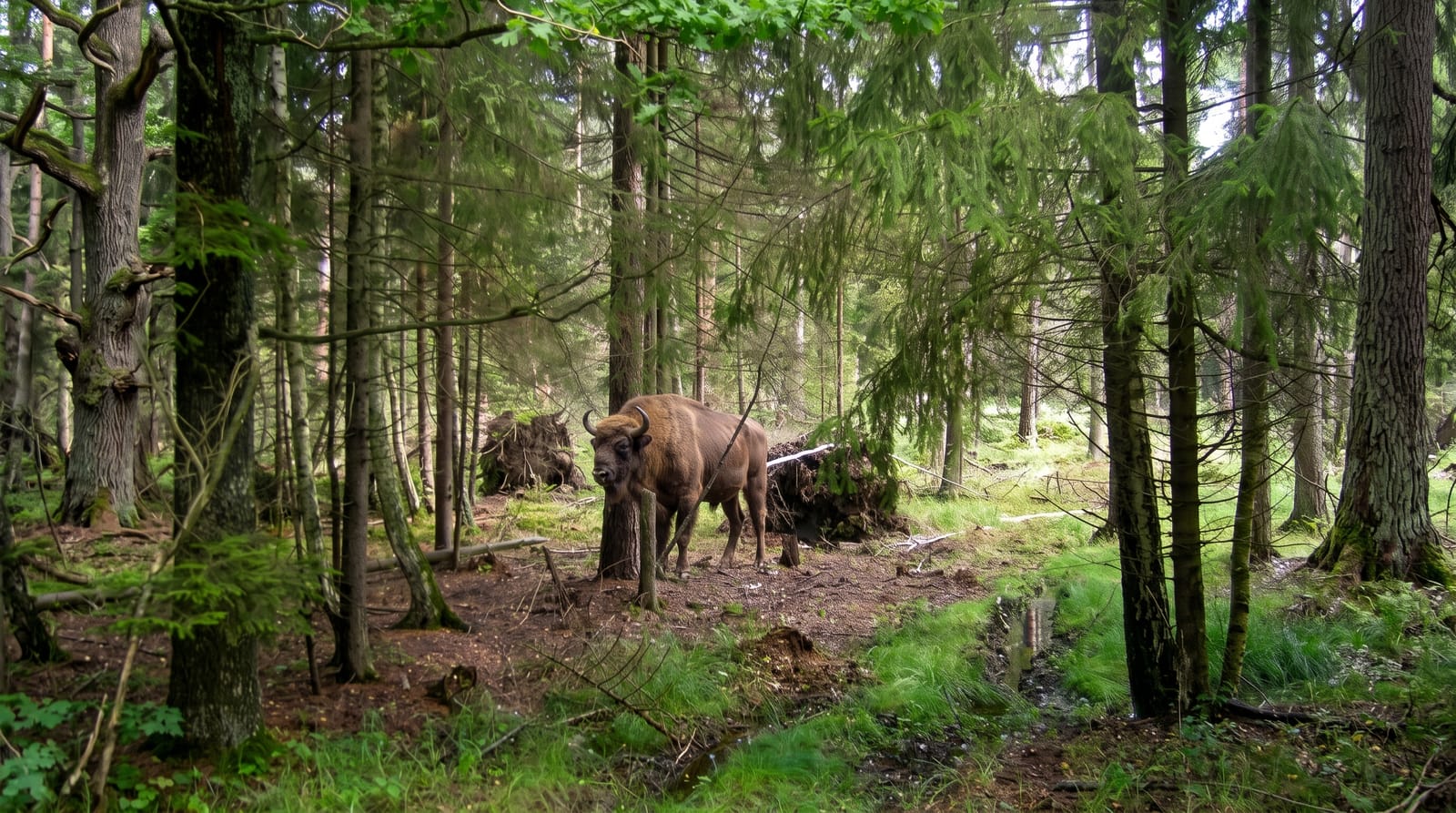
AI illustration
UNESCO World Heritage
Belovezhskaya Pushcha, Bialowieza on the Polish side, is a remnant of the forest that once covered the European plain, protected as a hunting reserve for centuries by successive rulers, which is why it was never cleared or fully worked; the result is old-growth oak, hornbeam, lime and spruce with standing and fallen deadwood in quantities found almost nowhere else, and the fungi, beetles and woodpeckers that depend on it. The European bison was hunted to extinction in the wild here by 1919 and reintroduced from captive stock in the 1920s; the forest now holds the largest free-living population. The core reserve is entered only with a guide; cycling, walking and a museum operate in the buffer areas.
History
Until about the 14th century travel through the forest was limited to river routes; in the 15th century it became the property of Grand Duke Jogaila, who took refuge from a plague in a wooden manor at Białowieża in 1426, and a document issued by Sigismund I in 1553 made poaching a bison punishable by death. After the Third Partition of Poland in 1795 the forest passed under Russian control, and in 1888 it was turned, in effect, into the Emperor's private hunting reserve. During the First World War about 5 million of an estimated 32 million cubic metres of timber were cut and the bison were hunted until February 1919; in 1929 the Polish state bought a herd of four from zoos and the Western Caucasus, and in 1932 most of the forest was declared a national park. After the Second World War the forest was divided between Poland and the Belarusian SSR, and in June 2014 the World Heritage Committee approved the extension of the site into its present form, Białowieża Forest, Belarus, Poland (Wikipedia, Białowieża Forest).
Highlights
- Old-growth stands - the oak and hornbeam with deadwood in place.
- European bison - the free-living herds, most visible at winter feeding.
- The nature museum - the exhibition at the park headquarters.
- Cycling routes - the marked tracks through the buffer forest.
When to go
May to September for cycling and walking; winter is when bison come to feeding sites and are actually seen. Core reserve access needs a guide and booking. Spring brings mud and mosquitoes.
Things to know
Wild bison are rarely seen outside winter feeding; the animals most visitors meet are in enclosures near the entrance. The strictly protected core is closed without a guide. The park has a tourist complex at the entrance that is heavily developed. Mosquitoes are severe in summer.
Nearby
Kamyanyets tower lies south; Brest is southeast.
Key facts
Source: Wikidata, item Q192666, read on 18 October 2026.
What to pack for Belovezhskaya Pushcha
Chosen from what this place is for. Tap a kit for the full checklist.
- Broken-in walking shoes or boots - Grip and ankle support matter more than looks; never hike in brand-new boots. Find on Amazon
- Padded shorts - The one thing that makes a full day in the saddle bearable. Find on Amazon
- Layers + a waterproof shell - Mountain weather turns fast; a packable rain jacket saves the day. Find on Amazon
- Helmet - Bring your own if you have a good one; rentals vary wildly. Find on Amazon
Some links on this page are Amazon affiliate links - if you buy through them we may earn a small commission at no extra cost to you.
All packing kitsPlan your trip
Where to start if Belovezhskaya Pushcha is going on the list.
Booking links on this page are affiliate links - if you book through them we may earn a small commission at no extra cost to you. It never changes what we write about a place.
Opening times, ticket prices and seasonal closures change - check the official source before you go: official site.