The Queen's Staircase
Sixty-five steps, sixty-six at first, cut by hand through solid limestone in Nassau by enslaved labour in the late eighteenth century.
Updated 18 October 2026
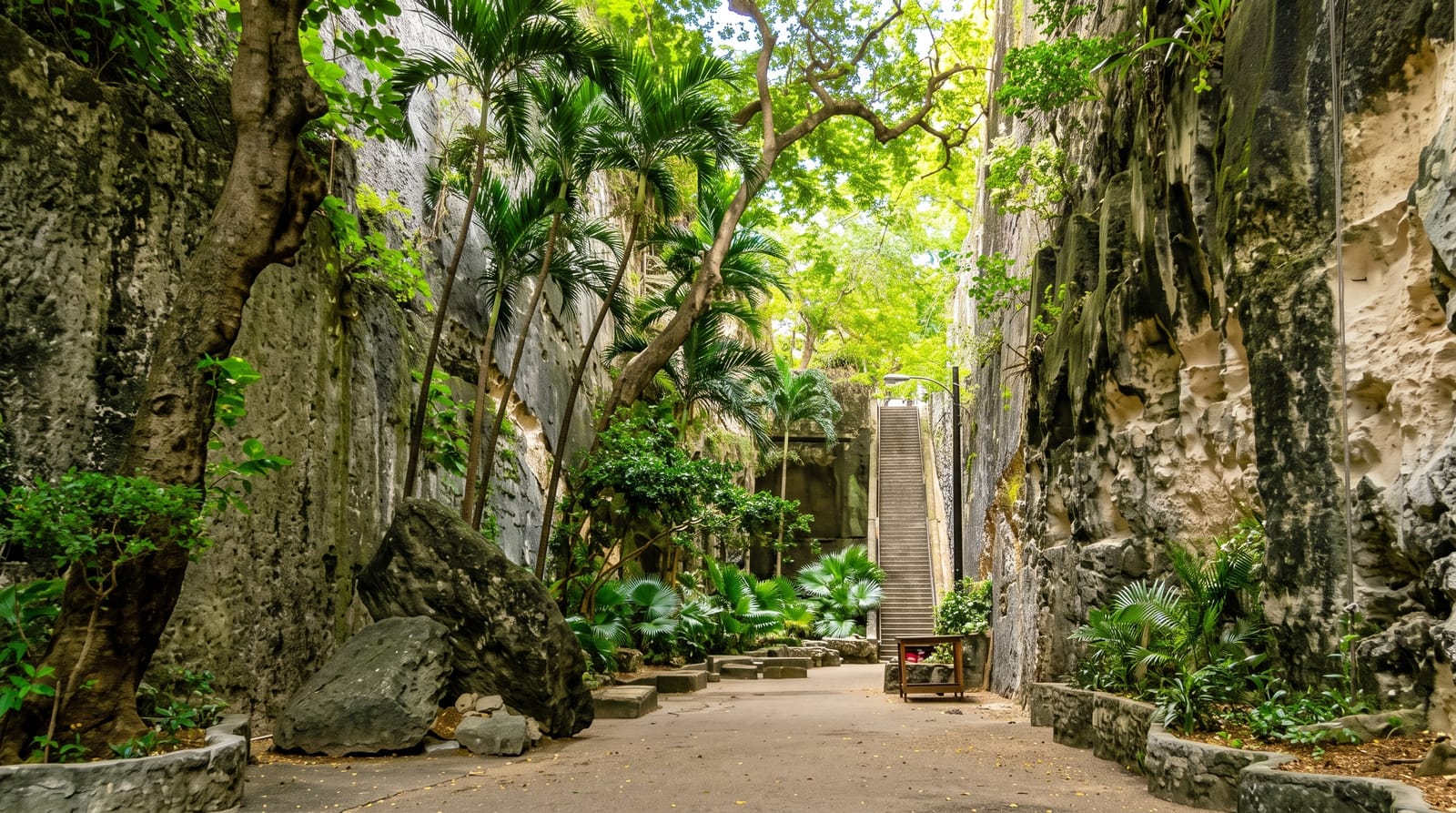
AI illustration
The Queen's Staircase is a passage roughly thirty metres deep cut straight down through the limestone ridge behind Nassau, with sixty-five steps in it, sixty-six at first, carved by hand by enslaved people in the 1790s to give the garrison at Fort Fincastle a direct route to the town without exposing it to fire from the harbour. It was named for Queen Victoria in the nineteenth century, a name usually linked to the end of slavery in the British empire, which sits oddly with who actually cut it. The walls are damp and hung with vines and a small waterfall runs down one side. Fort Fincastle, shaped like a ship's bow, stands at the top.
History
In 1793 some 600 enslaved people began cutting a staircase and road through solid limestone, with few tools, to link Fort Fincastle, finished the same year, with Nassau below, and the work was done by 1794; it had 66 steps, of which 65 remain. It was named for Queen Victoria in the 19th century, and the guides' story that the steps match the years of her reign is untrue, since she reigned for a little under 64 years, from 1837 to 1901 (Wikipedia, Queen's Staircase).
The main sights
- The staircase - sixty-five steps, sixty-six at first, cut by hand through solid rock.
- The rock walls - thirty metres of limestone hung with vines.
- Fort Fincastle - the ship-shaped fort at the top of the steps.
- The water tower - the island's highest point, beside the fort.
When to go
December to May is the dry season. Early morning avoids both the heat and the cruise passengers, who arrive in numbers from mid-morning. The passage itself is shaded and cool, which is welcome.
Good to know
It is a ten-minute visit and is heavily worked by vendors and unofficial guides who attach themselves at the bottom; a firm no is needed. On cruise days the staircase is a queue. The site is small and the history is presented lightly, with the enslaved labour that cut it barely acknowledged on the signage.
Nearby
Fort Fincastle is at the top; downtown Nassau is a short walk.
Key facts
Source: Wikidata, item Q43079731, read on 18 October 2026.
What to pack for The Queen's Staircase
Chosen from what this place is for. Tap a kit for the full checklist.
- Comfortable walking shoes - Sightseeing means kilometres of pavement and cobbles daily. Find on Amazon
- A slim anti-theft daypack - Zips that close properly; keep it in front in crowds and on transit. Find on Amazon
- A refillable water bottle - Many cities have public fountains; save money and plastic. Find on Amazon
- A light layer + compact umbrella - For museum air-con and a sudden shower. Find on Amazon
Some links on this page are Amazon affiliate links - if you buy through them we may earn a small commission at no extra cost to you.
All packing kitsPlan your trip
Where to start if The Queen's Staircase is going on the list.
Booking links on this page are affiliate links - if you book through them we may earn a small commission at no extra cost to you. It never changes what we write about a place.
Opening times, ticket prices and seasonal closures change - check the official source before you go: official site.