David Gareja
A monastery complex cut into desert hillsides southeast of Tbilisi, with painted cave chapels along a bare ridge.
Updated 19 October 2026
AI illustration
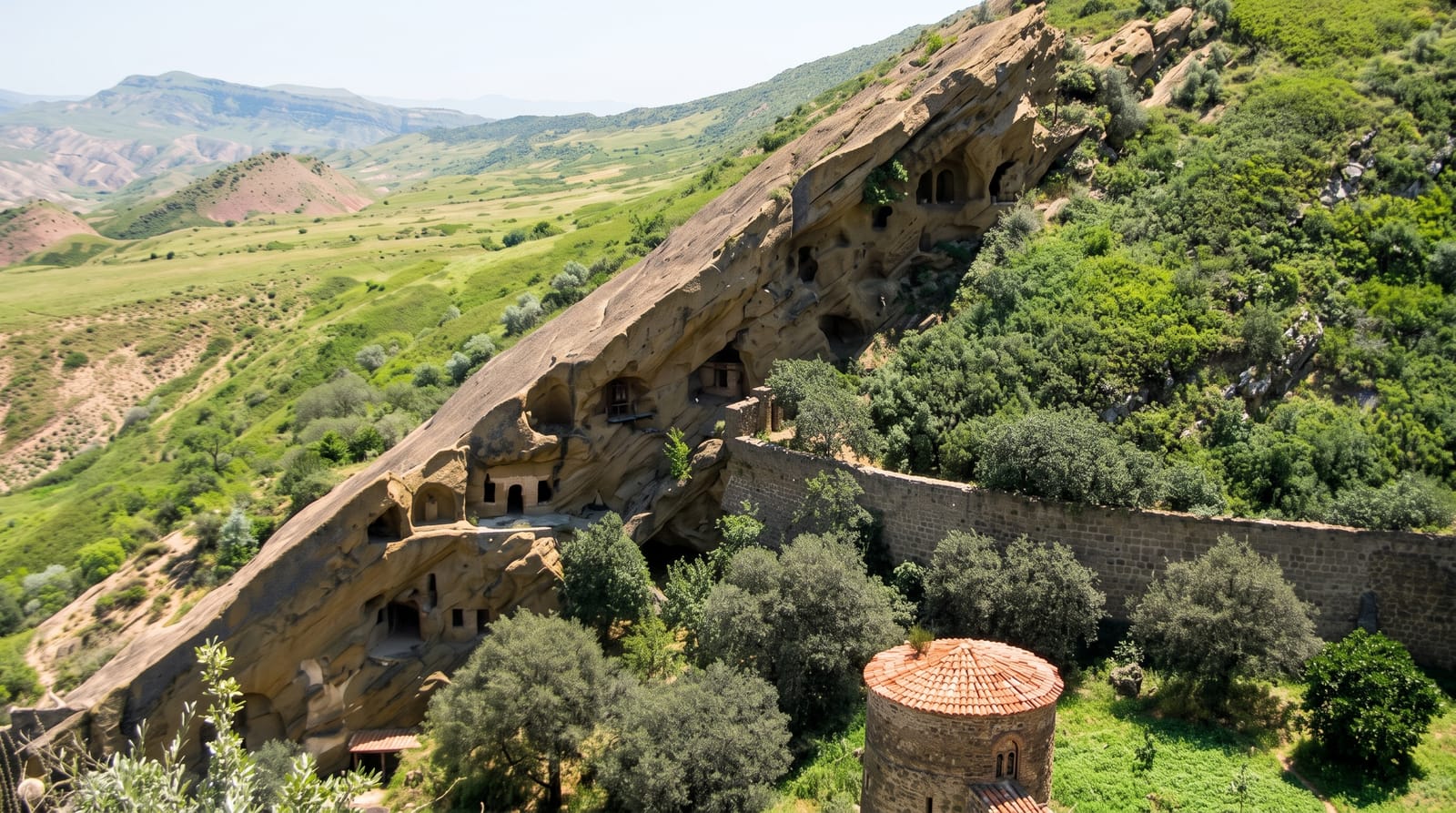
David Gareja sits in semi-desert badlands where Georgia's green gives out entirely, a landscape of striped ochre and grey hills with almost nothing growing on them. The complex was founded in the sixth century by one of the Assyrian fathers who brought monasticism to Georgia, and it grew into dozens of cave monasteries carved into the soft rock across the ridges. Lavra, the main monastery, is still active, with terraced buildings and cave cells built into the hillside. Above it a path climbs to Udabno, a line of cave chapels along the ridge whose walls hold frescoes from the tenth to thirteenth centuries, faded and scratched but remarkable. The ridge walk gives an enormous view over empty steppe in both directions.
History
The complex was founded in the 6th century by David of Gareji, one of the thirteen Assyrian monks who came to Georgia together, and his disciples Dodo and Luciane enlarged the first lavra and founded the monasteries of Dodo's Rka and Natlismtsemeli; it grew further under the 9th-century saint Hilarion the Iberian, and the 12th-century king Demetre I, author of the hymn Thou Art a Vineyard, retired here after giving up the throne. From the late 11th to the early 13th century it reached its height, when the monasteries of Udabno, Bertubani and Chichkhituri were built and its celebrated wall paintings made. The Mongol army devastated it in 1265 and the Safavids sacked it in 1615, destroying manuscripts and works of art, but each time it was restored, the second time under Onopre Machutadze, appointed father superior in 1690; monastic life was revived again in the late 20th century (Wikipedia, David Gareji monastery complex).
The main sights
- Lavra monastery - the working monastery of terraces and caves at the foot of the ridge.
- Udabno cave chapels - painted cave churches along the upper ridge, reached by a steep path.
- The frescoes - medieval wall paintings surviving in the open cave chapels.
- The badlands - striped desert hills and steppe stretching away on both sides.
When to go
Spring, when the semi-desert briefly flowers and the temperature is bearable, or autumn. Summer here is brutally hot with no shade at all, and winter can be cold and muddy. Snakes and tortoises are both active in the warm months.
Good to know
Access is the practical problem: no public transport, a rough final road, and a steep exposed climb to the painted chapels. The ridge is on the border, and access to the upper chapels has occasionally been restricted, so confirm before committing to the drive. Bring all your own water; there is nothing out there.
Nearby
Kakheti's wine villages lie north; Tbilisi is two hours west.
Key facts
Source: Wikidata, item Q1178627, read on 18 October 2026.
What to pack for David Gareja
Chosen from what this place is for. Tap a kit for the full checklist.
- Head torch + spare batteries - Hands-free light is essential; caves are truly dark. Find on Amazon
- Loose, light, long clothing - Covering up beats bare skin in the desert - and locals dress this way for a reason. Find on Amazon
- Comfortable walking shoes - Sightseeing means kilometres of pavement and cobbles daily. Find on Amazon
- Modest clothing - Shoulders and knees covered - the single most common requirement. Find on Amazon
Some links on this page are Amazon affiliate links - if you buy through them we may earn a small commission at no extra cost to you.
All packing kitsPlan your trip
Where to start if David Gareja is going on the list.
Booking links on this page are affiliate links - if you book through them we may earn a small commission at no extra cost to you. It never changes what we write about a place.
Opening times, ticket prices and seasonal closures change - check the official source before you go: official site.