The Leshan Giant Buddha
A UNESCO-listed Buddha carved from a river cliff over a thousand years ago, the largest stone Buddha in the world, gazing out over the meeting of three rivers.
Updated 18 October 2026
AI illustration
UNESCO World Heritage
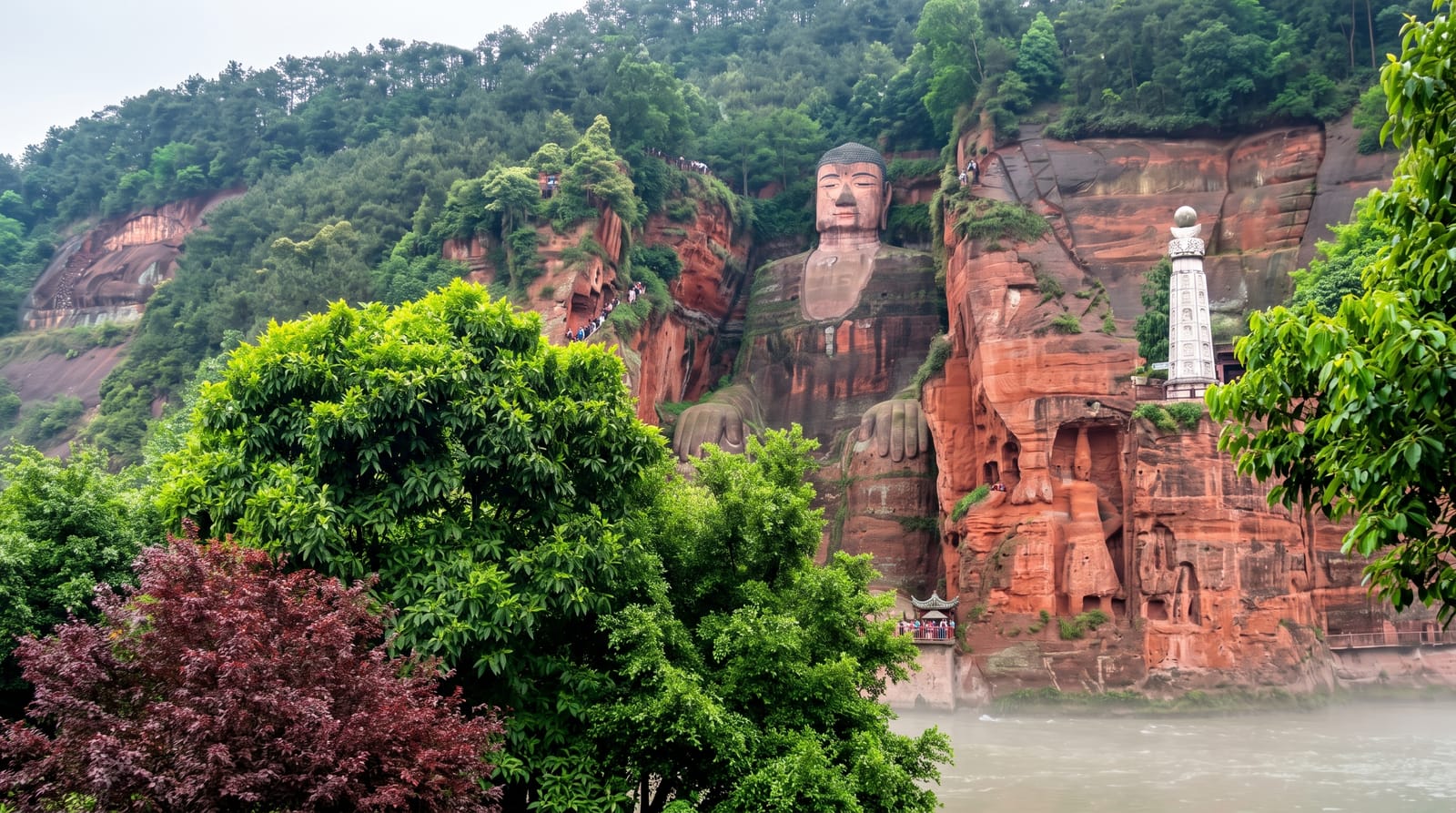
At Leshan in Sichuan, where three rivers meet, a colossal seated Buddha has been carved directly into the red sandstone cliff face, and at seventy-one metres tall it is the largest stone Buddha in the world, part of a World Heritage Site together with nearby Mount Emei. Begun in the eighth century by a monk who hoped that the merit of the work, and the rubble tipped into the river, would calm the dangerous waters where boats were wrecked, it took about ninety years to complete. The Buddha sits serenely with hands on knees, its feet at the water's edge and its head level with the clifftop, and an ingenious hidden drainage system in the carving has helped preserve it for over a millennium. Visitors can look across from a boat on the river for the full scale, or descend a steep stairway cut into the cliff beside the figure to stand at its feet, dwarfed by its toes.
History
The monk Hai Tong began the statue in the Tang dynasty, believing that a Maitreya Buddha would calm the turbulent waters that wrecked boats at the meeting of the Min and Dadu rivers; when funding was threatened he is said to have gouged out his own eyes to show his sincerity. After his death his disciples carried on with the support of a local official until work stopped at the knees, and some 70 years later the jiedushi Wei Gao funded the rest, so the Buddha was completed in 803; so much stone fell into the river that the currents were indeed made safer. A 13-storey wooden pavilion sheltered it until it was sacked by the Mongols at the end of the Yuan dynasty, and since 1996 the Buddha has been part of the Mount Emei World Heritage Site (Wikipedia, Leshan Giant Buddha).
What's there
- The Buddha from the river - the full scale of the figure seen from a boat.
- The cliffside stairway - the steep descent beside the Buddha to its feet.
- The carved details - the hidden drainage and the scale of the head and hands.
- The river confluence - the meeting of the three rivers the Buddha overlooks.
When to go
Spring and autumn are the most comfortable; summer is hot and humid and can bring high, muddy rivers, winter cooler and quieter. Weekdays are far less crowded than weekends and holidays, when the cliff stairway can back up badly. A boat trip avoids the queues and gives the best overall view.
Practical notes
The narrow stairway down beside the Buddha is the highlight but also a serious bottleneck: on busy days the queue to descend can take hours and shuffle slowly along the cliff, so weekdays or a river boat are far better. It is a couple of hours from Chengdu. The site involves a lot of stairs and can be hot. Seeing the Buddha from the water, if you skip the descent, is quicker and gives the grander view.
Nearby
The sacred mountain of Emei with its temples is close; Chengdu and its pandas are two hours away.
Key facts
Source: Wikidata, item Q205131, read on 18 October 2026.
What to pack for The Leshan Giant Buddha
Chosen from what this place is for. Tap a kit for the full checklist.
- Strong insect repellent - DEET or picaridin; the jungle is where bites and disease risk are highest. Find on Amazon
- Comfortable walking shoes - Sightseeing means kilometres of pavement and cobbles daily. Find on Amazon
- Modest clothing - Shoulders and knees covered - the single most common requirement. Find on Amazon
- Long, light, quick-dry clothing - Covers skin from insects and sun without cooking you in the humidity. Find on Amazon
Some links on this page are Amazon affiliate links - if you buy through them we may earn a small commission at no extra cost to you.
All packing kitsPlan your trip
Where to start if The Leshan Giant Buddha is going on the list.
Booking links on this page are affiliate links - if you book through them we may earn a small commission at no extra cost to you. It never changes what we write about a place.
Opening times, ticket prices and seasonal closures change - check the official source before you go: official site.