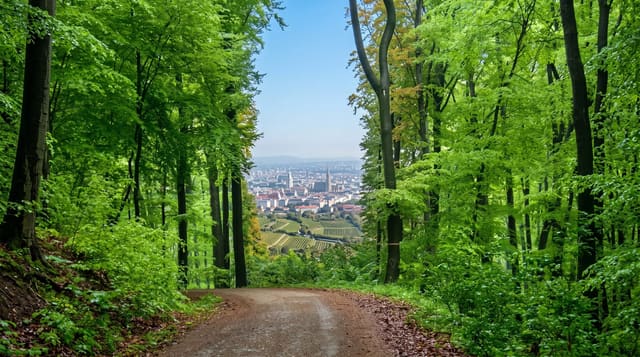
Lilienfeld Abbey
The largest medieval abbey complex in Austria, a Cistercian house of 1202 in the Traisen valley.
Updated 18 October 2026
Lilienfeld was founded in 1202 by Duke Leopold VI, who is buried in it, and the buildings that survive make it the largest medieval abbey complex in Austria - the church, cloister, chapter house, dormitory and refectory largely intact in the transitional style between Romanesque and Gothic, with the sober proportions Cistercian building rules imposed. The cloister with its fountain house is the set piece. The library holds around forty thousand volumes in a baroque hall. Unlike Melk or Göttweig the abbey was never given a full baroque rebuilding, so what you see is medieval fabric with baroque furnishing inserted, which makes it the better place to understand how a Cistercian house was actually laid out. The community is small and the abbey is quiet compared with the Danube houses.
History
Duke Leopold VI of Austria and Styria founded the abbey in 1202 as a daughter house of Heiligenkreuz, and its abbots, as councillors of Austria's rulers, made it rich; in 1683 abbot Matthew Kollweis turned it into a fortress against the Ottoman advance, with a garrison and shelter for many refugees. Baroque additions came in the 17th century and the tower, library and church interior were refitted in the first half of the 18th; Joseph II suppressed the abbey in 1789, but Leopold II reopened it in 1790, and after a fire in 1810 abbot Johann Ladislaus Pyrker, later Patriarch of Venice, rebuilt it. Pope Paul VI made the church a minor basilica in 1976 (Wikipedia, Lilienfeld Abbey).
The main sights
- The largest medieval abbey in Austria - church, cloister and claustral ranges intact.
- Transitional architecture - Romanesque going over into Gothic, plainly Cistercian.
- A baroque library hall - around forty thousand volumes.
- Leopold VI's tomb - the founder buried in his own abbey.
When to go
All year. Half a day.
Things to know
Access is by guided tour at set times, mostly in German. The church is cold. It is much quieter than Melk, which cuts both ways - fewer crowds, fewer facilities.
Nearby
The Traisental runs south to Mariazell; Sankt Pölten is north.
Key facts
Source: Wikidata, item Q674996, read on 18 October 2026.
What to pack for Lilienfeld Abbey
Chosen from what this place is for. Tap a kit for the full checklist.
- Comfortable walking shoes - Sightseeing means kilometres of pavement and cobbles daily. Find on Amazon
- Modest clothing - Shoulders and knees covered - the single most common requirement. Find on Amazon
- A slim anti-theft daypack - Zips that close properly; keep it in front in crowds and on transit. Find on Amazon
- A scarf or shawl - To cover the head or shoulders on entry; women especially at mosques. Find on Amazon
Some links on this page are Amazon affiliate links - if you buy through them we may earn a small commission at no extra cost to you.
All packing kitsPlan your trip
Where to start if Lilienfeld Abbey is going on the list.
Booking links on this page are affiliate links - if you book through them we may earn a small commission at no extra cost to you. It never changes what we write about a place.
Opening times, ticket prices and seasonal closures change - check the official source before you go: official site.