Minack Theatre
A theatre cut into a Cornish cliff by one woman and her gardener over decades, with the Atlantic as its backdrop.
Updated 20 October 2026
AI illustration
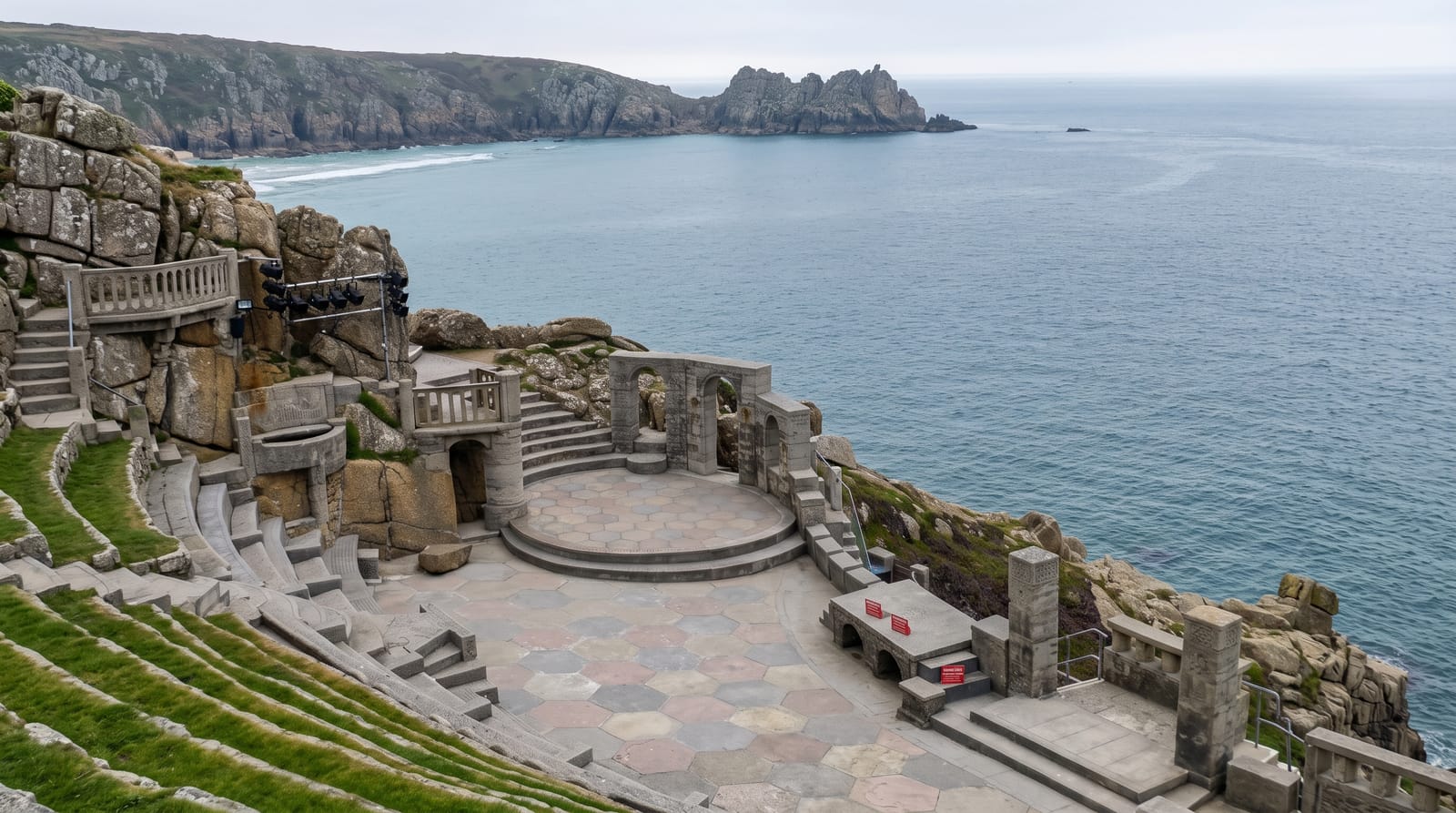
Rowena Cade owned the headland at Porthcurno and in 1929 began helping a local group of players with A Midsummer Night's Dream, and for their Tempest of 1932 she and her gardener Billy Rawlings then cut a terraced auditorium into the granite by hand, carrying sand up from the beach below on their backs to mix concrete, and worked on it every winter for the next fifty years. Cade was still hauling beams in her eighties and died in 1983. The stage sits above a drop to the sea, so performances run with gannets and sometimes dolphins passing behind the actors, and the theatre now stages about twenty productions across a season from Easter to the end of October. It is a rare thing in that the setting genuinely competes with whatever is on stage, which directors have to work around.
What you'll find
- The cut auditorium - granite terraces carved by hand over fifty years.
- The Atlantic backdrop - open sea directly behind the stage.
- The Cade story - an exhibition on the woman who built it herself.
- The subtropical planting - succulents and aeoniums in the terraces.
When to go
May to September for performances, which run afternoons and evenings; daytime visits run year-round when no show is on. Evening performances in June and July have the longest light.
Before you go
Seats are concrete terraces and cushions are essential; performances go ahead in rain and the audience sits through it in waterproofs. The theatre is exposed to wind off the sea. Parking is limited and the path down to the seats is steep with many steps.
Nearby
Porthcurno beach is directly below; Land's End and Penzance lie west and east.
Key facts
Source: Wikidata, item Q1752774, read on 18 October 2026.
What to pack for Minack Theatre
Chosen from what this place is for. Tap a kit for the full checklist.
- Binoculars - The single best wildlife tool - even a compact pair transforms a sighting. Find on Amazon
- Comfortable walking shoes - Sightseeing means kilometres of pavement and cobbles daily. Find on Amazon
- A zoom camera or long lens - Animals rarely come close; reach beats megapixels. Find on Amazon
- A slim anti-theft daypack - Zips that close properly; keep it in front in crowds and on transit. Find on Amazon
Some links on this page are Amazon affiliate links - if you buy through them we may earn a small commission at no extra cost to you.
All packing kitsPlan your trip
Where to start if Minack Theatre is going on the list.
Booking links on this page are affiliate links - if you book through them we may earn a small commission at no extra cost to you. It never changes what we write about a place.
Opening times, ticket prices and seasonal closures change - check the official source before you go: official site.