Si Satchanalai Historical Park
Sukhothai's quieter twin city, where elephant-ringed chedis and stucco reliefs stand under old trees beside the Yom River.
Updated 18 October 2026
AI illustration
UNESCO World Heritage
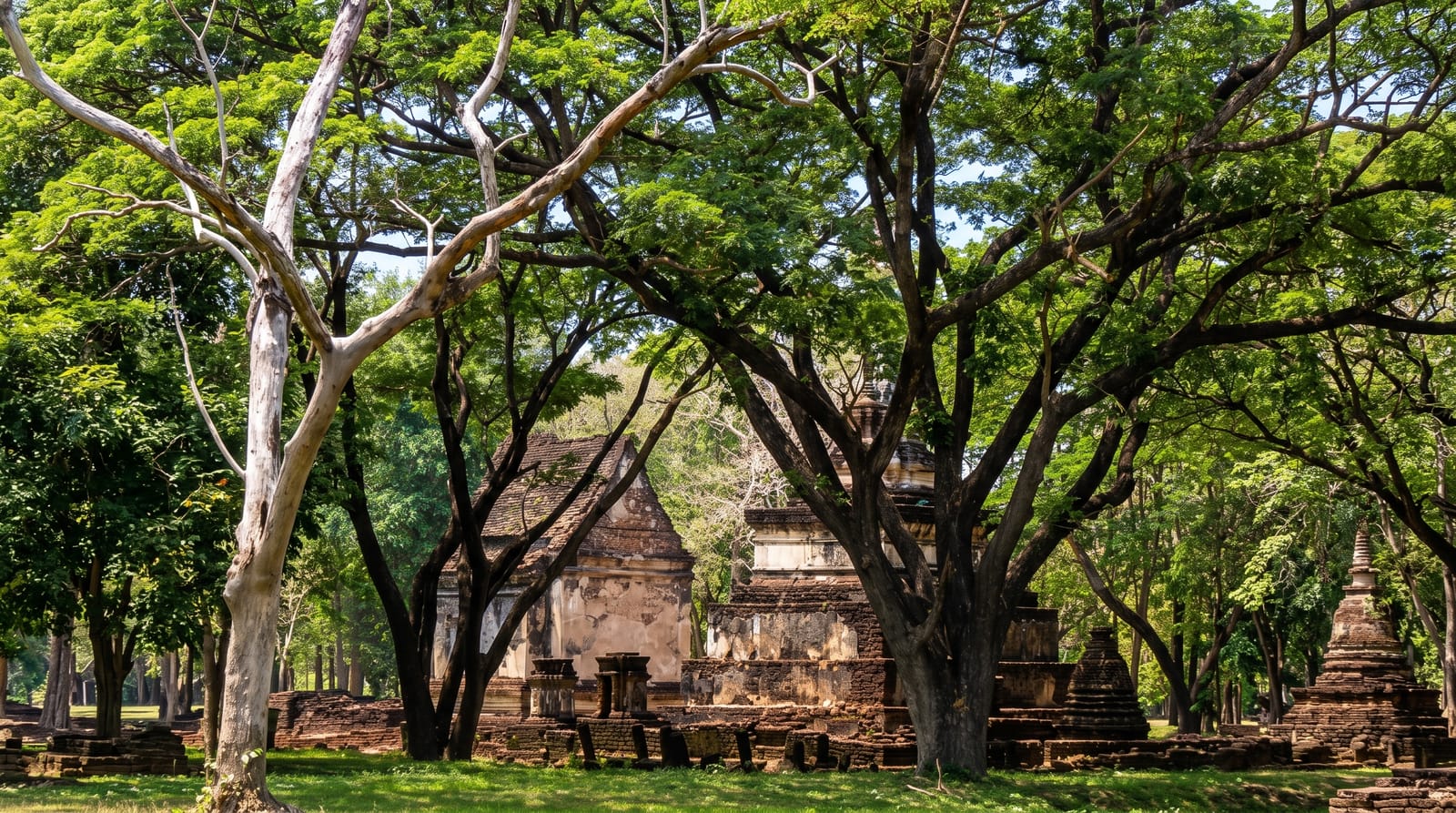
Si Satchanalai was the second city of the Sukhothai kingdom, held by the crown prince, and its ruins sit in a bend of the Yom River about an hour north of the main park. The scale is smaller and the setting greener: laterite walls under old trees, chedis rising out of rough grass, and a fraction of the visitors. Wat Chang Lom is ringed at its base by stone elephants, Wat Chedi Chet Thaeo gathers rows of smaller spires around a central tower, and Wat Nang Phaya keeps some of the finest stucco work in the country under a protective roof. Downriver at Ban Ko Noi lie the excavated kilns that fired Sangkhalok ceramics for export across Asia.
History
The older town here is Chaliang, on a bend of the Yom, a trading centre recorded as an independent polity in the Chinese Song Shi for 1001; in the late 12th century Sri Naw Nam Thum ruled it together with Sukhothai, Khom Sabat Khlon Lamphong took the towns from him, and in 1239 Pho Khun Bang Klang Hao and Pho Khun Pha Mueang took them back. Tradition says that in 1250 King Sri Indraditya built a new town west of Chaliang, Si Satchanalai, city of good people, as the second centre of the Sukhothai kingdom, and it became the custom for the crown prince to govern it, though the historian Michael Vickery placed the Si Satchanalai of the inscriptions at a separate site to the south. The city passed between Lan Na and Ayutthaya in the 15th century and was laid waste by a Burmese army in 1766 (Wikipedia, Si Satchanalai Historical Park).
What you'll find
- Wat Chang Lom - a bell-shaped chedi with stone elephants set into its base.
- Wat Chedi Chet Thaeo - rows of smaller spires crowding one central tower.
- Wat Nang Phaya - stucco reliefs sheltered under a modern roof.
- The Sangkhalok kilns - excavated ceramic kilns at Ban Ko Noi, downriver from the walls.
When to go
November to February is the dry, cooler season and the only comfortable time to cycle between the ruins. Mornings before ten are best, since by midday the laterite radiates heat and shade is patchy. Nothing needs booking and the park almost never feels full, but buy the combined zone ticket at the gate and carry water.
Things to know
It is a long detour from Sukhothai and public transport is thin, so most people end up hiring a driver or pedalling further than planned. The ruins are lower and plainer than Ayutthaya's, and several are fenced. The kiln site costs a separate ticket, sits a further drive away, and its sheds are dusty and dimly lit.
Nearby
Sukhothai Historical Park to the south and the riverside town of Sawankhalok.
Key facts
Source: Wikidata, item Q1395364, read on 18 October 2026.
What to pack for Si Satchanalai Historical Park
Chosen from what this place is for. Tap a kit for the full checklist.
- Comfortable walking shoes - Sightseeing means kilometres of pavement and cobbles daily. Find on Amazon
- A slim anti-theft daypack - Zips that close properly; keep it in front in crowds and on transit. Find on Amazon
- A refillable water bottle - Many cities have public fountains; save money and plastic. Find on Amazon
- A light layer + compact umbrella - For museum air-con and a sudden shower. Find on Amazon
Some links on this page are Amazon affiliate links - if you buy through them we may earn a small commission at no extra cost to you.
All packing kitsPlan your trip
Where to start if Si Satchanalai Historical Park is going on the list.
Booking links on this page are affiliate links - if you book through them we may earn a small commission at no extra cost to you. It never changes what we write about a place.
Opening times, ticket prices and seasonal closures change - check the official source before you go: official site.


