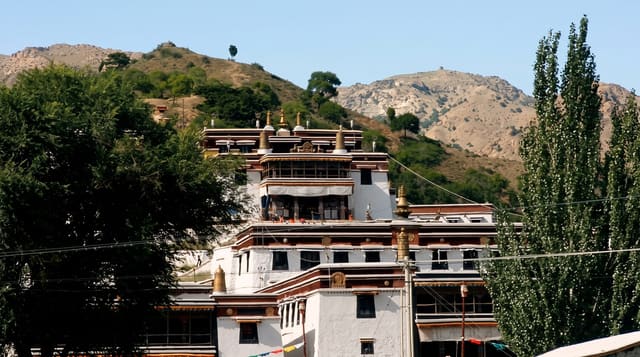
Mar Musa Monastery
A desert-cliff monastery with medieval frescoes, revived as a place of retreat.
Updated 18 October 2026
Deir Mar Musa al-Habashi - the monastery of Saint Moses the Abyssinian - clings to a cliff over a desert wadi, reached by three hundred and something steps, and its small church preserves the finest medieval frescoes in Syria, layered from the eleventh to thirteenth centuries, with a vivid Last Judgement across the west wall. Refounded in recent decades as a community of prayer, work and hospitality, it welcomes visitors and retreatants who share its silence, meals and terrace nights under desert stars.
History
The oldest buildings on the rock were probably Roman watchtowers over the road from Palmyra to Damascus, and the monastery itself was most likely founded in the 6th century, when a manuscript mentions the "convent of Mushe" on the hill east of Nabk; hermits' cells in the nearby cliffs date from the same time. It was the seat of a bishop until the end of the 14th century and was largely rebuilt in the 11th and 16th centuries. Its frescoes, painted between 1058 and 1208, are the only complete medieval church decoration to survive in greater Syria. After intermittent use the monastery was abandoned in the 19th century, and by 1981 most of the upper terrace had collapsed; in 1992 the Jesuit Paolo Dall'Oglio and the deacon Jacques Mourad restored it as a monastic community of the Syriac Catholic Church (Wikipedia, Monastery of Saint Moses the Abyssinian).
What you'll find
- The frescoes - the layered medieval paintings and Last Judgement.
- The cliff setting - the monastery hung above the wadi.
- The stair approach - the long climb that begins the visit.
- The terraces - desert views and the community's hospitality.
When to go
March to May and September to November are mild; summer days are hot but terrace evenings redeem them. Arrive with daylight for the climb. Feast days vary.
What to expect
The climb is genuinely long and there is no vehicle alternative. This is a living monastery - silence and simplicity are the offer, and conduct should match. Overnight stays need arranging ahead.
Nearby
Nabk is west on the highway, and Damascus is south.
Key facts
Source: Wikidata, item Q1157645, read on 18 October 2026.
What to pack for Mar Musa Monastery
Chosen from what this place is for. Tap a kit for the full checklist.
- Loose, light, long clothing - Covering up beats bare skin in the desert - and locals dress this way for a reason. Find on Amazon
- Comfortable walking shoes - Sightseeing means kilometres of pavement and cobbles daily. Find on Amazon
- Modest clothing - Shoulders and knees covered - the single most common requirement. Find on Amazon
- Shelter suited to the place - Tent, tarp or hut booking - match it to the terrain and rules. Find on Amazon
Some links on this page are Amazon affiliate links - if you buy through them we may earn a small commission at no extra cost to you.
All packing kitsPlan your trip
Where to start if Mar Musa Monastery is going on the list.
Booking links on this page are affiliate links - if you book through them we may earn a small commission at no extra cost to you. It never changes what we write about a place.
Opening times, ticket prices and seasonal closures change - check the official source before you go: official site.