Tower of Hercules
A Roman lighthouse on a Galician headland, refaced in the eighteenth century and still working after nineteen centuries.
Updated 18 October 2026
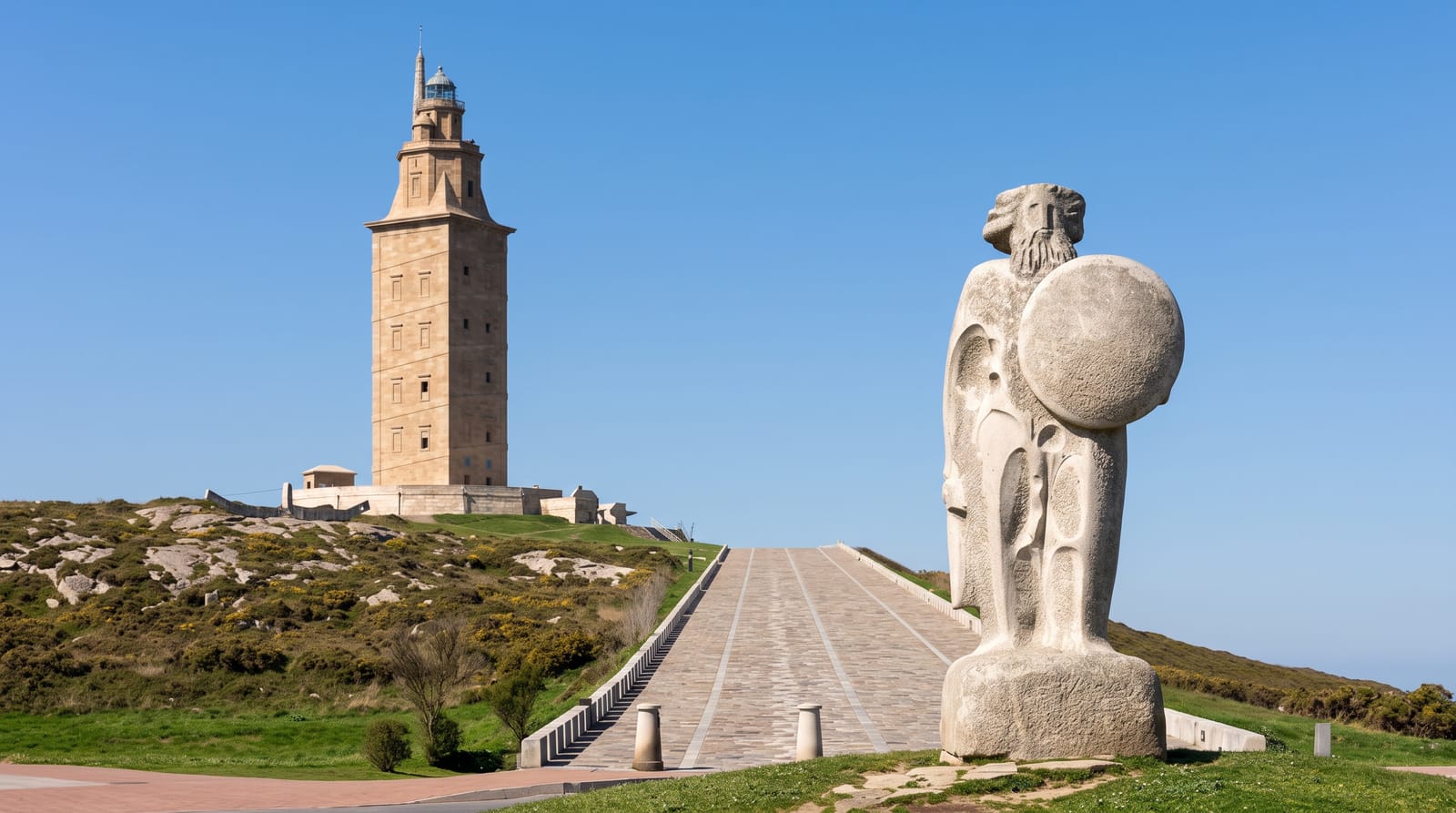
AI illustration
UNESCO World Heritage
The Tower of Hercules was built in the first or second century AD on a headland guarding the approach to A Coruna, and it is the only Roman lighthouse still in operation anywhere, working continuously since antiquity apart from periods of neglect. The Roman core survives inside a neoclassical casing added between 1788 and 1791 by the engineer Eustaquio Giannini, who encased the crumbling original in a square outer shell and added a new upper stage, taking it to fifty-five metres. An inscription at the base names the Roman architect, Caius Sevius Lupus. UNESCO listed it in 2009. Around it stretches a headland park with a sculpture trail, Celtic-themed monuments and a rock carving site.
History
The lighthouse stood by the 1st century and was built or rebuilt under Trajan, its design probably modelled on the Lighthouse of Alexandria, and a stone at its base names the architect Gaius Sevius Lupus of Aeminium, today's Coimbra, dedicating it to Mars; the Roman tower was shorter and wider, wrapped by a spiral ramp whose line still shows on the outside. Paulus Orosius described it around 415-417 as a very tall lighthouse at Brigantia looking towards Britain, and it was known as Farum Brigantium until the 20th century. In the 18th century the naval engineer Eustaquio Giannini restored the 34-metre Roman core and added a 21-metre top storey, a restoration UNESCO calls exemplary, and on 27 June 2009 it became a World Heritage Site, the only fully preserved Roman lighthouse still in use (Wikipedia, Tower of Hercules).
What you'll find
- The Roman core - original masonry inside the eighteenth-century casing.
- The neoclassical shell - a 1791 outer skin and upper stage.
- The founder's inscription - the Roman architect named at the base.
- The headland park - a sculpture trail and coastal walk around the tower.
When to go
April to June and September to November; the tower can be climbed, with 234 steps to the top, and closes in high wind. Galicia is wet year-round and the headland is exposed.
Practical notes
Almost nothing Roman is visible from outside, since the eighteenth-century casing covers it entirely; the original masonry is seen in a section inside. The climb is a narrow stair of 234 steps. Wind on the headland is strong.
Nearby
A Coruna's old town and glass-fronted seafront are south; the Costa da Morte runs west.
Key facts
Source: Wikidata, item Q245151, read on 18 October 2026.
What to pack for Tower of Hercules
Chosen from what this place is for. Tap a kit for the full checklist.
- Broken-in walking shoes or boots - Grip and ankle support matter more than looks; never hike in brand-new boots. Find on Amazon
- Comfortable walking shoes - Sightseeing means kilometres of pavement and cobbles daily. Find on Amazon
- Layers + a waterproof shell - Mountain weather turns fast; a packable rain jacket saves the day. Find on Amazon
- A slim anti-theft daypack - Zips that close properly; keep it in front in crowds and on transit. Find on Amazon
Some links on this page are Amazon affiliate links - if you buy through them we may earn a small commission at no extra cost to you.
All packing kitsPlan your trip
Where to start if Tower of Hercules is going on the list.
Booking links on this page are affiliate links - if you book through them we may earn a small commission at no extra cost to you. It never changes what we write about a place.
Opening times, ticket prices and seasonal closures change - check the official source before you go: official site.