Santiago de Compostela
The goal of the great pilgrimage - a granite old town around a magnificent cathedral holding the shrine of St James, end of the Camino, a UNESCO city in green Galicia.
Updated 18 October 2026
AI illustration
UNESCO World Heritage
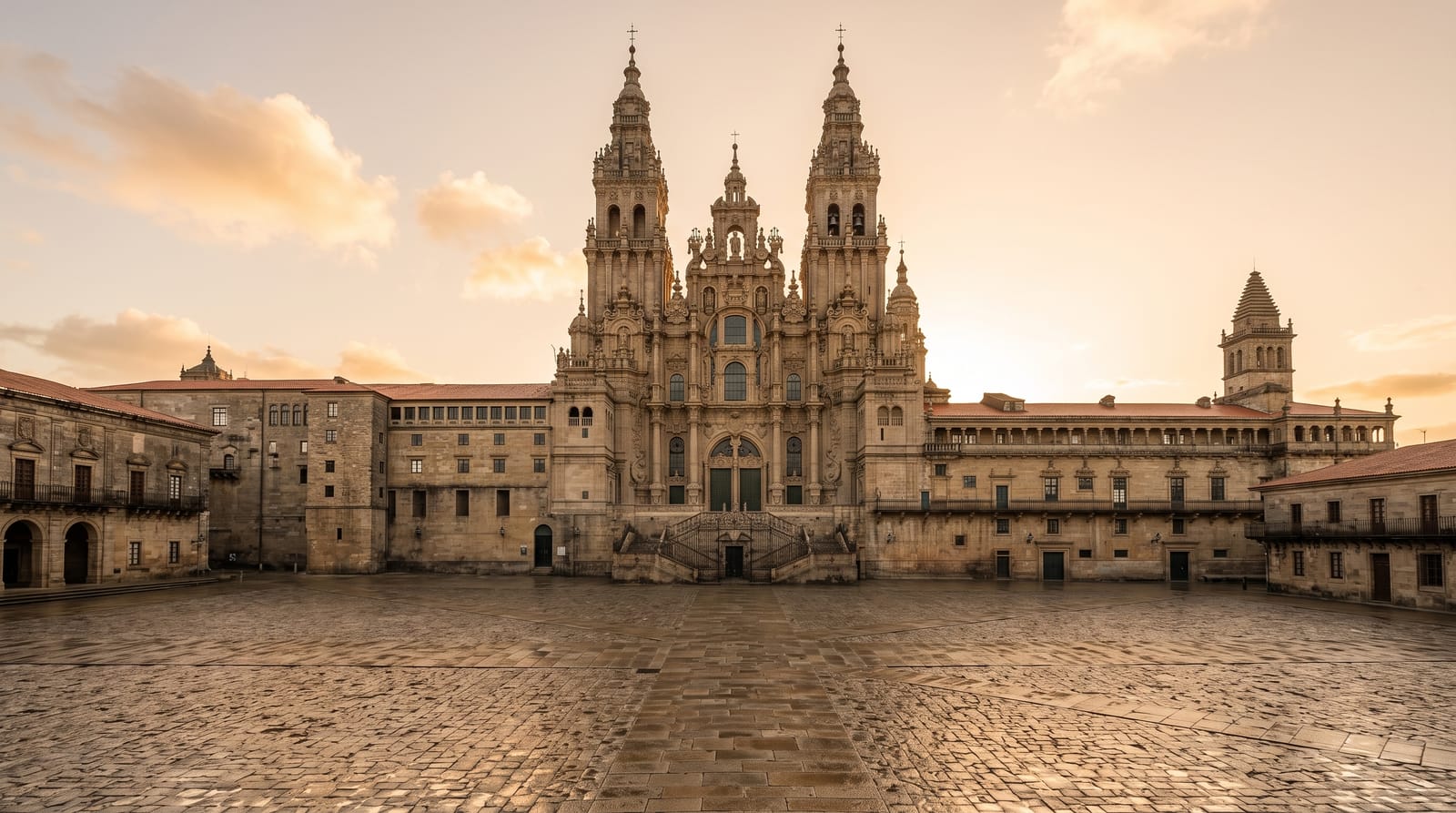
Santiago de Compostela is the goal of one of the world's great pilgrimages, the Camino de Santiago, whose paths across Spain end before its magnificent cathedral, believed to hold the shrine of St James. A UNESCO city of granite streets, arcades and squares, weathered by the rains of green Galicia and filled with the emotion of arriving pilgrims, it has drawn travellers for a thousand years.
History
The area was a Roman cemetery by the 4th century, was settled by the Suebi in the early 5th, assigned to the bishopric of Iria Flavia in the 6th, and in 585 passed with the Suebi kingdom to the Visigoths under Leovigild. Between 818 and 842, under Alfonso II of Asturias, Bishop Theodemar of Iria claimed to have found remains attributed to Saint James the Greater, and a new settlement and pilgrimage centre grew up around the find, known to the writer Usuard in 865 and called Compostella by the 10th century; after the Asturian court moved to León in 910 its political weight grew, and kings were crowned in its cathedral, among them Ordoño IV in 958, Bermudo II in 982 and Alfonso VII in 1111. The shrine has been the goal of the Way of Saint James, a leading pilgrimage route, since the 9th century, and in 1985 the old town became a World Heritage Site (Wikipedia, Santiago de Compostela).
What's there
- The cathedral - the great pilgrimage church and the shrine of St James.
- The Praza do Obradoiro - the grand square where pilgrims arrive.
- The old town - the granite streets, arcades and squares.
- The arriving pilgrims - the emotion of walkers reaching their goal.
When to go
Late spring to early autumn for the mildest, driest weather; Galicia is green because it rains often, so pack for showers any time. The Holy Years, when the feast falls on a Sunday, bring the greatest crowds.
Before you go
Galicia is rainy, so grey and wet days are common even in summer. The famous giant incense burner, the Botafumeiro, swings only at certain Masses, not on demand. The city is compact and seen in a day, though its atmosphere of pilgrimage is the real draw.
Nearby
The green coast and rias of Galicia are within reach; the Camino paths radiate outward.
Key facts
Source: Wikidata, item Q14314, read on 18 October 2026.
What to pack for Santiago de Compostela
Chosen from what this place is for. Tap a kit for the full checklist.
- Comfortable walking shoes - Sightseeing means kilometres of pavement and cobbles daily. Find on Amazon
- Modest clothing - Shoulders and knees covered - the single most common requirement. Find on Amazon
- A slim anti-theft daypack - Zips that close properly; keep it in front in crowds and on transit. Find on Amazon
- A scarf or shawl - To cover the head or shoulders on entry; women especially at mosques. Find on Amazon
Some links on this page are Amazon affiliate links - if you buy through them we may earn a small commission at no extra cost to you.
All packing kitsPlan your trip
Where to start if Santiago de Compostela is going on the list.
Booking links on this page are affiliate links - if you book through them we may earn a small commission at no extra cost to you. It never changes what we write about a place.
Opening times, ticket prices and seasonal closures change - check the official source before you go: official site.