Hwaseong Fortress, Suwon
A UNESCO-listed late-18th-century fortress ringing the city of Suwon with a walkable circuit of walls, gates, towers and command posts.
Updated 18 October 2026
AI illustration
UNESCO World Heritage
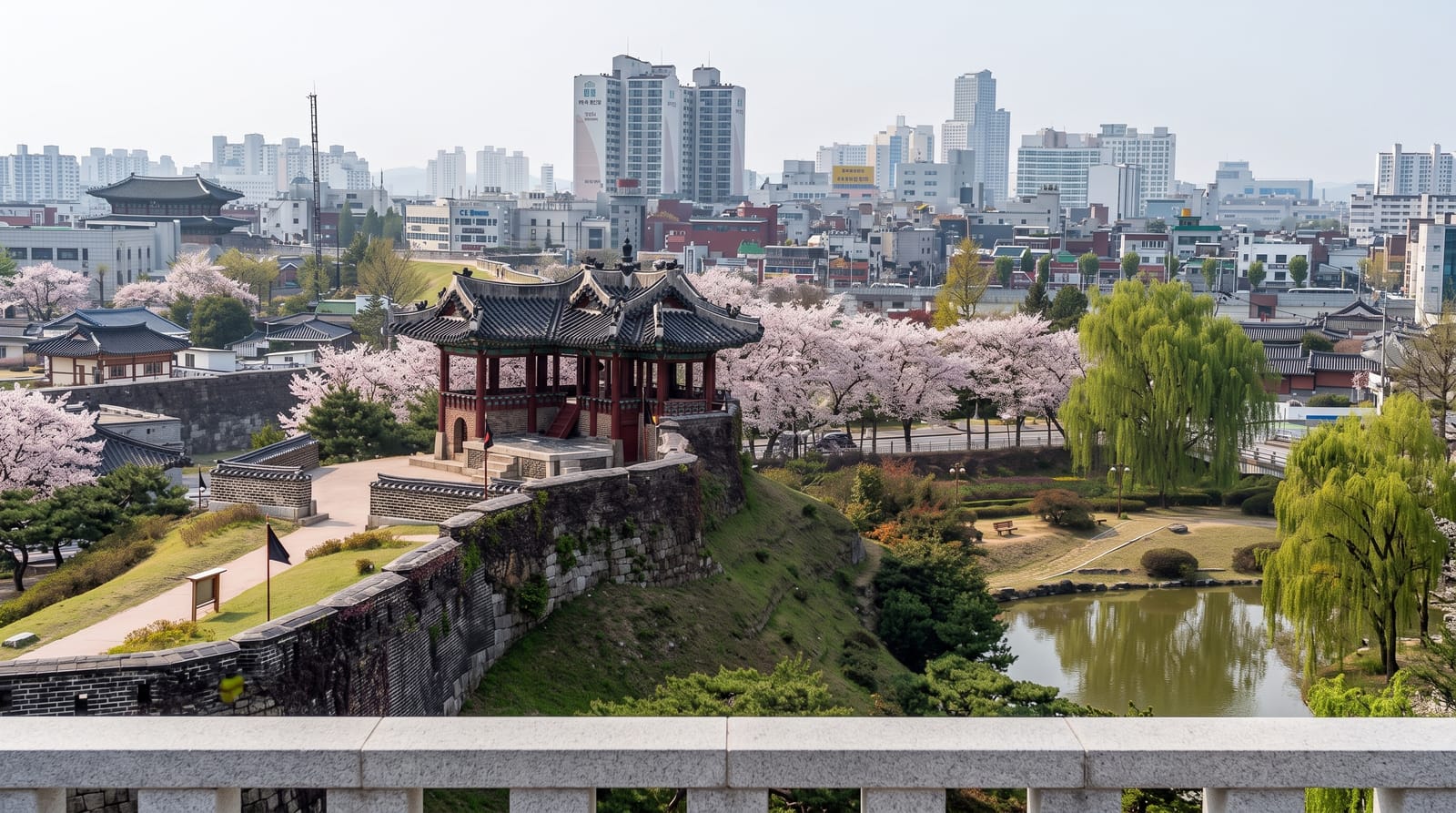
Hwaseong is a great fortress that encircles the old centre of Suwon, built at the end of the eighteenth century by King Jeongjo, partly in honour of his father, and it is a World Heritage Site admired as a high point of Korean military architecture. Its walls run for several kilometres over hills and across the valley, punctuated by imposing gates, arrow-slit towers, command posts, floodgates over a stream, and beacon platforms, blending Korean tradition with defensive ideas of its day and built with the help of early cranes and pulleys that were then novel. You can walk the entire circuit along the top of the walls, a rewarding couple of hours that rises to viewpoints over the modern city within and without, and within the walls stands the reconstructed Haenggung, the temporary palace where the king stayed. It brings together history, engineering and a genuinely pleasant walk.
History
King Jeongjo of Joseon built the fortress from 1794 to 1796 to house and honour the remains of his father, Crown Prince Sado, whom King Yeongjo had put to death by locking him in a rice chest, and apparently also to prepare a move of the capital to Suwon, away from the factional strife of the court; he paid people to settle there and freed them from taxes for ten years. The architect Chŏng Yagyong, later a leader of the Silhak movement of practical learning, combined Korean and Chinese fortress design with contemporary science, using brick, pulleys and cranes, and instead of the old pattern of a town wall with a separate mountain refuge he joined wall, fortress and town centre in one; the work took 700,000 person-hours and cost 870,000 nyang, and the workers were paid rather than conscripted. Restored from the Hwaseong Seongyeok Uigwe, the detailed record of its building, it became a World Heritage Site in 1997 (Wikipedia, Hwaseong Fortress).
What to look for
- The wall circuit - the several-kilometre walk along the ramparts over the hills.
- The four main gates - the grand gateways, especially Paldalmun and Janganmun.
- Hwaseong Haenggung - the reconstructed temporary palace within the walls.
- The command posts and beacon tower - the towers and viewpoints along the walls.
When to go
Spring and autumn are the most pleasant for the wall walk, with blossom or colour; summer is hot and humid and winter cold. The circuit is enjoyable in daylight, and parts are lit at night. An hour from Seoul by metro, it makes an easy day trip.
Good to know
The full circuit involves real walking with some uphill sections, so allow a couple of hours and wear proper shoes; those short on time can walk just the scenic hill stretches. Parts of the wall pass through and above the busy modern city, so it is not a wilderness. A tourist trolley and archery and other demonstrations run for visitors, which some enjoy and others find touristy.
Nearby
The Korean Folk Village is a short drive away; Seoul is an hour north.
Key facts
Source: Wikidata, item Q482423, read on 18 October 2026.
What to pack for Hwaseong Fortress, Suwon
Chosen from what this place is for. Tap a kit for the full checklist.
- Strong insect repellent - DEET or picaridin; the jungle is where bites and disease risk are highest. Find on Amazon
- Comfortable walking shoes - Sightseeing means kilometres of pavement and cobbles daily. Find on Amazon
- Long, light, quick-dry clothing - Covers skin from insects and sun without cooking you in the humidity. Find on Amazon
- A slim anti-theft daypack - Zips that close properly; keep it in front in crowds and on transit. Find on Amazon
Some links on this page are Amazon affiliate links - if you buy through them we may earn a small commission at no extra cost to you.
All packing kitsPlan your trip
Where to start if Hwaseong Fortress, Suwon is going on the list.
Booking links on this page are affiliate links - if you book through them we may earn a small commission at no extra cost to you. It never changes what we write about a place.
Opening times, ticket prices and seasonal closures change - check the official source before you go: official site.