Dobongsan Mountain
Granite spires at Seoul's northern edge inside Bukhansan National Park - the city's climbing wall and its busiest weekend trail.
Updated 21 October 2026
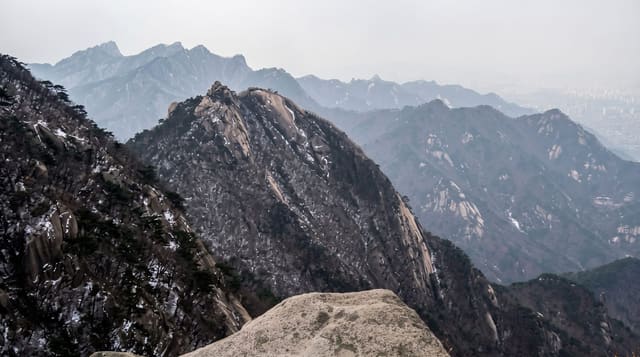
Dobongsan is the northern block of Bukhansan National Park, and its skyline is three bare granite peaks - Jaunbong at 740 metres, Manjangbong and Seoninbong - rising out of forest in sheer domes and slabs. Seoninbong is one of the best-known rock climbing faces in the country, with routes bolted since the 1930s, and on a fine weekend there are ropes on it all day. Walkers take the trails to Jaunbong or the ridge below the spires, with the last stretch involving fixed cables and steel steps on rock. Lower down are Cheonchuksa, the oldest temple in the area, and Mangwolsa, in wooded valleys, and the approach from the station passes a long strip of hiking shops, makgeolli bars and pajeon restaurants that is as much a part of the ritual as the mountain. Bukhansan is reputedly the most-visited national park per unit area in the world, and Dobongsan on a Saturday makes that easy to believe.
Highlights
- The granite spires - Jaunbong, Manjangbong and Seoninbong.
- The climbers - ropes on Seoninbong's faces at weekends.
- The cable sections - fixed steel on the upper rock.
- The temples - Cheonchuksa and Mangwolsa in the valleys.
When to go
April to June and September to November; autumn colour is the peak season and the trails are packed. Weekday mornings are far quieter.
Things to know
Upper sections are steep rock with cables - not for anyone uneasy with exposure, and genuinely hazardous in ice. Weekend crowds mean queuing at bottlenecks. Winter requires crampons.
Nearby
Bukhansan's main massif is south; the Dobongsan station strip has the post-hike food.
Key facts
Source: Wikidata, item Q626000, read on 18 October 2026.
What to pack for Dobongsan Mountain
Chosen from what this place is for. Tap a kit for the full checklist.
- Broken-in walking shoes or boots - Grip and ankle support matter more than looks; never hike in brand-new boots. Find on Amazon
- Layers for big temperature swings - Warm sun by day, near-freezing at night, even near the equator. Find on Amazon
- Modest clothing - Shoulders and knees covered - the single most common requirement. Find on Amazon
- Layers + a waterproof shell - Mountain weather turns fast; a packable rain jacket saves the day. Find on Amazon
Some links on this page are Amazon affiliate links - if you buy through them we may earn a small commission at no extra cost to you.
All packing kitsPlan your trip
Where to start if Dobongsan Mountain is going on the list.
Booking links on this page are affiliate links - if you book through them we may earn a small commission at no extra cost to you. It never changes what we write about a place.
Opening times, ticket prices and seasonal closures change - check the official source before you go: official site.