Spis Castle
One of the largest castle ruins in Central Europe - a vast medieval fortress sprawled across a limestone hill in eastern Slovakia, a UNESCO site.
Updated 18 October 2026
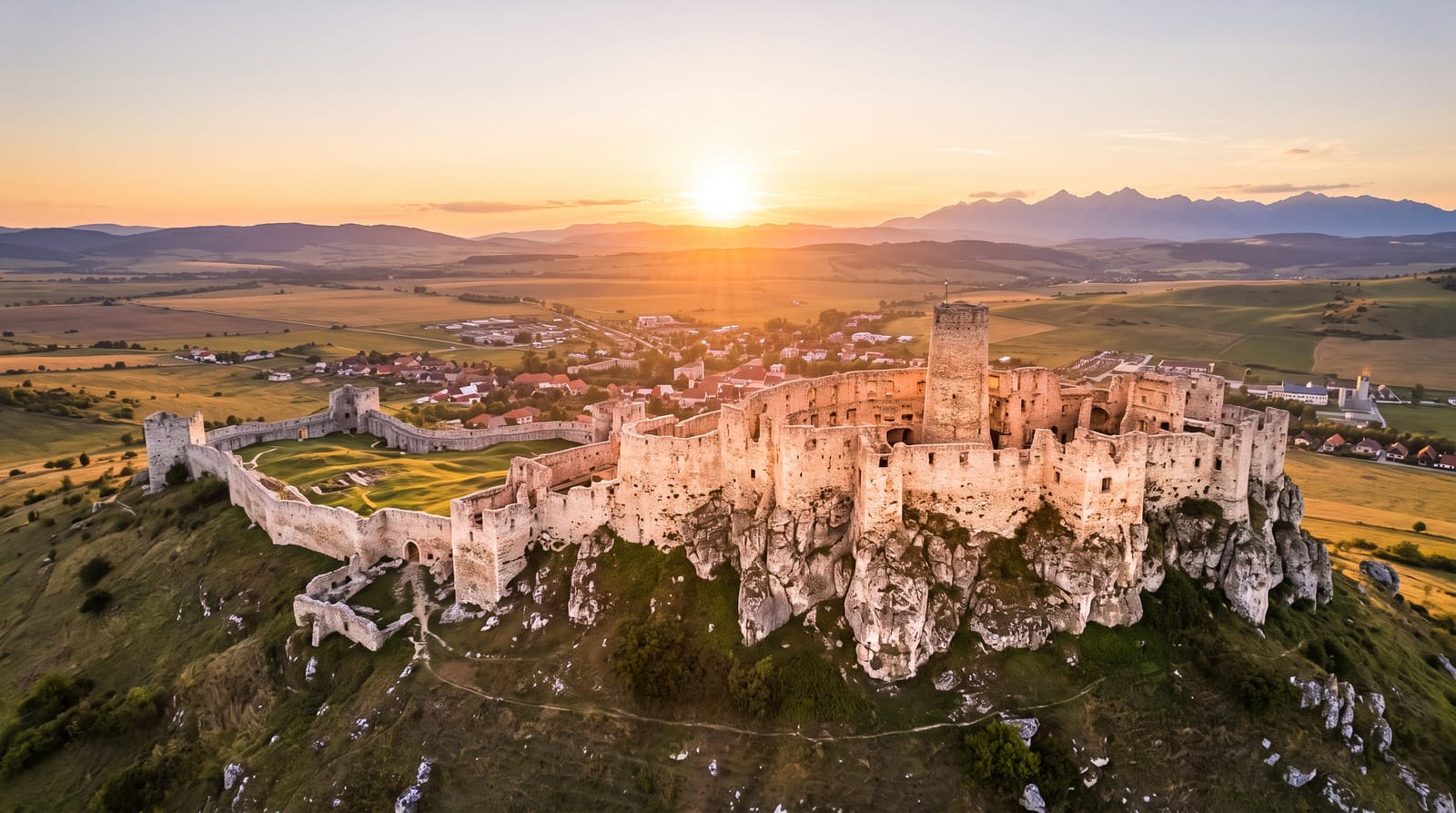
AI illustration
UNESCO World Heritage
Spis Castle is one of the largest castle complexes in Central Europe, a vast ruined medieval fortress sprawled dramatically across a limestone hill above the plains of eastern Slovakia. A UNESCO site whose walls, towers and courtyards cover a huge area, it dominates the landscape for miles and offers a vivid sense of medieval power, best seen glowing at sunset.
History
Building on the travertine hill began early in the 12th century, and the castle is first mentioned in 1120, as a border fort on the northern frontier of the Kingdom of Hungary; it went on to be the seat of the county of Szepes for centuries. A Romanesque palace and basilica were built by the late 13th century, the area doubled in the 14th, and the castle was rebuilt in the 15th, when a late Gothic chapel was added around 1470. It belonged to the kings of Hungary, then to the Zápolya, Thurzó and Csáky families; the Csákys left it in the early 18th century as too uncomfortable, and after a fire in 1780 of unknown cause it was abandoned to decay. It was partly rebuilt in the late 20th century and listed as a World Heritage Site in 1993 (Wikipedia, Spiš Castle).
The main sights
- The vast ruins - the sprawling walls, towers and courtyards on the hill.
- The hilltop setting - the fortress dominating the surrounding plains.
- The keep and palace - the surviving core of the medieval castle.
- The wider region - the UNESCO Spis area of towns and the Zehra church.
When to go
The warm months for walking the extensive ruins and the hilltop; sunset lights the stone dramatically. A clear day suits the far-reaching views.
Practical notes
It is a ruin, so it is walls, towers and imagination rather than furnished rooms, and the site is large with a fair climb. Reconstruction work has been under way and the castle has been closed to visitors for it, so check what is open before making the journey. It is exposed on its hill to wind and sun. It is remote in eastern Slovakia, a real journey.
Nearby
The town of Levoca and the Spis region towns are nearby; Slovak Paradise is close.
Key facts
Source: Wikidata, item Q205558, read on 18 October 2026.
What to pack for Spis Castle
Chosen from what this place is for. Tap a kit for the full checklist.
- Comfortable walking shoes - Sightseeing means kilometres of pavement and cobbles daily. Find on Amazon
- Modest clothing - Shoulders and knees covered - the single most common requirement. Find on Amazon
- A slim anti-theft daypack - Zips that close properly; keep it in front in crowds and on transit. Find on Amazon
- A scarf or shawl - To cover the head or shoulders on entry; women especially at mosques. Find on Amazon
Some links on this page are Amazon affiliate links - if you buy through them we may earn a small commission at no extra cost to you.
All packing kitsPlan your trip
Where to start if Spis Castle is going on the list.
Booking links on this page are affiliate links - if you book through them we may earn a small commission at no extra cost to you. It never changes what we write about a place.
Opening times, ticket prices and seasonal closures change - check the official source before you go: official site.