Felix Romuliana
A late Roman imperial palace built by an emperor for his retirement, with mosaics and a fortified wall of twenty towers.
Updated 18 October 2026
AI illustration
UNESCO World Heritage
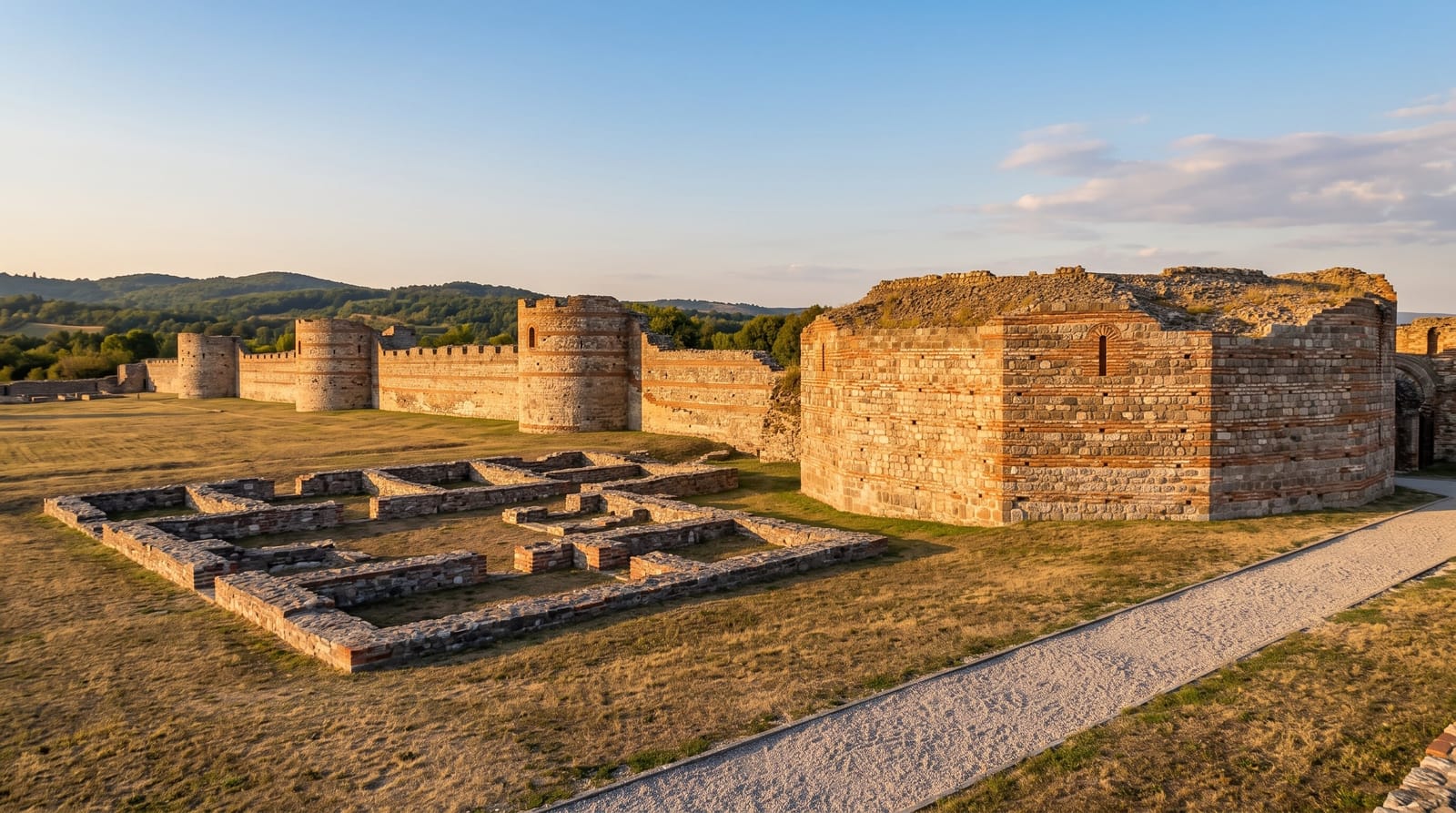
Galerius, the Roman emperor who ruled at the start of the fourth century, built this palace complex near his birthplace and named it after his mother Romula. It is a fortified rectangle with massive walls and twenty towers enclosing palaces, temples, baths and a basilica, and on hills nearby are the mausolea and consecration monuments where he and his mother were buried and deified, an arrangement found nowhere else in the Roman world. Mosaic floors survive, including a striking Dionysus panel now displayed in the museum at Zaječar. It sits in open farmland in a quiet part of eastern Serbia and receives very few visitors, so the scale registers without distraction.
History
The emperor Galerius, a tetrarch of Dacian origin and the adopted son and son-in-law of Diocletian, began the complex in 298, after a victory over the Sasanians, to mark his birthplace, and named it after his mother Romula, a priestess of a pagan cult; it served at once as a place to worship her, a monument to his deeds and a luxurious villa. Romuliana lasted until the Huns plundered it in the mid-5th century, then became a modest settlement of farmers and craftsmen, abandoned early in the 7th century as the Slavs arrived. Early explorers took it for a Roman army camp; Baron von Herder described it in 1835 and Felix Kanitz drew its walls in 1860 and 1864; systematic excavation began in 1953 under Vekoslav Popović, and in 1984 an archivolt inscribed FELIX ROMULIANA was found, confirming that this was Galerius's palace (Wikipedia, Gamzigrad).
Highlights
- The fortified walls and towers - the massive enclosure with its twenty towers.
- Mosaic floors - surviving palace pavements, with major panels in the Zaječar museum.
- Magura hill - the mausolea and consecration monuments above the palace.
- The palace complex - temples, baths and residential ranges inside the walls.
When to go
April to October; the site is open and exposed with little shade. Mornings and late afternoons give better light on the walls. It is quiet at almost any time.
Before you go
The site is remote from Serbia's usual routes and needs a car. Much of the interior is foundations, and the best mosaics are in the museum in Zaječar rather than on site, so doing both is necessary to make sense of it. Facilities are minimal and interpretation is limited.
Nearby
Zaječar's museum holds the mosaics; the Timok valley and Rajac wine cellars are nearby.
What to pack for Felix Romuliana
Chosen from what this place is for. Tap a kit for the full checklist.
- Comfortable walking shoes - Sightseeing means kilometres of pavement and cobbles daily. Find on Amazon
- Modest clothing - Shoulders and knees covered - the single most common requirement. Find on Amazon
- A slim anti-theft daypack - Zips that close properly; keep it in front in crowds and on transit. Find on Amazon
- A scarf or shawl - To cover the head or shoulders on entry; women especially at mosques. Find on Amazon
Some links on this page are Amazon affiliate links - if you buy through them we may earn a small commission at no extra cost to you.
All packing kitsPlan your trip
Where to start if Felix Romuliana is going on the list.
Booking links on this page are affiliate links - if you book through them we may earn a small commission at no extra cost to you. It never changes what we write about a place.
Opening times, ticket prices and seasonal closures change - check the official source before you go: official site.