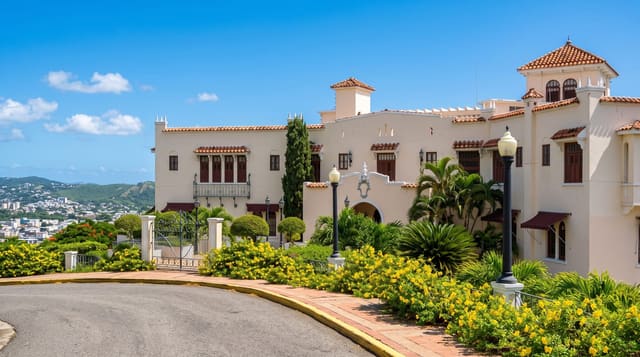
Oranienbaum Palace
The one imperial palace near St Petersburg the Germans never reached, so its eighteenth-century interiors are original.
Updated 31 October 2026
UNESCO World Heritage
Oranienbaum was begun in 1710 for Alexander Menshikov and later held by Peter III and Catherine II, and it is the exception among the palaces around St Petersburg: it lay inside the defended perimeter through the siege and the Germans never occupied it, so it was not burned, looted or blown up. Everything else - Peterhof, Tsarskoye Selo, Pavlovsk, Gatchina - is restoration; Oranienbaum's interiors are the originals. The most remarkable is the Chinese Palace, built by Rinaldi for Catherine in the 1760s, whose Glass Bead Room is lined with panels of embroidery on glass-bead ground made by Russian craftswomen, the only interior of its kind surviving anywhere. There is also Peter III's small palace, the Sliding Hill pavilion - all that remains of an enormous wooden roller-coaster structure - and a park running down to the gulf. Conservation is delicate precisely because the fabric is original, and access is restricted accordingly.
History
In 1707, four years after founding Saint Petersburg, Peter the Great gave the seaside grounds to his right-hand man Alexander Menshikov, whose architects Giovanni Maria Fontana and Gottfried Schädel built the Grand Menshikov Palace from 1710 to 1727; Menshikov fell soon after Peter's death and died in exile. In 1743 Oranienbaum became the summer residence of the heir, the future Peter III, for whom Antonio Rinaldi built the Peterstadt fortress ensemble in 1756-1762, the Upper Park was laid out from 1750 to 1770, and the palace saw the premieres of two operas to libretti by Metastasio, in 1755 and 1760. In the 19th century it became a noble manor; in the 1940s it suffered much less than the other suburbs, but it was later neglected, and serious restoration began only in the late 1990s (Wikipedia, Oranienbaum, Russia).
What's there
- The original interiors - the only palace here not destroyed and rebuilt after 1945.
- The Glass Bead Room - embroidered panels on glass-bead ground, unique anywhere.
- The Chinese Palace - Rinaldi's 1760s building for Catherine.
- The Sliding Hill pavilion - the survivor of a vast wooden roller-coaster structure.
When to go
May to September - the Chinese Palace opens only in the warm dry months because of the fragility of the interiors. Half a day.
Good to know
The Chinese Palace is closed in cold and damp weather and for much of the year, which catches people out - check before travelling. Visitor numbers inside are capped. Multiple separate tickets. Less restored and less polished than Peterhof, which is the point.
Nearby
Peterhof is east along the coast; Kronstadt is across the water.
Key facts
Source: Wikidata, item Q2315050, read on 18 October 2026.
What to pack for Oranienbaum Palace
Chosen from what this place is for. Tap a kit for the full checklist.
- Comfortable walking shoes - Sightseeing means kilometres of pavement and cobbles daily. Find on Amazon
- A slim anti-theft daypack - Zips that close properly; keep it in front in crowds and on transit. Find on Amazon
- A refillable water bottle - Many cities have public fountains; save money and plastic. Find on Amazon
- A light layer + compact umbrella - For museum air-con and a sudden shower. Find on Amazon
Some links on this page are Amazon affiliate links - if you buy through them we may earn a small commission at no extra cost to you.
All packing kitsPlan your trip
Where to start if Oranienbaum Palace is going on the list.
Booking links on this page are affiliate links - if you book through them we may earn a small commission at no extra cost to you. It never changes what we write about a place.
Opening times, ticket prices and seasonal closures change - check the official source before you go: official site.