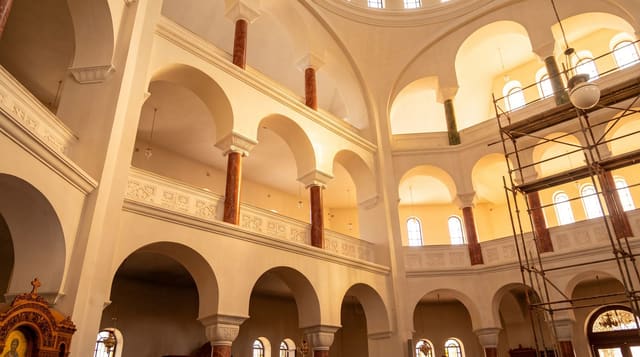
Ferapontov Monastery
A small monastery holding the only complete surviving fresco cycle by Dionisy, painted in 1502 and never repainted.
Updated 18 October 2026
UNESCO World Heritage
Ferapontov is small - a handful of white buildings between two lakes - and it holds something no other place does: the complete fresco cycle Dionisy and his sons painted in the Nativity cathedral in 1502, covering about six hundred square metres, and never subsequently repainted, overpainted or restored in the destructive way most Russian medieval painting was. The monastery declined early, was closed in 1798, and its poverty is exactly why the frescoes survived: nobody had money to modernise the interior. Dionisy was the leading painter of his generation after Rublev, and this is the only fresco cycle of his to survive complete. The pigments were made partly from local minerals and keep an unusual soft blue and pink range. UNESCO listed the ensemble in 2000. The cathedral is climate-sensitive, so entry is limited by numbers, closed in damp or cold weather, and visits are short.
History
Saint Ferapont, a fellow monk of Saint Cyril of Beloozero, founded the monastery in 1398 east of the Kirillo-Belozersky Monastery, and its fame grew under Saint Martinian, who became father superior of the Trinity Lavra in 1447, while members of Ivan III's family protected it. Masters from Rostov built its oldest structure, the brick Cathedral of the Nativity of the Virgin, in 1490, and the painter Dionisius covered its interior walls with frescoes; in the 1530s a treasury, a refectory and the Annunciation church with its belfry were added, when the monastery held some 60 villages and Ivan the Terrible often came as a pilgrim. Poles ravaged it in the Time of Troubles, its last buildings and a belfry clock of 1638, said to be the oldest in Russia, came during its recovery, and it later served as a place of exile for clerics such as Patriarch Nikon; Emperor Paul abolished it in 1798, it was revived as a convent in 1904 and ended by the Bolsheviks twenty years later, and it became a museum in 1975 and a World Heritage Site in 2000 (Wikipedia, Ferapontov Monastery).
What's there
- The Dionisy cycle - about six hundred square metres from 1502, never repainted.
- The uniqueness - the only fresco cycle by the painter to survive complete.
- The reason it survived - a monastery too poor to modernise its interior.
- The setting - a small white ensemble between two lakes.
When to go
May to September; the cathedral closes in cold and damp weather. Two hours. Entry is timed and capped - book or arrive early.
Things to know
Cathedral access is strictly limited by humidity and numbers, and closes without much notice - some visitors travel far and do not get in. Time inside is short. Photography is prohibited. The village has minimal facilities.
Nearby
Kirillo-Belozersky monastery is twenty kilometres south-west; Vologda is south.
Key facts
Source: Wikidata, item Q838256, read on 18 October 2026.
What to pack for Ferapontov Monastery
Chosen from what this place is for. Tap a kit for the full checklist.
- Strong insect repellent - DEET or picaridin; the jungle is where bites and disease risk are highest. Find on Amazon
- Comfortable walking shoes - Sightseeing means kilometres of pavement and cobbles daily. Find on Amazon
- Modest clothing - Shoulders and knees covered - the single most common requirement. Find on Amazon
- Long, light, quick-dry clothing - Covers skin from insects and sun without cooking you in the humidity. Find on Amazon
Some links on this page are Amazon affiliate links - if you buy through them we may earn a small commission at no extra cost to you.
All packing kitsPlan your trip
Where to start if Ferapontov Monastery is going on the list.
Booking links on this page are affiliate links - if you book through them we may earn a small commission at no extra cost to you. It never changes what we write about a place.
Opening times, ticket prices and seasonal closures change - check the official source before you go: official site.