Belogorsky Monastery
A white cathedral on a bare Urals hilltop, often above the cloud, reached by a road that climbs out of the forest.
Updated 22 October 2026
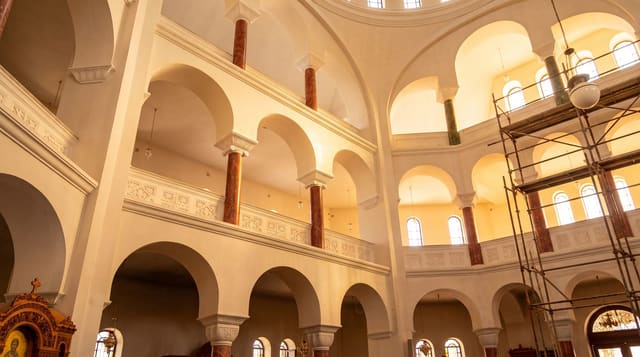
The monastery stands on Belaya Gora, the white mountain, a hill of about 450 metres that rises clear of the surrounding forest, and the name comes from snow lying there long after it has gone below. The Cross cathedral, begun in 1902 and finished in 1917, is Byzantine in manner, white with grey domes, and very large for its position - it seats several thousand, on a hilltop with no town. Because the hill stands above the general level, low cloud often sits below it, and the cathedral appears from the road to float. In the Soviet years the buildings served as a home for the disabled, and the cathedral burned in 1980, losing its roof and domes. Restoration from the late 1980s rebuilt it. A tall cross on the summit marks where an earlier wooden one stood.
History
The first wooden church on the hill was completed in February 1894 and opened as a school for orphaned boys, and after it burned on 16 November 1897 work on a two-storey stone church began in June 1902; it opened only in 1917. The revival of the monastery began in 1988-1989, a restoration project was drawn up in 1993, and Patriarch Alexis II visited in May 1996 (Wikipedia, Belogorsky Monastery).
The main sights
- The hilltop position - a cathedral alone on a bare 450 metre hill above forest.
- The cloud - low cloud sitting below the summit on many days.
- The 1917 cathedral - Byzantine in style, white with grey domes, seating thousands.
- The fire and rebuild - a shell after 1980, restored from the 1990s.
When to go
June to September; the road is hard in winter and the hill is exposed. Two to three hours.
What to expect
The hilltop is windy and cold even in summer, and there is no shelter outside the buildings. The monastery is active with dress rules. Restoration is unfinished inside. The road up is poor in wet weather, and there is nothing else at the top.
Nearby
Kungur ice cave is about 70 km east.
Key facts
Source: Wikidata, item Q816122, read on 18 October 2026.
What to pack for Belogorsky Monastery
Chosen from what this place is for. Tap a kit for the full checklist.
- Head torch + spare batteries - Hands-free light is essential; caves are truly dark. Find on Amazon
- Warm base layers - Merino or synthetic against the skin - never cotton, which chills when damp. Find on Amazon
- Comfortable walking shoes - Sightseeing means kilometres of pavement and cobbles daily. Find on Amazon
- Modest clothing - Shoulders and knees covered - the single most common requirement. Find on Amazon
Some links on this page are Amazon affiliate links - if you buy through them we may earn a small commission at no extra cost to you.
All packing kitsPlan your trip
Where to start if Belogorsky Monastery is going on the list.
Booking links on this page are affiliate links - if you book through them we may earn a small commission at no extra cost to you. It never changes what we write about a place.
Opening times, ticket prices and seasonal closures change - check the official source before you go: official site.