Cozia Monastery
A fourteenth-century monastery on the bank of the Olt, with banded stone walls and the tomb of its founder Mircea the Elder.
Updated 22 October 2026
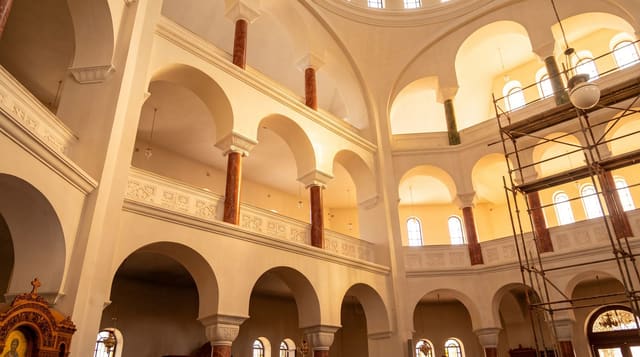
Cozia was founded around 1388 by Mircea the Elder and is one of the oldest surviving monastic complexes in Wallachia, built at a narrow point of the Olt valley where the river cuts through the Carpathians. The church shows its Serbian Morava influences clearly in the alternating bands of brick and stone and the rosettes carved around the windows, and inside it holds fourteenth-century wall painting alongside later work. Mircea's tomb is in the nave. A porch was added in the Brâncovenesc period, along with a fountain and improvements to the courtyards, and the museum in the complex holds manuscripts and icons. The monastery sits directly beside a busy main road, which is both why it is so easy to visit and why the setting is less peaceful than it was; the wooded slopes of the Cozia massif rise immediately behind.
History
Mircea the Elder, who ruled Wallachia from 1386 to 1418, built the monastery between 1387 and 1391 on a site first known as Nucetul, the walnut grove, and is buried here. Radu Paisie added the infirmary church in 1543, with frescoes including a votive portrait of Mircea and his sons, and in 1707 Constantin Brâncoveanu added the open porch, the stone fountain, a small chapel and a guard tower; repairs followed in 1850-1856 and a long restoration ran from 1958 to 1980 (Wikipedia, Cozia Monastery).
What's there
- The banded facade - alternating brick and stone with carved rosettes.
- Mircea the Elder's tomb - the founder's burial in the church.
- Fourteenth-century painting - original frescoes surviving in the nave.
- The Brâncovenesc porch - the later addition and the courtyard fountain.
When to go
Year-round. The Olt valley is attractive in autumn. Sunday services and feast days fill the church. Weekday mornings are the calmest, and the roadside parking is easier then.
What to expect
The main road runs a few metres from the walls and traffic noise is constant, which undercuts the atmosphere. The complex is small and an hour is enough. Photography inside is restricted and modest dress is required. The museum keeps irregular hours.
Nearby
Călimănești spa is minutes away; Cozia National Park trails climb from the valley.
Key facts
Source: Wikidata, item Q3320280, read on 18 October 2026.
What to pack for Cozia Monastery
Chosen from what this place is for. Tap a kit for the full checklist.
- Comfortable walking shoes - Sightseeing means kilometres of pavement and cobbles daily. Find on Amazon
- Modest clothing - Shoulders and knees covered - the single most common requirement. Find on Amazon
- A slim anti-theft daypack - Zips that close properly; keep it in front in crowds and on transit. Find on Amazon
- A scarf or shawl - To cover the head or shoulders on entry; women especially at mosques. Find on Amazon
Some links on this page are Amazon affiliate links - if you buy through them we may earn a small commission at no extra cost to you.
All packing kitsPlan your trip
Where to start if Cozia Monastery is going on the list.
Booking links on this page are affiliate links - if you book through them we may earn a small commission at no extra cost to you. It never changes what we write about a place.
Opening times, ticket prices and seasonal closures change - check the official source before you go: official site.