Quinta da Regaleira
A neo-Manueline villa in Sintra with a spiral initiation well, tunnels, grottoes and stepping stones hidden through terraced gardens.
Updated 18 October 2026
AI illustration
UNESCO World Heritage
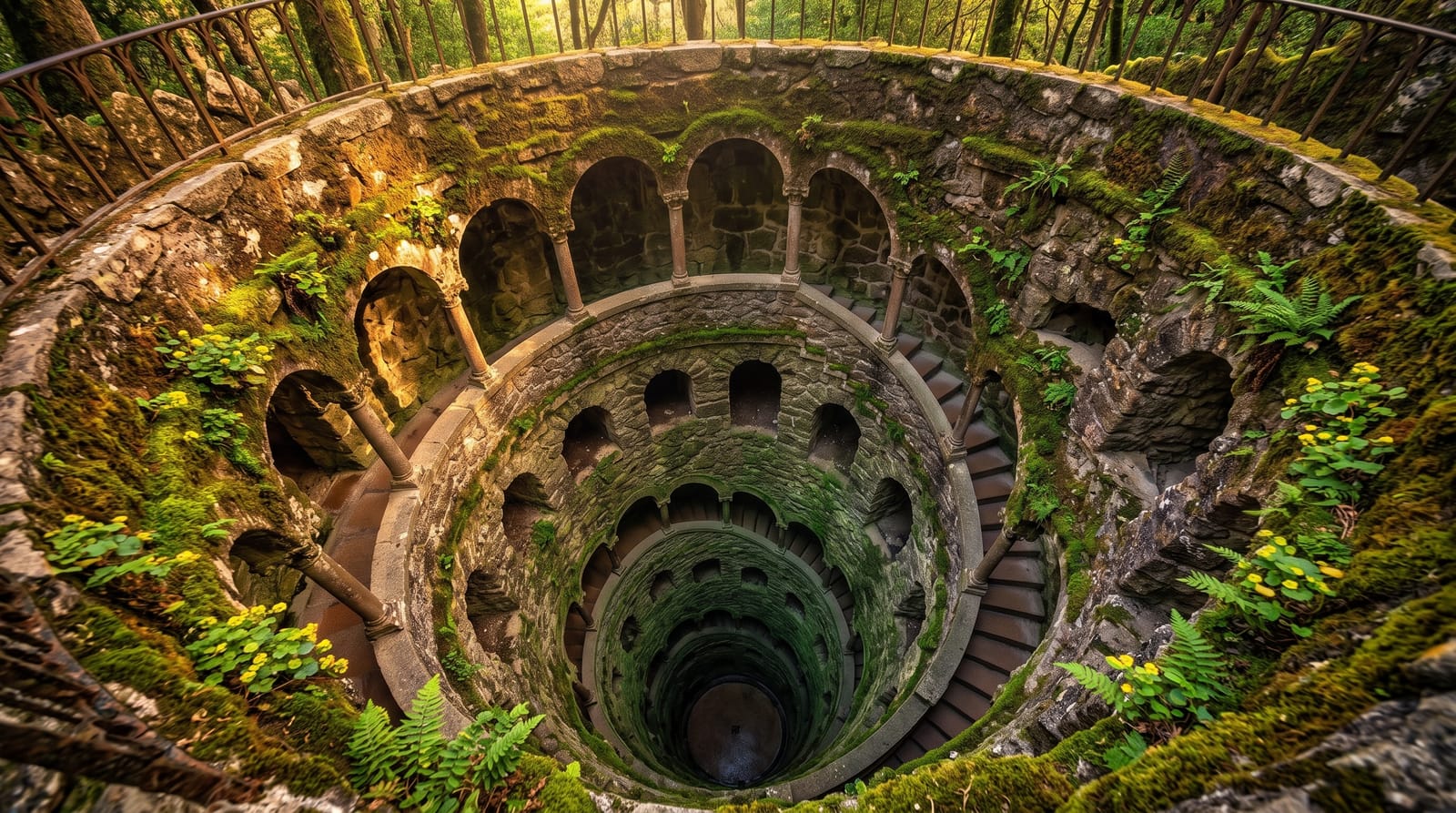
Regaleira was built between 1904 and 1910 for a wealthy collector, Carvalho Monteiro, with the Italian designer Luigi Manini, and it is less a house than a garden with a house attached. The villa wears a Gothic and Manueline costume of pinnacles and carved stone, but the point is the grounds: a wooded slope threaded with tunnels, false grottoes, mossy stairways and a lake crossed on stepping stones under a waterfall. At the centre is the Initiation Well, an inverted tower dropping nine spiral landings into the hillside and connecting underground to the rest. The estate sits inside Sintra's cultural landscape, the area UNESCO listed in 1995.
History
The estate had many owners and belonged to the Viscountess of Regaleira, of a wealthy merchant family from Porto, when António Augusto Carvalho Monteiro bought it in 1892 for 25,000 réis; with the Italian architect Luigi Manini he remade the 4-hectare grounds, adding enigmatic buildings said to hold symbols of alchemy, Masonry, the Knights Templar and the Rosicrucians, in a mix of Roman, Gothic, Renaissance and Manueline styles, built mostly from 1904 to 1910. Waldemar d'Orey bought it in 1942 as a home for his large family and had it repaired, and in 1987 it passed to the Japanese Aoki Corporation and stopped being a residence. Sintra Town Council acquired it in 1997, restoration began at once, it opened to the public in June 1998, and it lies within the World Heritage Cultural Landscape of Sintra (Wikipedia, Quinta da Regaleira).
What to look for
- The Initiation Well - nine spiral landings descending into the hill, lit from the opening above.
- The tunnels - unlit passages linking the well to grottoes and garden exits.
- The stepping stones - a crossing of the lake beneath an artificial waterfall.
- The villa - carved neo-Manueline facade with a small set of rooms open inside.
When to go
Go at opening or in the last two hours; the middle of the day means queuing at the well and shuffling through the tunnels behind other people. Timed tickets are required in summer and sell out. Rain makes the stone slippery but empties the gardens, and the moss looks better wet.
Practical notes
The well is a bottleneck: a single narrow spiral with traffic going both ways and a queue outside for most of the day. The gardens are steep, wet and slick, with unlit tunnels where phone torches are needed. The house interior is thin compared to the grounds. Sintra's buses and parking are a trial in season.
Nearby
Seteais and the Sintra town centre are minutes away, with the Moorish castle ridge above.
Key facts
Source: Wikidata, item Q2630165, read on 18 October 2026.
What to pack for Quinta da Regaleira
Chosen from what this place is for. Tap a kit for the full checklist.
- Head torch + spare batteries - Hands-free light is essential; caves are truly dark. Find on Amazon
- Comfortable walking shoes - Sightseeing means kilometres of pavement and cobbles daily. Find on Amazon
- Grippy closed shoes - Cave floors are wet, muddy and slick with formations. Find on Amazon
- A slim anti-theft daypack - Zips that close properly; keep it in front in crowds and on transit. Find on Amazon
Some links on this page are Amazon affiliate links - if you buy through them we may earn a small commission at no extra cost to you.
All packing kitsPlan your trip
Where to start if Quinta da Regaleira is going on the list.
Booking links on this page are affiliate links - if you book through them we may earn a small commission at no extra cost to you. It never changes what we write about a place.
Opening times, ticket prices and seasonal closures change - check the official source before you go: official site.