Ludwigsburg Palace
One of Europe's largest surviving baroque palaces, never destroyed, with a garden of fairy tale scenes.
Updated 16 October 2026
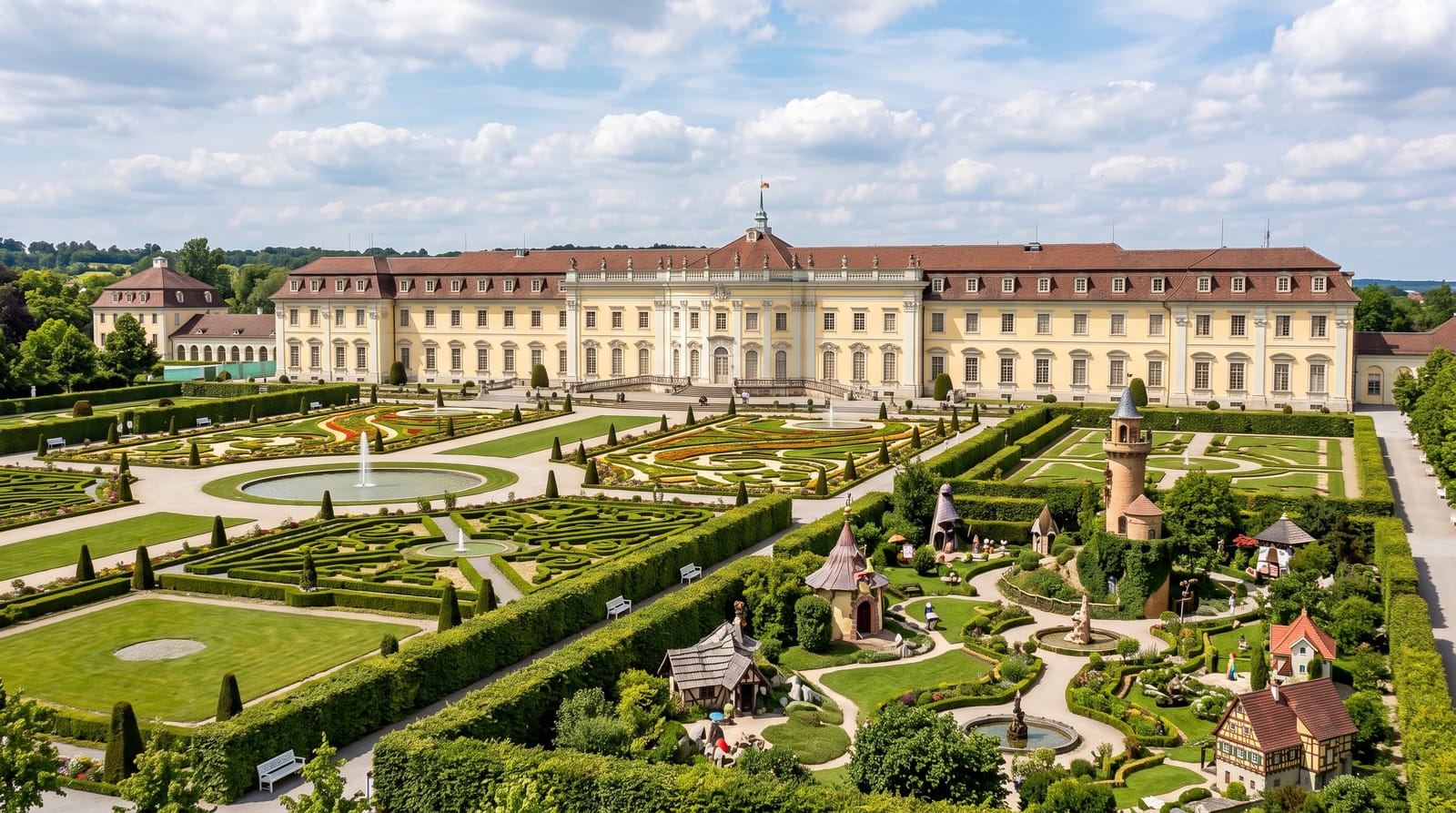
AI illustration
Built from 1704 as a hunting lodge and extended into a residence with eighteen buildings and four hundred and fifty-two rooms, Ludwigsburg is among the largest baroque palace complexes in Europe still standing in its original form; it was never bombed or burned, so the interiors survive with original fittings across baroque, rococo and neoclassical phases. The court theatre of 1758 keeps its wooden stage machinery in working order, one of the oldest such systems anywhere. In the gardens, the Märchengarten presents scenes from German fairy tales with animated figures, and separate museums cover ceramics, fashion and the palace's porcelain manufactory.
Background
Nicknamed the "Versailles of Swabia", the palace sits in grounds of 32 hectares including the gardens, the largest palatial estate in Germany. Duke Eberhard Louis gave it his name in 1705, Ludwigsburg meaning Louis's castle. Philipp Joseph Jenisch directed the early work, Johann Friedrich Nette took over in 1707 and built most of the palace and gardens, and after Nette died in 1714 Donato Giuseppe Frisoni finished much of the façades. Work was completed in 1733 at a cost of 3,000,000 florins. Philippe de La Guêpière later added Rococo touches, and Nikolaus Friedrich von Thouret reworked many rooms in the Neoclassical style. The palace opened to the public in 1918, and the Blooming Baroque gardens were laid out in 1954.
Source: Wikipedia, "Ludwigsburg Palace"
The main sights
- The undamaged interiors - original fittings across three style phases.
- The 1758 theatre - working wooden stage machinery of the period.
- The Märchengarten - fairy tale scenes with animated figures in the garden.
- The garden layout - the Blooming Baroque grounds around the palace.
When to go
April to October for the gardens, which close for winter while the palace stays open on guided tours. The pumpkin exhibition runs in autumn.
What to expect
Palace interiors are seen only on guided tours at set times. Gardens are ticketed separately and closed in winter. The complex is very large.
Nearby
Stuttgart lies south; the Neckar runs east.
Key facts
Source: Wikidata, item Q704831, read on 18 October 2026.
What to pack for Ludwigsburg Palace
Chosen from what this place is for. Tap a kit for the full checklist.
- Comfortable walking shoes - Sightseeing means kilometres of pavement and cobbles daily. Find on Amazon
- A slim anti-theft daypack - Zips that close properly; keep it in front in crowds and on transit. Find on Amazon
- A refillable water bottle - Many cities have public fountains; save money and plastic. Find on Amazon
- A light layer + compact umbrella - For museum air-con and a sudden shower. Find on Amazon
Some links on this page are Amazon affiliate links - if you buy through them we may earn a small commission at no extra cost to you.
All packing kitsPlan your trip
Where to start if Ludwigsburg Palace is going on the list.
Booking links on this page are affiliate links - if you book through them we may earn a small commission at no extra cost to you. It never changes what we write about a place.
Opening times, ticket prices and seasonal closures change - check the official source before you go: official site.