The Imperial City of Hue
The former imperial capital of Vietnam - a vast walled citadel of palaces, temples and gates on the Perfume River, seat of the Nguyen emperors, with royal tombs nearby, a UNESCO site.
Updated 18 October 2026
AI illustration
UNESCO World Heritage
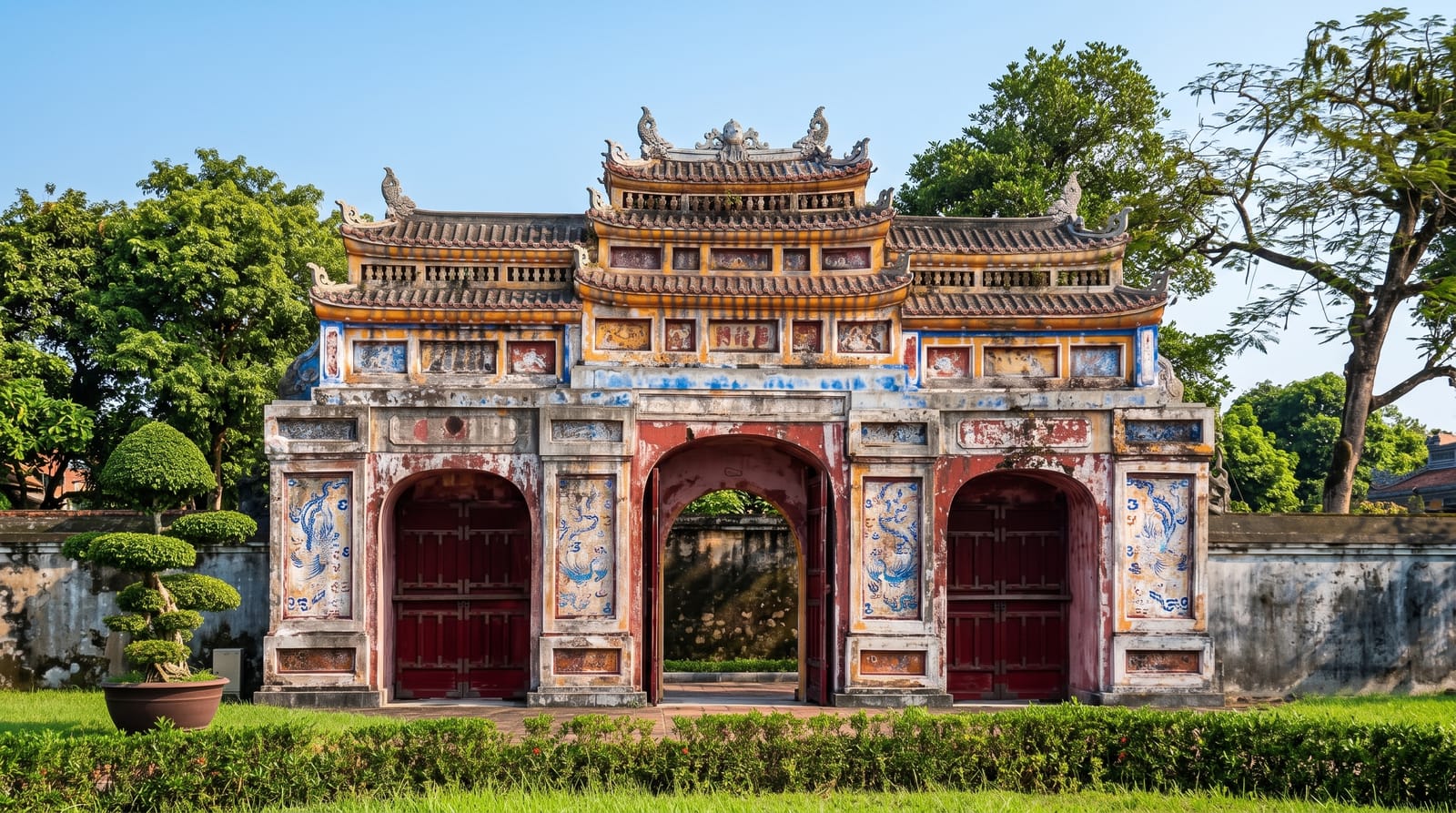
Hue was the imperial capital of Vietnam under the Nguyen dynasty from the early nineteenth century, and its vast walled Citadel on the Perfume River, a UNESCO site, holds the ruins and restored halls of the Imperial City, modelled on Beijing's Forbidden City. Battered by war, its moated palaces, ornate gates, temples and pavilions, together with the grand royal tombs scattered in the countryside beyond, evoke the faded grandeur of Vietnam's last emperors.
History
Huế, then called Phú Xuân, was the seat of the Nguyễn lords of the south, whose palaces stood at Kim Long from 1635 to 1687 and later at Phú Xuân, and the Tây Sơn emperor Quang Trung also made it his capital in 1789. In June 1802 Nguyễn Phúc Ánh, having defeated the Tây Sơn, became Emperor Gia Long of a united Vietnam and, consulting geomancers, chose the city for a palace complex modelled on Beijing's Forbidden City; the citadel was begun in 1803 and the imperial palace in 1804, and it was remodelled and enlarged to its present scale in 1833. Under French rule it served mostly for ceremony and as the imperial residence, after the monarchy ended in 1945 it suffered heavy damage and neglect in the wars that lasted into the 1980s, and in 1993 it became a World Heritage Site as part of the Complex of Huế Monuments (Wikipedia, Imperial City of Huế).
Highlights
- The Imperial City - the walled citadel of palaces, gates and courtyards.
- The royal tombs - the elaborate emperors' tombs in the countryside.
- The Perfume River - a boat trip past pagodas and the Thien Mu temple.
- The Ngo Mon Gate - the grand ceremonial gate of the citadel.
When to go
February to April for the driest, mildest weather, as Hue is one of the wettest cities in Vietnam, with a long rainy season from around September to December. The citadel and scattered tombs need time, so allow a full day or more.
Before you go
Much of the Imperial City was destroyed in war, so it is a mix of atmospheric ruins and ongoing restoration rather than a fully intact palace, which takes some imagination. The royal tombs are spread out in the countryside, needing a tour, boat or motorbike to link them. Hue is often rainy, so pick your season.
Nearby
Da Nang, Hoi An and the Hai Van Pass are to the south; the DMZ battle sites are to the north.
Key facts
Source: Wikidata, item Q10769129, read on 18 October 2026.
What to pack for The Imperial City of Hue
Chosen from what this place is for. Tap a kit for the full checklist.
- Padded shorts - The one thing that makes a full day in the saddle bearable. Find on Amazon
- Comfortable walking shoes - Sightseeing means kilometres of pavement and cobbles daily. Find on Amazon
- Modest clothing - Shoulders and knees covered - the single most common requirement. Find on Amazon
- Helmet - Bring your own if you have a good one; rentals vary wildly. Find on Amazon
Some links on this page are Amazon affiliate links - if you buy through them we may earn a small commission at no extra cost to you.
All packing kitsPlan your trip
Where to start if The Imperial City of Hue is going on the list.
Booking links on this page are affiliate links - if you book through them we may earn a small commission at no extra cost to you. It never changes what we write about a place.
Opening times, ticket prices and seasonal closures change - check the official source before you go: official site.


