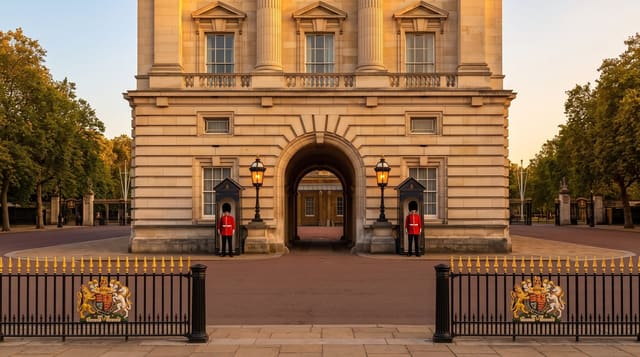
Schloss Eggenberg
A seventeenth-century palace on the edge of Graz laid out as a calendar in stone, with a walled peacock park around it.
Updated 18 October 2026

AI illustration
UNESCO World Heritage
Eggenberg was begun in 1625 for Hans Ulrich von Eggenberg as a diagram of time as much as a residence. The plan works through the divisions of the year: towers for the seasons, gates and floors counted out, windows tallied to the days, and twenty-four state rooms on the upper floor leading to a Planetary Room painted with the signs of the zodiac. Those rooms are seen only on a guided tour and keep their original ceilings and painted panels. Outside, a walled park runs to formal beds and old trees, with peacocks that treat the lawns as their own.
History
In 1625 Prince Hans Ulrich von Eggenberg, the mind behind its symbolic programme, commissioned the court architect Giovanni Pietro de Pomis to plan the palace; it has 365 exterior windows, one for each day of the year, and 24 state rooms on the second floor arranged in a ring for the hours of the day, and Hans Adam Weissenkircher painted the oil-painting cycle of the Planetary Room. Between 1754 and 1762 Count Johann Leopold Herberstein had the building and garden renewed in a second great phase of decoration, and the Herberstein family kept it until 1939, when the state of Styria bought the palace and park, which the Joanneum, Austria's oldest museum, now manages. In 2010 the palace was added to the Graz Historic Centre World Heritage Site (Wikipedia, Eggenberg Palace, Graz).
What to look for
- The Planetary Room - the painted hall at the end of the state rooms, worked through with planets and zodiac signs.
- The state rooms - the twenty-four connected chambers of the upper floor, seen on a guided tour.
- The palace park - the walled grounds with formal beds, old trees and free-roaming peacocks.
- The calendar plan - the counting of towers, gates, floors and windows through the divisions of the year.
When to go
State room tours run from spring to autumn at set times and in limited numbers, so book ahead or arrive early for a slot. The park opens year-round and is at its best in May and October. Winter closes the interiors almost entirely. A weekday morning gives the smallest tour group.
Good to know
Without a tour ticket you see a park and a facade, and tours are often full or German only. The palace sits out on a tram line rather than in the centre, adding half an hour each way. Photography inside is restricted. The interest here is largely intellectual, and anyone expecting Schonbrunn-scale opulence leaves underwhelmed.
Nearby
Graz old town is twenty minutes back along the tram line.
Key facts
Source: Wikidata, item Q203797, read on 18 October 2026.
What to pack for Schloss Eggenberg
Chosen from what this place is for. Tap a kit for the full checklist.
- Comfortable walking shoes - Sightseeing means kilometres of pavement and cobbles daily. Find on Amazon
- A slim anti-theft daypack - Zips that close properly; keep it in front in crowds and on transit. Find on Amazon
- A refillable water bottle - Many cities have public fountains; save money and plastic. Find on Amazon
- A light layer + compact umbrella - For museum air-con and a sudden shower. Find on Amazon
Some links on this page are Amazon affiliate links - if you buy through them we may earn a small commission at no extra cost to you.
All packing kitsPlan your trip
Where to start if Schloss Eggenberg is going on the list.
Booking links on this page are affiliate links - if you book through them we may earn a small commission at no extra cost to you. It never changes what we write about a place.
Opening times, ticket prices and seasonal closures change - check the official source before you go: official site.