Angra do Heroismo
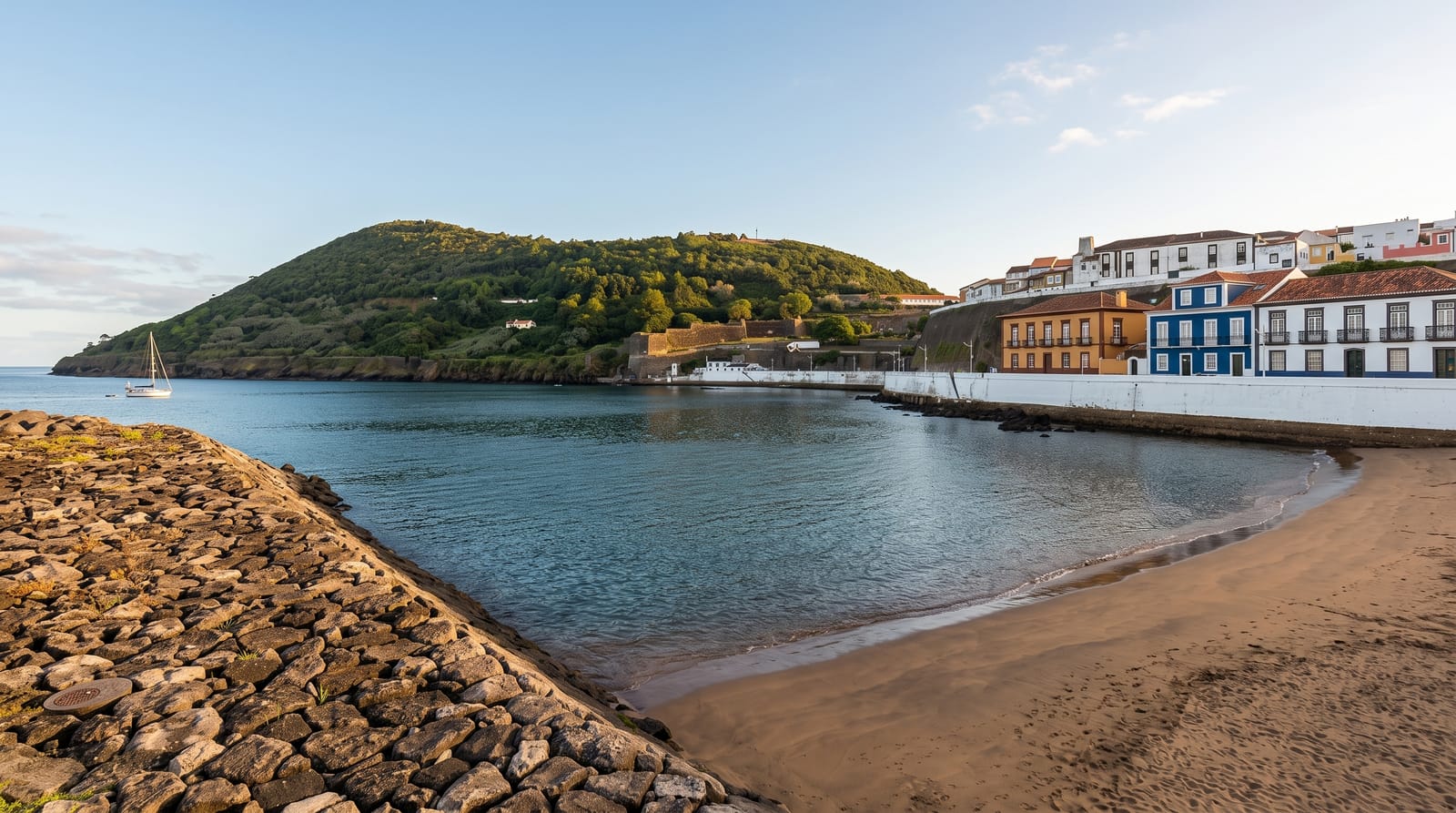
A Renaissance-planned Atlantic port on Terceira, with painted facades, two harbour forts and a volcanic headland closing the bay.
Updated 18 October 2026
AI illustration
UNESCO World Heritage
Angra was laid out from the late 15th century as a stopover for ships crossing between Europe and the Americas, and the plan shows: a regular grid of streets sloping to a sheltered bay, houses in ochre, blue and white with iron balconies, and churches at the corners of the grid. Two fortifications stand over the water, the small Sao Sebastiao and the very large Sao Joao Baptista spread across the neck of Monte Brasil, the wooded volcanic cone that closes the harbour and can be walked in an afternoon. An earthquake in 1980 badly damaged the town and the restoration that followed is why the facades look so uniform now. UNESCO listed the central zone in 1983.
History
The city dates its founding to 1478, though accounts differ: some credit Álvaro Martins, others say the Fleming Jácome de Bruges, in the service of Prince Henry the Navigator, founded it in 1450 or 1451, and he was named in March 1450 to administer Terceira, which was still unpopulated in 1460. The settlers chose a ridge opening like an amphitheatre onto two bays beside the extinct volcano of Monte Brasil, one deep enough, at about 40 metres, to anchor large ships, and in 1474 Álvaro Martins Homem diverted the river into a stone channel to drive a mill, which let the land on either side be laid out on a rectilinear street plan. In 1534 Angra became the first city in the archipelago and the seat of a diocese over all the Azores, its port played a part in the Portuguese East Indies trade from the 15th century, it served as Portugal's capital during the Liberal Wars, and in 1983 it became a World Heritage Site (Wikipedia, Angra do Heroísmo).
Highlights
- The grid of painted streets - ochre and blue facades on the street plan begun in the 1470s.
- Monte Brasil - the volcanic cone above the bay, with walking trails and viewpoints.
- Fortress of Sao Joao Baptista - vast bastioned walls across the neck of the headland.
- The Duke of Terceira garden - a terraced public garden of Azorean plants above the centre.
When to go
Late spring to early autumn for the most settled weather, though Azorean cloud can sit on the island any month and change within the hour. June brings the town's street festival and fills every bed on Terceira. Bring a waterproof whatever the forecast says, and expect cool evenings.
Before you go
Getting here means a flight, and inter-island connections are weather-dependent and cancel at short notice. The town is quiet, with little open on Sundays and a short list of sights - two days covers it comfortably. Rain arrives without warning. Parts of the large fortress are closed to visitors and access to the rest changes without notice.
Nearby
Terceira's Algar do Carvao lava cave and the Biscoitos coastal pools are both a short drive.
Key facts
Source: Wikidata, item Q193677, read on 18 October 2026.
What to pack for Angra do Heroismo
Chosen from what this place is for. Tap a kit for the full checklist.
- Head torch + spare batteries - Hands-free light is essential; caves are truly dark. Find on Amazon
- Comfortable walking shoes - Sightseeing means kilometres of pavement and cobbles daily. Find on Amazon
- Grippy closed shoes - Cave floors are wet, muddy and slick with formations. Find on Amazon
- A slim anti-theft daypack - Zips that close properly; keep it in front in crowds and on transit. Find on Amazon
Some links on this page are Amazon affiliate links - if you buy through them we may earn a small commission at no extra cost to you.
All packing kitsPlan your trip
Where to start if Angra do Heroismo is going on the list.
Booking links on this page are affiliate links - if you book through them we may earn a small commission at no extra cost to you. It never changes what we write about a place.
Opening times, ticket prices and seasonal closures change - check the official source before you go: official site.