Makli Necropolis
One of the largest funerary sites on earth, a plateau of carved stone tombs and domed mausoleums stretching for kilometres.
Updated 18 October 2026
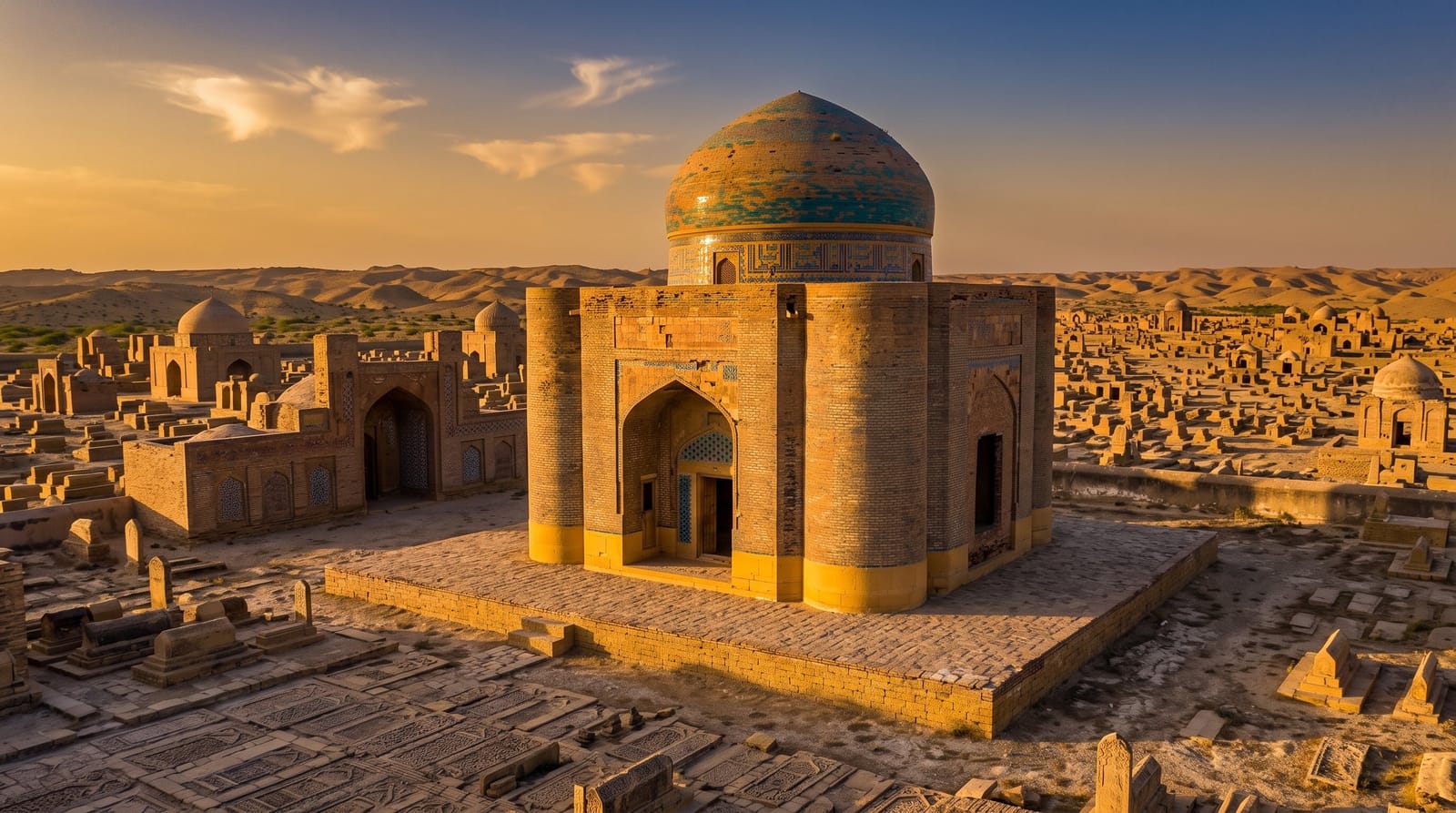
AI illustration
UNESCO World Heritage
Makli is a burial ground on a plateau above Thatta that ran for around four hundred years from the fourteenth century, and the scale is difficult to convey: hundreds of thousands of graves spread across several square kilometres, from simple carved slabs to monumental domed mausoleums of stone and glazed brick. The carving is the reason to come. Sindhi stonemasons covered tomb chambers and canopies with geometric interlace, floral panels and calligraphy of extraordinary density, and the mixture of Hindu, Persian and Mughal motifs in the same panels records exactly where this place sat culturally. Nearby in Thatta, the Shah Jahan Mosque is roofed with blue and white tiled domes and has an acoustic that carries a speaking voice across the hall.
History
The Sufi saint, poet and scholar Shaikh Jamali set up a khanqah at Makli and was buried there, and the 14th-century Samma ruler Jam Tamachi, who revered him, asked to be buried near him, starting the use of Makli as a burial ground; it grew into a great necropolis under the Samma dynasty, whose capital was near Thatta, and its finest tombs date from the Mughal era, between 1570 and 1640. Legend says a pilgrim on the way to Mecca declared the place his Mecca and Shaikh Jamali named it Makli, little Mecca, though the historian Ali Ahmad Brohi traces the name to an ancient temple of Mahakali. With some 500,000 to a million tombs built over 400 years across 10 kilometres, it became a World Heritage Site in 1981 (Wikipedia, Makli Necropolis).
What's there
- The royal mausoleums - domed stone tombs of the Samma and Tarkhan rulers.
- Carved slab graves - dense geometric and floral stonework across the plateau.
- Shah Jahan Mosque, Thatta - tiled blue domes and a famous acoustic.
- The scale itself - kilometres of graves, best appreciated on foot at either end of the day.
When to go
November to February; Sindh is brutally hot the rest of the year and the plateau has no shade at all. Early morning and late afternoon give raking light that shows the carving properly.
What to expect
Conservation has been a struggle and many monuments are in poor condition, with collapsed domes and eroded carving; it has spent time on watchlists for that reason. The site is enormous and unstructured, with no marked route, so a guide makes the difference between wandering and understanding. There is no shade or water on the plateau.
Nearby
Thatta and its mosque are adjacent; Karachi is around two hours west.
Key facts
Source: Wikidata, item Q155043, read on 18 October 2026.
What to pack for Makli Necropolis
Chosen from what this place is for. Tap a kit for the full checklist.
- Comfortable walking shoes - Sightseeing means kilometres of pavement and cobbles daily. Find on Amazon
- Modest clothing - Shoulders and knees covered - the single most common requirement. Find on Amazon
- A slim anti-theft daypack - Zips that close properly; keep it in front in crowds and on transit. Find on Amazon
- A scarf or shawl - To cover the head or shoulders on entry; women especially at mosques. Find on Amazon
Some links on this page are Amazon affiliate links - if you buy through them we may earn a small commission at no extra cost to you.
All packing kitsPlan your trip
Where to start if Makli Necropolis is going on the list.
Booking links on this page are affiliate links - if you book through them we may earn a small commission at no extra cost to you. It never changes what we write about a place.
Opening times, ticket prices and seasonal closures change - check the official source before you go: official site.