The Sultan Qaboos Grand Mosque
Oman's principal mosque, completed in 2001, open to non-Muslim visitors on weekday mornings.
Updated 21 October 2026
AI illustration
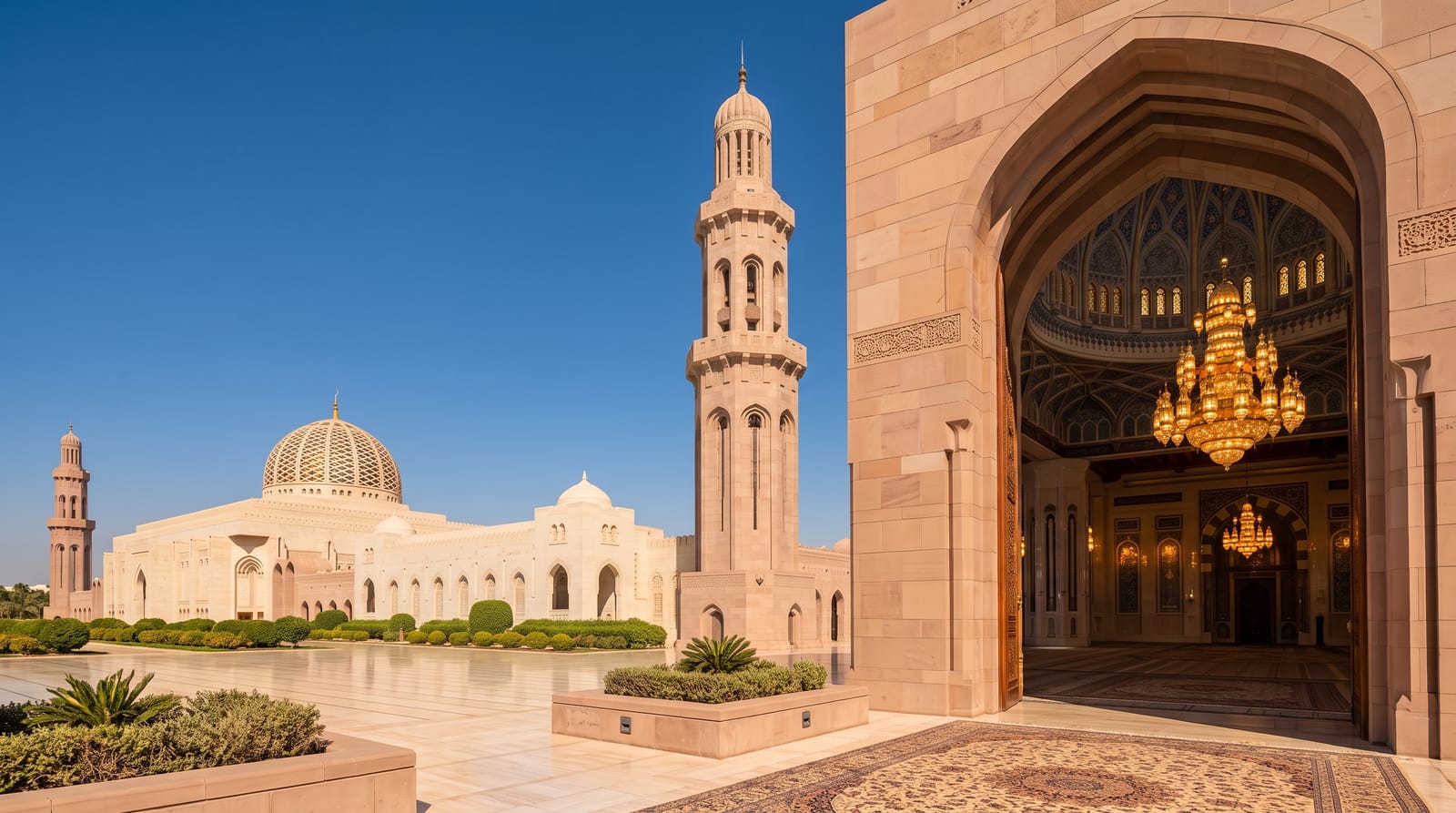
The Grand Mosque was built from December 1994 to 2001 in Indian sandstone, a complex of prayer halls, courtyards, arcades and gardens holding around twenty thousand worshippers. The main prayer hall carries a single Persian carpet, knotted by six hundred weavers over four years and covering more than four thousand square metres, and a chandelier of Swarovski crystal fourteen metres high, both of which were the largest of their kind when installed. The arcades around the courtyard are decorated in a sequence of regional Islamic styles. It is one of the few grand mosques in the Gulf that admits non-Muslim visitors, on weekday mornings only and under a strict dress code.
History
In 1992 Sultan Qaboos directed that the country should have a grand mosque, a design competition followed in 1993, and construction began at Bausher in December 1994, taking six years and seven months; about 270,000 tonnes of Indian sandstone were imported for it. The mosque was inaugurated on 4 May 2001, and its prayer-hall carpet, with 1.7 million knots, took over 600 workers four years to make (Wikipedia, Sultan Qaboos Grand Mosque).
What to look for
- The main prayer hall - the single Persian carpet and the crystal chandelier.
- The courtyard arcades - the sequence of regional Islamic decorative styles.
- The minarets - the five towers around the complex.
- The gardens - the planted grounds surrounding the mosque.
When to go
October to April for comfortable weather. Non-Muslim visiting is restricted to weekday mornings, usually around eight to eleven, and closed on Fridays; check current hours before going. Arrive early to avoid tour groups.
What to expect
The dress code is enforced: long sleeves and long trousers or skirt for everyone, and a headscarf covering the hair for women, with no exceptions. Visiting hours are short and the mosque closes to visitors well before midday. Photography rules vary by area. Tour groups fill the prayer hall late in the window.
Nearby
Mutrah and old Muscat lie east; the opera house is close by.
Key facts
Source: Wikidata, item Q1548443, read on 18 October 2026.
What to pack for The Sultan Qaboos Grand Mosque
Chosen from what this place is for. Tap a kit for the full checklist.
- Comfortable walking shoes - Sightseeing means kilometres of pavement and cobbles daily. Find on Amazon
- Modest clothing - Shoulders and knees covered - the single most common requirement. Find on Amazon
- A slim anti-theft daypack - Zips that close properly; keep it in front in crowds and on transit. Find on Amazon
- A scarf or shawl - To cover the head or shoulders on entry; women especially at mosques. Find on Amazon
Some links on this page are Amazon affiliate links - if you buy through them we may earn a small commission at no extra cost to you.
All packing kitsPlan your trip
Where to start if The Sultan Qaboos Grand Mosque is going on the list.
Booking links on this page are affiliate links - if you book through them we may earn a small commission at no extra cost to you. It never changes what we write about a place.
Opening times, ticket prices and seasonal closures change - check the official source before you go: official site.