Doubtful Sound
A long, deep Fiordland fiord reached only by lake boat and mountain road, quieter and broader than its famous neighbour.
Updated 18 October 2026
AI illustration
UNESCO World Heritage
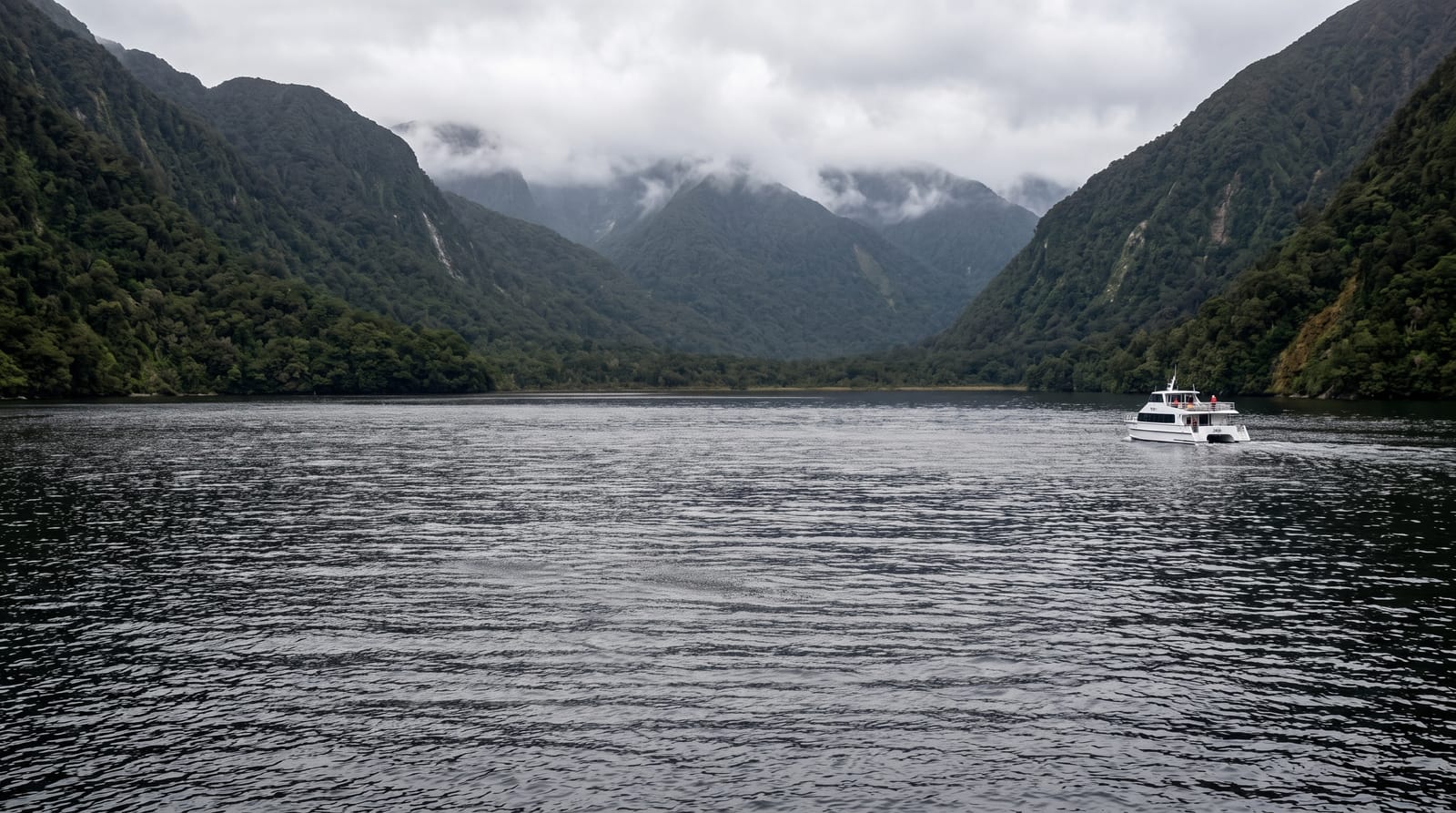
Doubtful Sound is longer and much deeper than Milford, with three distinct arms, and reaching it takes work: a boat across Lake Manapouri, then a bus over Wilmot Pass on a road built to serve a power station and connected to no other road. That effort keeps the numbers down. The fiord is broad and quiet, with forest growing straight off near-vertical rock and a layer of fresh water sitting on top of the sea, stained brown with tannin from the bush. Bottlenose dolphins live here permanently and fur seals use the outer rocks. Most cruises stop their engines somewhere in the middle and ask everyone to stay silent for a few minutes.
History
Captain Cook named it Doubtful Harbour in 1770 because he was unsure it could be sailed in and out of, and did not enter; whalers and sealers later called it Doubtful Sound, although it is a fiord, not a sound. In February 1793 a Spanish scientific expedition under Alessandro Malaspina came to measure the force of gravity with a pendulum, part of the effort behind the new metric system, and its officers, among them the cartographer Felipe Bauzá, made the first chart of the entrance and lower sound, leaving most of the Spanish names on the map of New Zealand: Febrero Point, Bauza Island, the Nee Islets, Pendulo Reach and Malaspina Reach. After the Ngāi Tahu Claims Settlement Act of 1998 its official name became Doubtful Sound / Patea (Wikipedia, Doubtful Sound / Patea).
Highlights
- The three arms - the branching fiord, wider and less enclosed than Milford.
- Wilmot Pass - the bus road over the range, with a view down the fiord from the top.
- The silence stop - engines off in mid-fiord, with only water and birds audible.
- Resident dolphins - the bottlenose pod that lives in the fiord all year.
When to go
Trips run year round, weather permitting, and rain is likely in every month; it fills the cliffs with temporary waterfalls, so a wet day is not a wasted one. Overnight cruises leave in the afternoon and give you the fiord at dusk and dawn without other boats around. Book well ahead for summer, and allow a full day even for the shortest option.
What to expect
It is expensive and slow: a whole day for a day trip, with three separate stages of transport each way and no road access at all. Weather cancels sailings. Wildlife is not guaranteed and the dolphins keep their distance. Sandflies at the wharves are savage. Anyone comparing it directly with Milford should know it is broader and less sheer, traded for quiet.
Nearby
Manapouri and Te Anau are the bases, with the rest of Fiordland and its walking tracks to the north.
Key facts
Source: Wikidata, item Q575365, read on 18 October 2026.
What to pack for Doubtful Sound
Chosen from what this place is for. Tap a kit for the full checklist.
- Broken-in walking shoes or boots - Grip and ankle support matter more than looks; never hike in brand-new boots. Find on Amazon
- Binoculars - The single best wildlife tool - even a compact pair transforms a sighting. Find on Amazon
- Spare batteries + cards - Cold and long shoots drain power; never run out at the good light. Find on Amazon
- Shelter suited to the place - Tent, tarp or hut booking - match it to the terrain and rules. Find on Amazon
Some links on this page are Amazon affiliate links - if you buy through them we may earn a small commission at no extra cost to you.
All packing kitsPlan your trip
Where to start if Doubtful Sound is going on the list.
Booking links on this page are affiliate links - if you book through them we may earn a small commission at no extra cost to you. It never changes what we write about a place.
Opening times, ticket prices and seasonal closures change - check the official source before you go: official site.