Staphorst
A strip village eleven kilometres long where traditional dress is still worn daily by some of the women.
Updated 21 October 2026
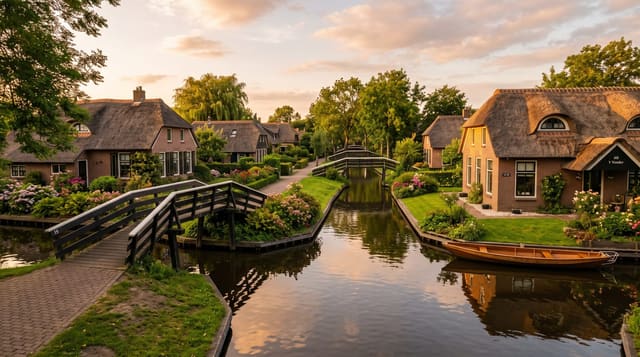
Staphorst and Rouveen form one continuous strip settlement running about eleven kilometres along a single road, with the farms set at right angles on long narrow plots - a medieval reclamation pattern that has never been broken up. The village is strongly Reformed, with a conservative religious culture that shaped daily life, and traditional dress is still worn: a number of older women wear the full Staphorst costume, the printed cotton, the pointed cap and the striped bodice, every day rather than for display, and this is one of the last places in the country where that is true. Photographing people without asking is resented and has caused real friction, which visitors should know. The farmhouses carry painted green and blue window frames and doors in a local pattern. A museum farm shows the interior and the building type.
History
Staphorst and Rouveen came into being in the 13th century, when monks began to bring the bogs into cultivation, and the farms were built along the long road through the bog, making a village 11 km long. A decree of Napoleon in 1811 joined Rouveen, Staphorst and IJhorst into one municipality, called Staphorst since 1818, whose borders have hardly changed; most of the farms standing now were built between 1850 and 1910 (Wikipedia, Staphorst).
What's there
- An eleven-kilometre strip village - farms at right angles on medieval reclamation plots.
- Costume worn daily - by a number of older women, not as a display.
- Painted green and blue joinery - the local pattern on the farmhouses.
- A museum farm - the building type and interior shown.
When to go
April to October. Half a day.
Things to know
Do not photograph people without asking - this is a live grievance here and has caused confrontations. Sunday is observed strictly and almost everything closes. The village is a working community, not an attraction.
Nearby
Zwolle is south; the Weerribben are north-west.
Key facts
Source: Wikidata, item Q10021, read on 18 October 2026.
What to pack for Staphorst
Chosen from what this place is for. Tap a kit for the full checklist.
- Comfortable walking shoes - Sightseeing means kilometres of pavement and cobbles daily. Find on Amazon
- A slim anti-theft daypack - Zips that close properly; keep it in front in crowds and on transit. Find on Amazon
- A refillable water bottle - Many cities have public fountains; save money and plastic. Find on Amazon
- A light layer + compact umbrella - For museum air-con and a sudden shower. Find on Amazon
Some links on this page are Amazon affiliate links - if you buy through them we may earn a small commission at no extra cost to you.
All packing kitsPlan your trip
Where to start if Staphorst is going on the list.
Booking links on this page are affiliate links - if you book through them we may earn a small commission at no extra cost to you. It never changes what we write about a place.
Opening times, ticket prices and seasonal closures change - check the official source before you go: official site.