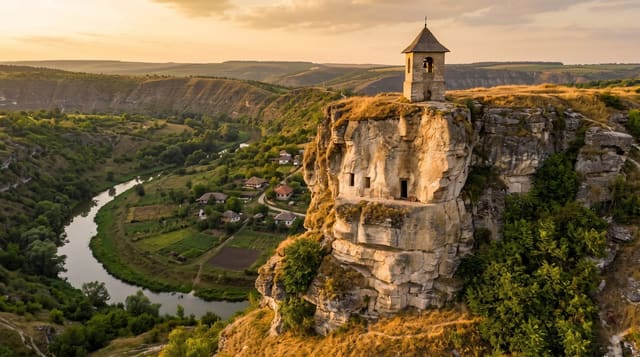
Tipova Cave Monastery
Cells and a church carved into a limestone cliff above the Dniester - one of the largest cave monasteries in eastern Europe.
Updated 7 August 2026

AI illustration
Above a bend in the Dniester, monks cut cells, corridors and a church directly into the limestone cliff, creating one of the largest cave monastery complexes in the region - parts of it are dated to as early as the eleventh century, with expansion over the following centuries. Rooms open onto the drop with the river far below, and the complex is reached by a steep path from the plateau. Local legend holds that Stephen the Great married here, and that the poet-king Orpheus is buried in the gorge, which is the sort of claim Moldova makes with a straight face and a shrug.
What you'll find
- The rock-cut church - the main carved chapel in the cliff.
- Cliff cells and corridors - monastic rooms opening onto the gorge.
- The Dniester views - the river bend far below the complex.
- The gorge waterfall - the cascade in the ravine below the monastery.
When to go
Spring and autumn give comfortable walking and the best light in the gorge. Summer is hot on the exposed path. Winter makes the descent icy and dangerous. Water in the gorge is strongest in spring.
Practical notes
The path down is steep, rocky and unprotected in places - not suitable for limited mobility, and slippery when wet. There are no facilities at the site. The active part of the monastery expects modest dress and quiet. Getting here really needs a car; public transport reaches the village but leaves a long walk.
Nearby
Saharna monastery, Orheiul Vechi and the Dniester valley villages.
What to pack for Tipova Cave Monastery
Chosen from what this place is for. Tap a kit for the full checklist.
- Head torch + spare batteries - Hands-free light is essential; caves are truly dark. Find on Amazon
- Comfortable walking shoes - Sightseeing means kilometres of pavement and cobbles daily. Find on Amazon
- Modest clothing - Shoulders and knees covered - the single most common requirement. Find on Amazon
- Grippy closed shoes - Cave floors are wet, muddy and slick with formations. Find on Amazon
Some links on this page are Amazon affiliate links - if you buy through them we may earn a small commission at no extra cost to you.
All packing kitsPlan your trip
Where to start if Tipova Cave Monastery is going on the list.
Booking links on this page are affiliate links - if you book through them we may earn a small commission at no extra cost to you. It never changes what we write about a place.
Opening times, ticket prices and seasonal closures change - check the official source before you go: official site.