Hospicio Cabanas
Orozco's Man of Fire under a neoclassical dome - Guadalajara's UNESCO-listed former hospice, its chapel painted with one of the Americas' great mural cycles.
Updated 18 October 2026
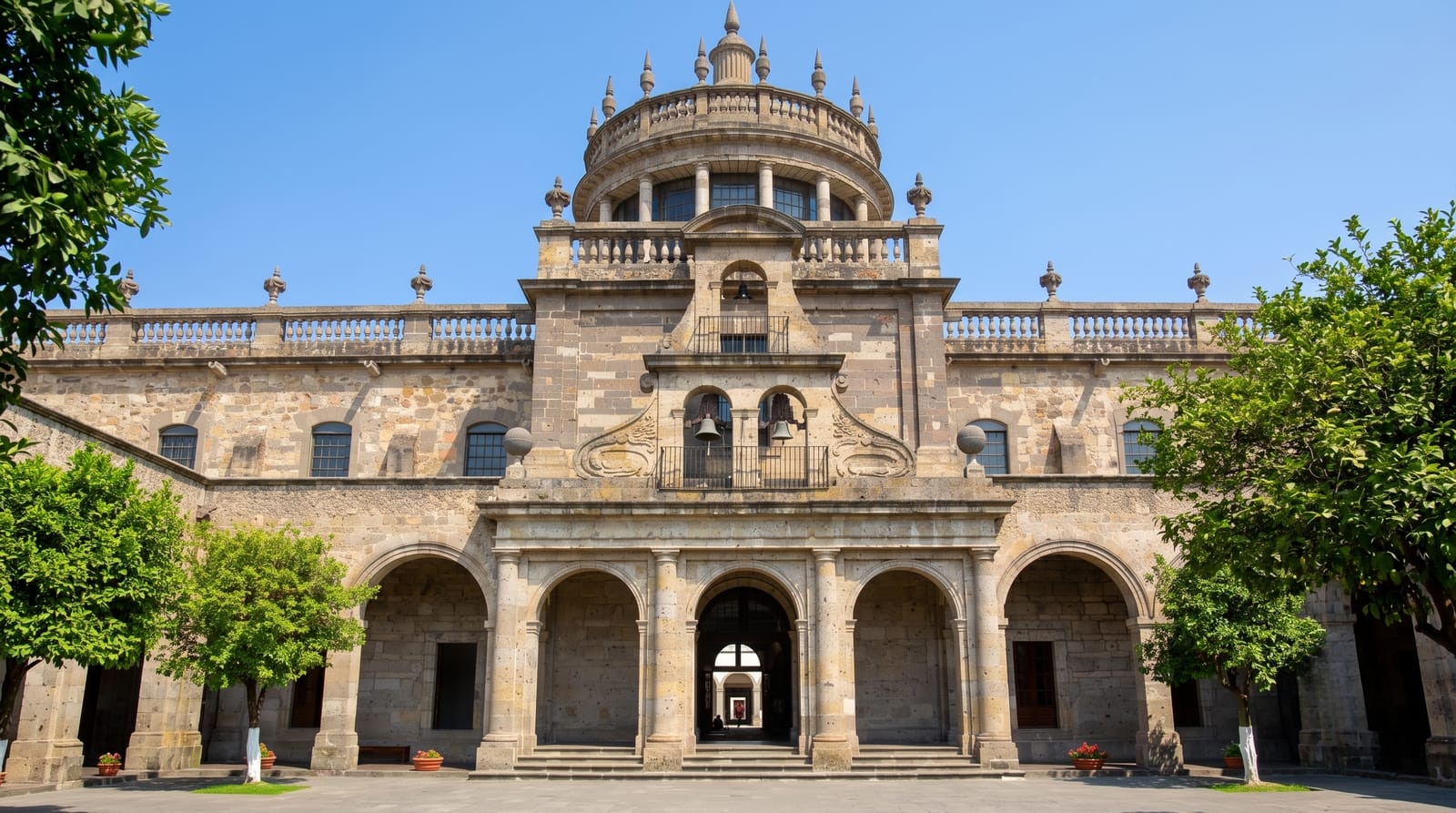
AI illustration
UNESCO World Heritage
Bishop Juan Cruz Ruiz de Cabañas, who took up the see of Guadalajara in 1796, founded the Hospicio in 1810 as a shelter for orphans, the elderly and the sick, and the architect Manuel Tolsa gave it a plan of severe neoclassical logic: a single-storey complex of twenty-three courtyards around a domed chapel, low and light so that residents could move easily. It functioned as a hospice into the 1980s and was inscribed by UNESCO in 1997, both for the architecture and for what covers the chapel: Jose Clemente Orozco painted the vaults, walls and dome between 1936 and 1939 with fifty-seven frescoes on the conquest of Mexico and the machine age - masked warriors, conquistadors as armoured automatons, Franciscan friars - culminating overhead in El Hombre de Fuego, the Man of Fire, a figure engulfed in flame rising into the dome's lantern, generally reckoned Orozco's masterpiece. Benches let visitors lie back and look up, which is the only sane way to see it. The rest of the complex houses the Cabañas Cultural Institute, with Orozco's easel work, contemporary galleries and courtyards that repay wandering.
History
Juan Ruiz de Cabañas, appointed bishop of Guadalajara in 1796, founded the institution in 1810 to combine a workhouse, hospital, orphanage and almshouse, and engaged the Mexico City architect Manuel Tolsá, who drew on Les Invalides in Paris and El Escorial near Madrid for a rectangle of 164 by 145 metres, single-storey buildings 7.5 metres high, so that the sick, the old and children could move about easily, around a chapel with a dome rising to 32.5 metres. Building went on after the bishop's death in 1823 until 1829; the complex served for a time as barracks in the mid-19th century, but the hospice worked well into the 20th, until in 1980 the Cabañas Cultural Institute with its arts and crafts schools moved in. Its chief glory is José Clemente Orozco's frescoes, among them The Man of Fire of 1936-39, and in 1997 it became a World Heritage Site (Wikipedia, Hospicio Cabañas).
Highlights
- The Man of Fire - Orozco's dome figure over the chapel.
- The fresco cycle - fifty-seven panels of conquest and machinery.
- Tolsa's plan - twenty-three courtyards in neoclassical calm.
- The galleries - Orozco's easel work and rotating shows.
When to go
Any day but Monday; mornings for the best natural light in the chapel. Two hours lets you do the murals slowly and still see the courtyards.
Things to know
Neck strain is real - use the reclining benches. Sections close for conservation periodically. The surrounding Plaza Tapatia is busy and hawker-heavy at weekends.
Nearby
The Mercado San Juan de Dios, the cathedral and Tlaquepaque's galleries are all within the city.
Key facts
Source: Wikidata, item Q28416, read on 18 October 2026.
What to pack for Hospicio Cabanas
Chosen from what this place is for. Tap a kit for the full checklist.
- Comfortable walking shoes - Sightseeing means kilometres of pavement and cobbles daily. Find on Amazon
- Modest clothing - Shoulders and knees covered - the single most common requirement. Find on Amazon
- A slim anti-theft daypack - Zips that close properly; keep it in front in crowds and on transit. Find on Amazon
- A scarf or shawl - To cover the head or shoulders on entry; women especially at mosques. Find on Amazon
Some links on this page are Amazon affiliate links - if you buy through them we may earn a small commission at no extra cost to you.
All packing kitsPlan your trip
Where to start if Hospicio Cabanas is going on the list.
Booking links on this page are affiliate links - if you book through them we may earn a small commission at no extra cost to you. It never changes what we write about a place.
Opening times, ticket prices and seasonal closures change - check the official source before you go: official site.