Balamand Monastery
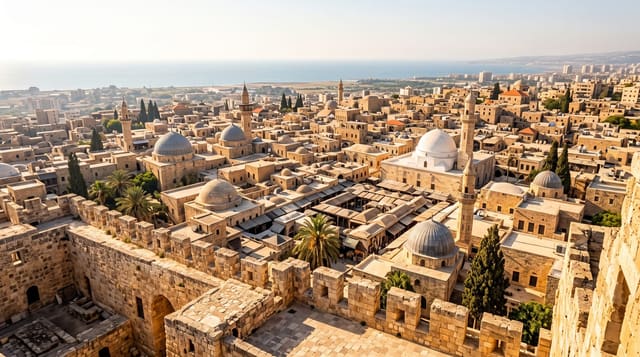
A twelfth-century Cistercian abbey above the Koura plain, later Orthodox, now sharing a hill with a university.
Updated 16 October 2026
Balamand was founded in 1157 by Cistercians who came with the Crusader states, and the church, cloister and vaulted ranges they built survive, plain and heavy in the way Cistercian work is. After the Crusader withdrawal the site passed to the Greek Orthodox church, which has held it since the fourteenth century, and it is now the seat of a patriarchal monastery with a library of manuscripts and icons. A university was built on the same hill in 1988.
Background
Its old names include Belmont, meaning "beautiful mountain", as well as Bellimontis ultra Mare and Bellus-Mons. French Cistercian monks raised the abbey between 1157 and 1169 and stayed until 1289. Syriac-Arabic manuscripts from around 1492 suggest that hermits still lived here in the late 15th century. In 1603 Greek Orthodox monks under Youwakim, metropolitan of Tripoli, restored the monastery, and by 1610 it had been endowed again as a waqf and settled by a dozen monks, who replanted vineyards and olive groves and brought back livestock. The English traveller Henry Maundrell stayed here in 1697 and counted about forty monks.
Source: Wikipedia, "Balamand Monastery"
What you'll find
- The Cistercian church - the twelfth-century abbey church, plain and vaulted.
- The cloister - the medieval courtyard and surrounding ranges.
- The icon collection - Orthodox icons and manuscripts held by the monastery.
- The Koura view - olive country spread below the hill towards the sea.
When to go
April to November is comfortable. The monastery keeps visiting hours around its services and closes at midday. Term time brings university traffic to the hill.
Things to know
It is an active monastery and access to parts is restricted. The university buildings crowd the medieval core. Modest dress is required.
Nearby
Tripoli is fifteen kilometres north, and Enfeh is on the coast below.
Key facts
Source: Wikidata, item Q1774990, read on 18 October 2026.
What to pack for Balamand Monastery
Chosen from what this place is for. Tap a kit for the full checklist.
- Comfortable walking shoes - Sightseeing means kilometres of pavement and cobbles daily. Find on Amazon
- Modest clothing - Shoulders and knees covered - the single most common requirement. Find on Amazon
- A slim anti-theft daypack - Zips that close properly; keep it in front in crowds and on transit. Find on Amazon
- A scarf or shawl - To cover the head or shoulders on entry; women especially at mosques. Find on Amazon
Some links on this page are Amazon affiliate links - if you buy through them we may earn a small commission at no extra cost to you.
All packing kitsPlan your trip
Where to start if Balamand Monastery is going on the list.
Booking links on this page are affiliate links - if you book through them we may earn a small commission at no extra cost to you. It never changes what we write about a place.
Opening times, ticket prices and seasonal closures change - check the official source before you go: official site.