North Tarawa
The traditional half - islets of thatch villages and lagoon flats across the channel from South Tarawa's crowd, reached by canoe and causeway's end.
Updated 20 October 2026
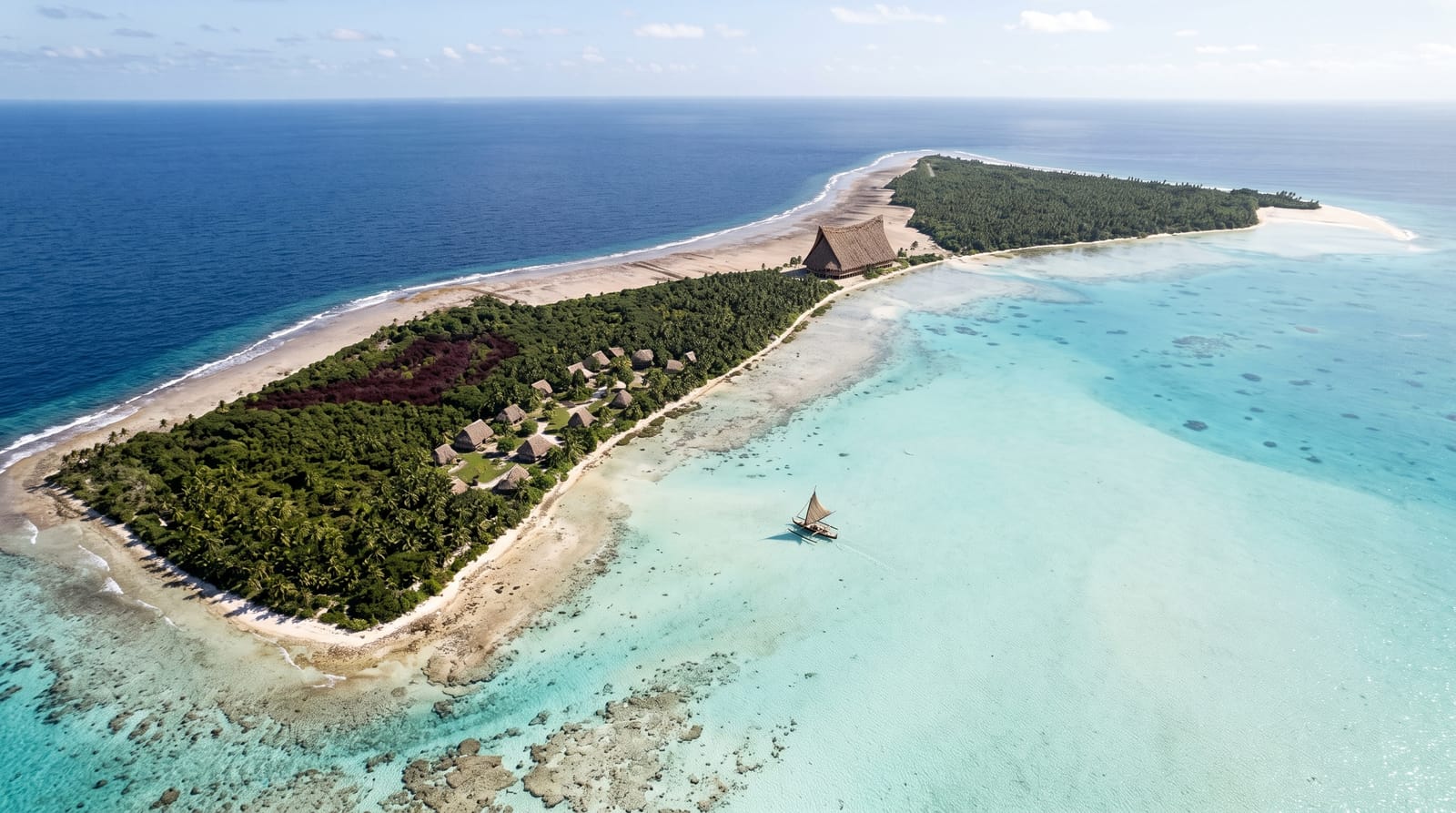
AI illustration
Where South Tarawa's crowded ribbon ends, the atoll's other life begins: North Tarawa runs its islets in traditional register - thatch-and-local-timber villages under coconut and breadfruit, lagoon flats worked for shellfish at low tide, canoe crossings threading the channels between islets, and the pace set by tide, church and the maneaba's gatherings. Guesthouse stays at Buota and beyond host the visiting version: lagoon swims off white flats, village walks with greeting protocol, and nights where the generator's end hands the sky to stars. It is Kiribati's daily culture at nearest reach.
History
Tarawa was ruled as one island under a king until colonial times, and the colonial administrative centre of Kiribati was first at Taratai in North Tarawa, where the last king had lived, before it moved to South Tarawa. In the early 1970s a boat built at Taratai sailed to Fiji by traditional navigation, in a project led by James Siers (Wikipedia, North Tarawa).
What you'll find
- The islet villages - thatch tradition under the palms.
- The lagoon flats - shellfish work at low tide.
- The canoe channels - crossings as the local roads.
- The maneaba life - the meeting house's ordered welcome.
When to go
May to October, the drier trades; tides schedule the flats and crossings - local word times both.
Things to know
Custom is the frame: greetings, modest dress and maneaba protocol as hosts direct; comforts are village-simple and mosquitoes attend dusk.
Nearby
South Tarawa's causeway ribbon and the lagoon's breadth.
Key facts
Source: Wikidata, item Q15647452, read on 18 October 2026.
What to pack for North Tarawa
Chosen from what this place is for. Tap a kit for the full checklist.
- Reef-safe sunscreen - High SPF that will not bleach the coral you are swimming over. Find on Amazon
- Quick-dry clothing - Board shorts or synthetics that shrug off spray and dry fast. Find on Amazon
- Quick-dry towel - A microfibre towel packs small and dries in minutes. Find on Amazon
- Secure water shoes or reef boots - Grip on slippery launches and protection on rocky shores. Find on Amazon
Some links on this page are Amazon affiliate links - if you buy through them we may earn a small commission at no extra cost to you.
All packing kitsPlan your trip
Where to start if North Tarawa is going on the list.
Booking links on this page are affiliate links - if you book through them we may earn a small commission at no extra cost to you. It never changes what we write about a place.
Opening times, ticket prices and seasonal closures change - check the official source before you go: official site.


