Ueno Park
Japan's first public park, holding most of the country's major national museums and about a thousand cherry trees.
Updated 20 October 2026
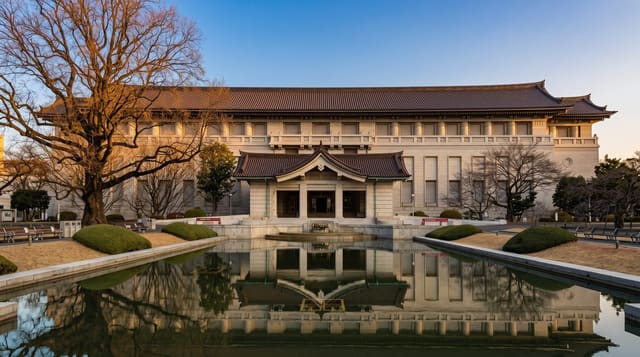
Ueno was the grounds of Kaneiji temple until the 1860s and became one of Japan's first public parks in 1873. What accumulated there afterwards is the reason to spend a day: the Tokyo National Museum, the largest collection of Japanese art and archaeology anywhere; the National Museum of Nature and Science; the National Museum of Western Art in a building by Le Corbusier that is UNESCO-listed as part of his serial inscription; the Tokyo Metropolitan Art Museum; and Ueno Zoo, the country's oldest. Shinobazu Pond at the southern end fills with lotus in summer and has a shrine on an island in it. The park's other identity is hanami: about a thousand cherry trees line the central avenue, and in the first days of April the ground under them is claimed from dawn with blue tarpaulins and the drinking runs late.
History
The park occupies land of Kan'ei-ji, a temple founded in 1625 in the unlucky north-east "demon gate" of Edo Castle. Most of its buildings were lost in 1868, and on the advice of the Dutch doctor Bauduin the hill became one of Japan's first public parks in 1873; in 1924 Emperor Taishō gave it to the city (Wikipedia, Ueno Park).
What you'll find
- The museum cluster - national museums of art, science and Western art in one park.
- The Corbusier building - the National Museum of Western Art, UNESCO-listed.
- A thousand cherry trees - the central avenue, and Tokyo's loudest hanami.
- Shinobazu Pond - lotus in summer with an island shrine.
When to go
Late March to early April for blossom; any time for museums. A full day.
Before you go
Blossom season here is genuinely chaotic - crowded, loud and littered by evening. Museums close Mondays and queue for special exhibitions. The park has a visible homeless population and the city's handling of it has been criticised. Zoo conditions divide opinion.
Nearby
Yanaka is north-west; Asakusa is east.
Key facts
Source: Wikidata, item Q746216, read on 18 October 2026.
What to pack for Ueno Park
Chosen from what this place is for. Tap a kit for the full checklist.
- Broken-in walking shoes or boots - Grip and ankle support matter more than looks; never hike in brand-new boots. Find on Amazon
- Modest clothing - Shoulders and knees covered - the single most common requirement. Find on Amazon
- Layers + a waterproof shell - Mountain weather turns fast; a packable rain jacket saves the day. Find on Amazon
- A scarf or shawl - To cover the head or shoulders on entry; women especially at mosques. Find on Amazon
Some links on this page are Amazon affiliate links - if you buy through them we may earn a small commission at no extra cost to you.
All packing kitsPlan your trip
Where to start if Ueno Park is going on the list.
Booking links on this page are affiliate links - if you book through them we may earn a small commission at no extra cost to you. It never changes what we write about a place.
Opening times, ticket prices and seasonal closures change - check the official source before you go: official site.