Sannai-Maruyama Site
A Jomon settlement occupied for about 1,700 years, found in 1992 under a planned baseball stadium.
Updated 18 October 2026
UNESCO World Heritage
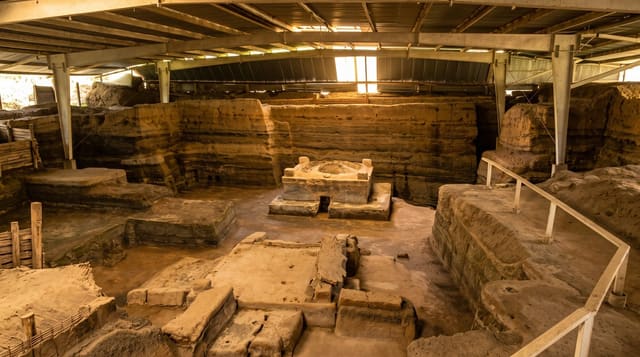
In 1992 Aomori prefecture began work on a baseball stadium and the excavation that preceded it found something that stopped the project: a settlement occupied from roughly 3900 to 2200 BC, the largest Jomon site known, with hundreds of pit dwellings, storage pits, a burial road, and the postholes of a very large structure - six holes a metre across, arranged in two rows, which have been reconstructed as a tower of about fifteen metres, though the original form is inferred rather than known and the reconstruction is contested. The Jomon were hunter-gatherers who nonetheless lived in permanent settlements, made elaborate pottery, cultivated chestnut, and traded jade and obsidian over long distances - which complicates the usual account of what settled life requires. The site was inscribed by UNESCO in 2021 with sixteen others in northern Japan. Reconstructions stand over the excavated ground.
History
Hunter-gatherers first used the site on a temporary basis around 3900 BC, and from the middle of the Early Jōmon to the late Middle Jōmon period, about 3900 to 2200 BC, it grew into the largest Jōmon settlement yet found in Japan, with 648 pit dwellings over some 40 hectares. Its true significance was recognised only in 1992, when Aomori Prefecture began surveying the ground for a baseball stadium, and excavations found storage pits, raised storehouses and long houses that show how the community and its buildings changed as people settled. It became a Special National Historic Site in 2000, was put forward for the World Heritage List in 2009, and on 27 July 2021 was inscribed as part of the Jōmon Prehistoric Sites in Northern Japan (Wikipedia, Sannai-Maruyama Site).
What's there
- A 1,700-year settlement - occupied from roughly 3900 to 2200 BC.
- The six great postholes - a metre across, reconstructed as a tower whose form is debated.
- Reconstructed dwellings - pit houses and longhouses built over the excavated ground.
- A 2021 UNESCO inscription - listed with sixteen other northern Jomon sites.
When to go
April to November; winter access is limited by snow. Two to three hours.
Practical notes
Most of what stands is reconstruction and the tower's form is genuinely uncertain. Winter snow closes much of the outdoor site. English signage exists but is limited in depth. The museum is the better half for finds.
Nearby
Aomori city and the Nebuta museum are north-east.
Key facts
Source: Wikidata, item Q911970, read on 18 October 2026.
What to pack for Sannai-Maruyama Site
Chosen from what this place is for. Tap a kit for the full checklist.
- Warm base layers - Merino or synthetic against the skin - never cotton, which chills when damp. Find on Amazon
- Comfortable walking shoes - Sightseeing means kilometres of pavement and cobbles daily. Find on Amazon
- An insulated + windproof jacket - A down or synthetic layer under a hard shell handles most cold. Find on Amazon
- A slim anti-theft daypack - Zips that close properly; keep it in front in crowds and on transit. Find on Amazon
Some links on this page are Amazon affiliate links - if you buy through them we may earn a small commission at no extra cost to you.
All packing kitsPlan your trip
Where to start if Sannai-Maruyama Site is going on the list.
Booking links on this page are affiliate links - if you book through them we may earn a small commission at no extra cost to you. It never changes what we write about a place.
Opening times, ticket prices and seasonal closures change - check the official source before you go: official site.