Rikugien Garden
A strolling garden built to stage eighty-eight scenes from classical poetry, most of which are no longer marked.
Updated 20 October 2026
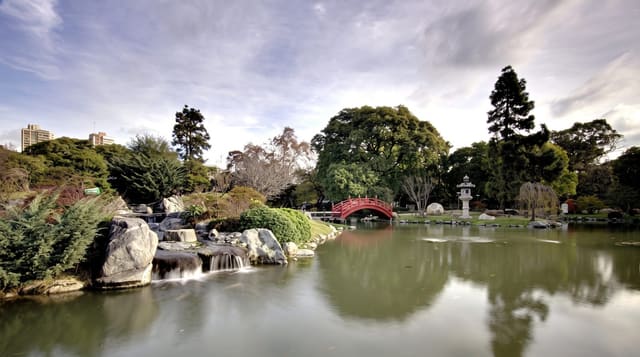
Rikugien was laid out between 1695 and 1702 by Yanagisawa Yoshiyasu, a senior official under the fifth shogun, and its organising idea is literary: the garden was designed to reproduce eighty-eight scenes drawn from waka poetry, chiefly from the Man'yoshu and the Kokinshu, as you walk the circuit around the central pond. Only a fraction of the markers survive, so the scheme now reads as a very good strolling garden rather than as a legible text, which is honest to say. The circuit is about forty minutes at an unhurried pace, past the pond, a small hill that gives a view over the whole layout, a stone bridge and a teahouse. Its reputation now rests on autumn: the maples around the pond are lit at night for about two weeks from late November, and the queue at the gate on those evenings is long.
History
Yanagisawa Yoshiyasu laid out the garden between 1695 and 1702 with the permission of the fifth shogun, Tokugawa Tsunayoshi; it was neglected after his death, and in 1878 Iwasaki Yatarō, founder of Mitsubishi, bought it and began restoring it, work continued by his younger brother Iwasaki Yanosuke. In 1938 it was given to the city of Tokyo (Wikipedia, Rikugi-en Gardens).
What you'll find
- A poetry garden - built to stage eighty-eight scenes from classical waka.
- The pond circuit - about forty minutes past hill, bridge and teahouse.
- The viewing hill - a small rise giving the whole layout at once.
- The autumn lighting - maples lit at night for about two weeks from late November.
When to go
Late November to early December for the lit maples; April for azaleas. Two hours.
Practical notes
Most of the eighty-eight scenes are unmarked and the literary scheme is largely invisible now. Night-lighting evenings involve long queues and controlled entry. It is small and can be done in under an hour. Entry is charged and it closes at five outside special openings.
Nearby
Komagome station is beside it; Ueno Park is south-east.
Key facts
Source: Wikidata, item Q1889010, read on 18 October 2026.
What to pack for Rikugien Garden
Chosen from what this place is for. Tap a kit for the full checklist.
- Broken-in walking shoes or boots - Grip and ankle support matter more than looks; never hike in brand-new boots. Find on Amazon
- Layers + a waterproof shell - Mountain weather turns fast; a packable rain jacket saves the day. Find on Amazon
- Daypack with rain cover - 20-30 litres holds water, snacks, layers and a first-aid kit. Find on Amazon
- Offline maps + a power bank - Download the trail before you lose signal; carry backup charge. Find on Amazon
Some links on this page are Amazon affiliate links - if you buy through them we may earn a small commission at no extra cost to you.
All packing kitsPlan your trip
Where to start if Rikugien Garden is going on the list.
Booking links on this page are affiliate links - if you book through them we may earn a small commission at no extra cost to you. It never changes what we write about a place.
Opening times, ticket prices and seasonal closures change - check the official source before you go: official site.