Matsumoto Castle
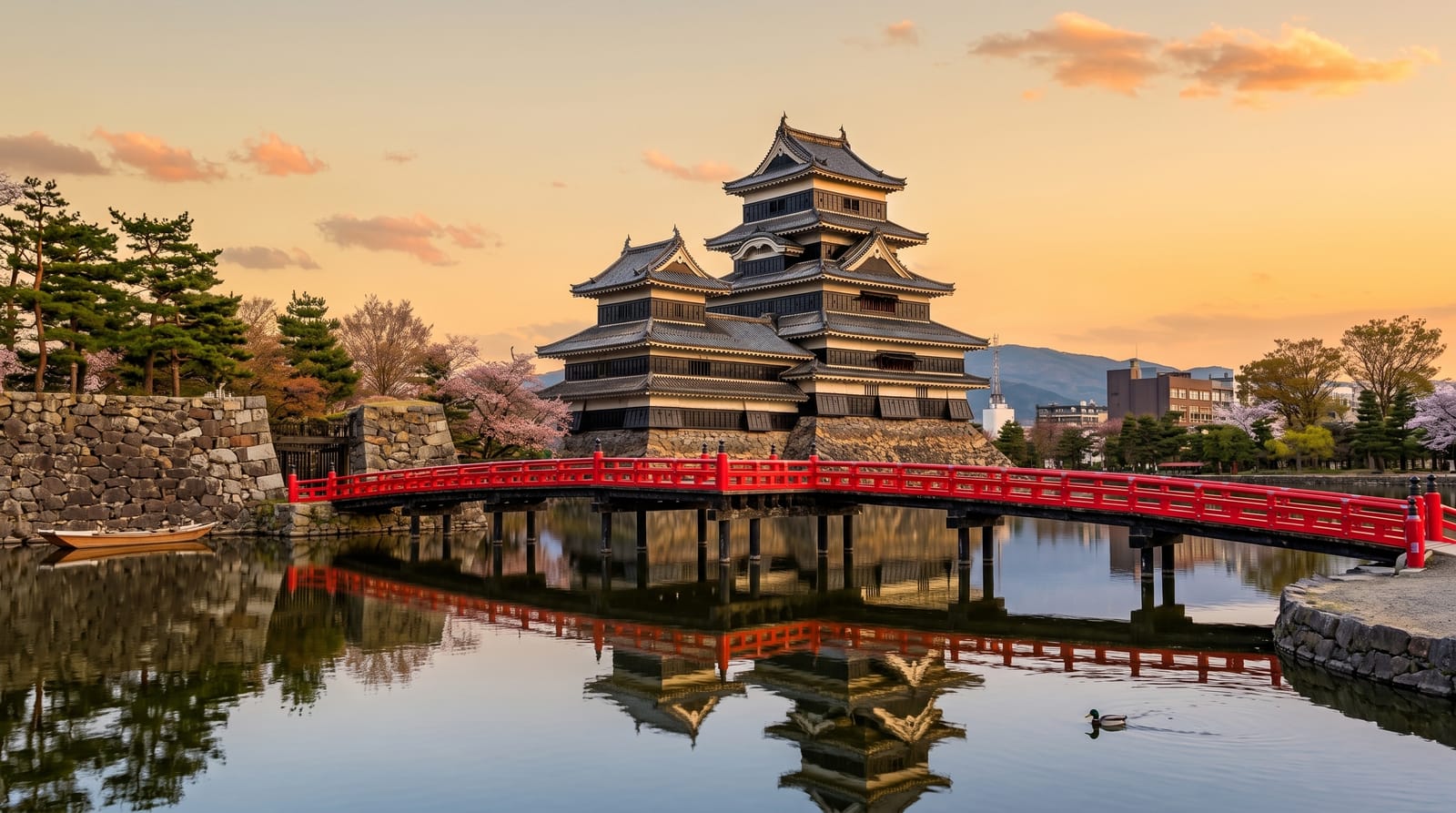
The Crow Castle - Japan's oldest surviving five-tiered keep, black-lacquered above a swan moat with the Northern Alps behind.
Updated 18 October 2026
AI illustration
Matsumoto Castle raises Japan's oldest surviving five-tiered keep above its swan-swum moat - completed around 1594, a National Treasure, and one of only twelve original keeps left in the whole country. Its black-lacquered walls earned the nickname Crow Castle centuries before the snow line of the Northern Alps became its standard photographic backdrop. The keep is the genuine article: no lifts, no concrete, just six internal floors of massive timber pillars, ladder-steep stairs, arrow slits and stone-drop chutes, plus a moon-viewing turret added in the peaceable 1630s when a castle could finally afford poetry. The red Uzumibashi bridge frames the classic composition across the water, cherry trees ring the grounds in late April, and midwinter stages the black keep against white mountains at its most severe and beautiful.
History
The castle began in the Eishō era (1504-1520) as Fukashi Castle, a minor border post built by Shimadachi Sadanaga of the Ogasawara clan. The Takeda seized it in 1550 and used it as their headquarters for taking the Matsumoto basin; after the fall of the Takeda and the death of Oda Nobunaga in 1582 it went back to the Ogasawara, and Ogasawara Sadayoshi, now pledged to Tokugawa Ieyasu, renamed it Matsumoto Castle. After 1590 Ishikawa Kazumasa and his son Yasunaga built the keep and most of the castle as it stands today, together with the castle town, much of it finished by 1593-94. Through the Edo period it was the seat of the Matsumoto Domain, held by a succession of clans until the Meiji Restoration of 1868 (Wikipedia, Matsumoto Castle).
The main sights
- The original keep - six floors of 1590s timber, climbed by ladder-stairs.
- The moon-viewing turret - the 1630s addition built for pleasure, not war.
- The moat composition - black walls, red bridge and resident swans.
- The Alps backdrop - snow peaks behind the crow-black silhouette.
When to go
Late April pairs the keep with cherry blossom; January and February set it against snow with the clearest Alps. Summer works but hauls the longest keep-entry queues.
What to expect
The interior stairs are close to ladders - steep, low and one-way in crowds, so bad knees should think twice; you carry your shoes in a bag. Blossom week queues an hour or more for keep entry. The town's other draws are modest - most visitors pair it with the Alps or the Nakasendo.
Nearby
Kamikochi's alpine valley, the Nakasendo post towns and Nagano city.
Key facts
Source: Wikidata, item Q739612, read on 18 October 2026.
What to pack for Matsumoto Castle
Chosen from what this place is for. Tap a kit for the full checklist.
- Warm base layers - Merino or synthetic against the skin - never cotton, which chills when damp. Find on Amazon
- Comfortable walking shoes - Sightseeing means kilometres of pavement and cobbles daily. Find on Amazon
- An insulated + windproof jacket - A down or synthetic layer under a hard shell handles most cold. Find on Amazon
- A slim anti-theft daypack - Zips that close properly; keep it in front in crowds and on transit. Find on Amazon
Some links on this page are Amazon affiliate links - if you buy through them we may earn a small commission at no extra cost to you.
All packing kitsPlan your trip
Where to start if Matsumoto Castle is going on the list.
Booking links on this page are affiliate links - if you book through them we may earn a small commission at no extra cost to you. It never changes what we write about a place.
Opening times, ticket prices and seasonal closures change - check the official source before you go: official site.