Lake Suwa
A highland lake whose ice, in a cold enough winter, cracks and buckles into a ridge across the surface.
Updated 21 October 2026
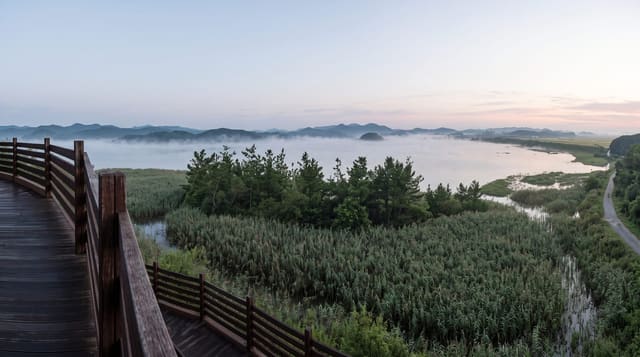
Suwa sits at about 760 metres in a basin on the Fossa Magna, the tectonic trough that crosses central Honshu, and it is fed by hot springs - the town of Kamisuwa has public baths and a geyser on the shore. The phenomenon it is known for is the omiwatari: in a hard freeze the ice sheet expands and contracts with day and night temperatures until it fractures and the broken edges push up into a ridge running across the lake, sometimes a metre high. Shrine records of its appearance go back to 1443, and the priests of the local Yatsurugi shrine still log it, which makes the record one of the longest continuous climate observations anywhere; it now forms far less often than it did, and several recent decades have passed with almost none. The lakeside is otherwise a ring road with onsen, a summer fireworks festival among the largest in the country, and views to the Yatsugatake range.
What you'll find
- The omiwatari - a pressure ridge pushed up across the ice in a hard freeze.
- A six-century record - shrine priests logging its appearance since the 1400s.
- Hot springs on the shore - public baths and a geyser at Kamisuwa.
- A summer fireworks festival - among the largest displays in Japan.
When to go
January and February for a chance of the ice ridge; August for fireworks. A day.
Good to know
The omiwatari now forms rarely and cannot be planned for. The lakeshore is developed and the ring road is not scenic in most sections. Water quality has been a long-standing problem. The fireworks festival brings extreme crowding and booked-out accommodation.
Nearby
Suwa Taisha's four shrines are around the lake; Matsumoto is north.
Key facts
Source: Wikidata, item Q1206692, read on 18 October 2026.
What to pack for Lake Suwa
Chosen from what this place is for. Tap a kit for the full checklist.
- Reef-safe sunscreen - High SPF that will not bleach the coral you are swimming over. Find on Amazon
- Warm base layers - Merino or synthetic against the skin - never cotton, which chills when damp. Find on Amazon
- Modest clothing - Shoulders and knees covered - the single most common requirement. Find on Amazon
- Swimwear - Needed at most public thermal pools; some traditional baths are nude and single-sex. Find on Amazon
Some links on this page are Amazon affiliate links - if you buy through them we may earn a small commission at no extra cost to you.
All packing kitsPlan your trip
Where to start if Lake Suwa is going on the list.
Booking links on this page are affiliate links - if you book through them we may earn a small commission at no extra cost to you. It never changes what we write about a place.
Opening times, ticket prices and seasonal closures change - check the official source before you go: official site.