Kumamoto Castle
A vast Kyushu fortress famous for curving stone walls, now half castle and half open restoration site after the 2016 earthquakes.
Updated 20 October 2026
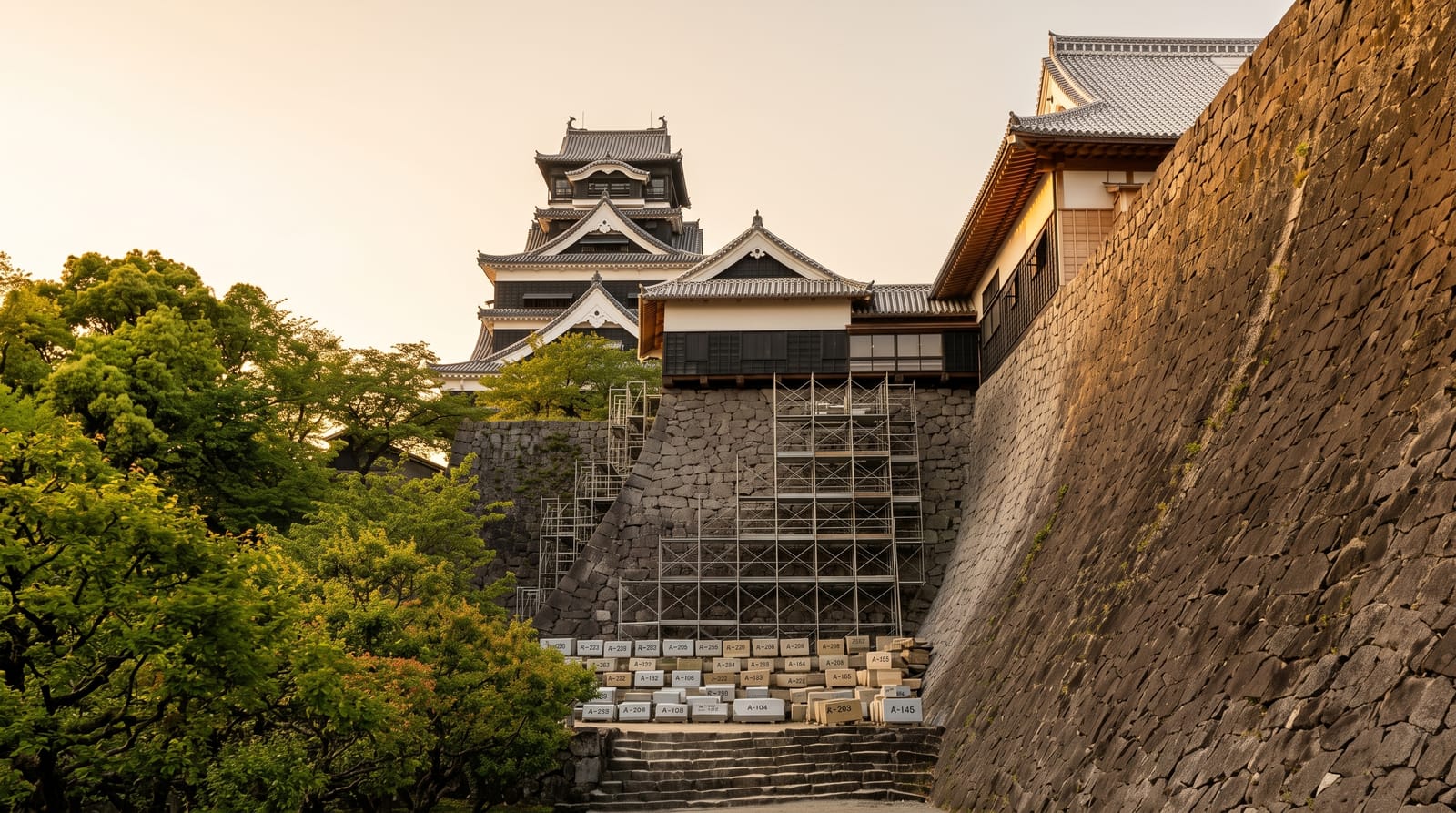
AI illustration
Kumamoto's castle was laid out at the start of the 1600s and its best feature is underfoot rather than overhead: enormous ramps of fitted stone that start as a gentle slope and curl to near vertical at the lip, a profile built to defeat anyone climbing. The earthquakes of 2016 brought down turrets and whole panels of that stonework, and the site has been a repair project ever since. The main keep has been rebuilt and reopened, reached along a raised walkway that carries visitors over ground still closed off, so the restoration becomes the exhibit: numbered stones laid out in rows, cranes above the ramparts, walls stripped back to their cores. Inside, the keep holds a modern museum of its own history.
History
Ideta Hidenobu first fortified the site in 1467, and Katō Kiyomasa, who came here in 1588, greatly enlarged the castle from 1601 to 1607, with 49 turrets, 18 turret gates and 29 smaller gates. In 1877, during the Satsuma Rebellion, the castle held out against a siege though its keep burned, and 13 buildings that survived are Important Cultural Properties (Wikipedia, Kumamoto Castle).
Highlights
- The curving stone walls - musha-gaeshi ramps that flare from a walkable slope into a vertical lip.
- The elevated walkway - a raised route threading above sections still fenced for repair.
- The rebuilt keep - gallery floors of castle history and a top-floor view across the city to the hills.
- The stone yards - thousands of numbered blocks laid in fields, each waiting to return to its exact place.
When to go
Blossom in late March and early April is the peak, with the grounds lit in the evening for a short season. Autumn is drier and clearer. Kyushu summers are heavy and the walkway offers almost no shade. Check what is open before travelling, since access routes shift as repair work moves from one section of wall to the next.
Good to know
This is not a castle you wander freely. Large areas stay fenced, paths are routed, and the work will run for many years yet. The keep's interior is modern concrete with lifts, so anyone expecting old timber inside will be disappointed - the original craft is all in the walls outside. Summer heat on the exposed walkway is punishing.
Nearby
Suizenji Jojuen garden sits across the city, and the Aso caldera is about two hours east.
Key facts
Source: Wikidata, item Q613355, read on 18 October 2026.
What to pack for Kumamoto Castle
Chosen from what this place is for. Tap a kit for the full checklist.
- Comfortable walking shoes - Sightseeing means kilometres of pavement and cobbles daily. Find on Amazon
- A slim anti-theft daypack - Zips that close properly; keep it in front in crowds and on transit. Find on Amazon
- A refillable water bottle - Many cities have public fountains; save money and plastic. Find on Amazon
- A light layer + compact umbrella - For museum air-con and a sudden shower. Find on Amazon
Some links on this page are Amazon affiliate links - if you buy through them we may earn a small commission at no extra cost to you.
All packing kitsPlan your trip
Where to start if Kumamoto Castle is going on the list.
Booking links on this page are affiliate links - if you book through them we may earn a small commission at no extra cost to you. It never changes what we write about a place.
Opening times, ticket prices and seasonal closures change - check the official source before you go: official site.