Mount Aso
An active volcano inside one of the world's largest calderas, with a steaming crater above grassland and farmland in central Kyushu.
Updated 20 October 2026
AI illustration
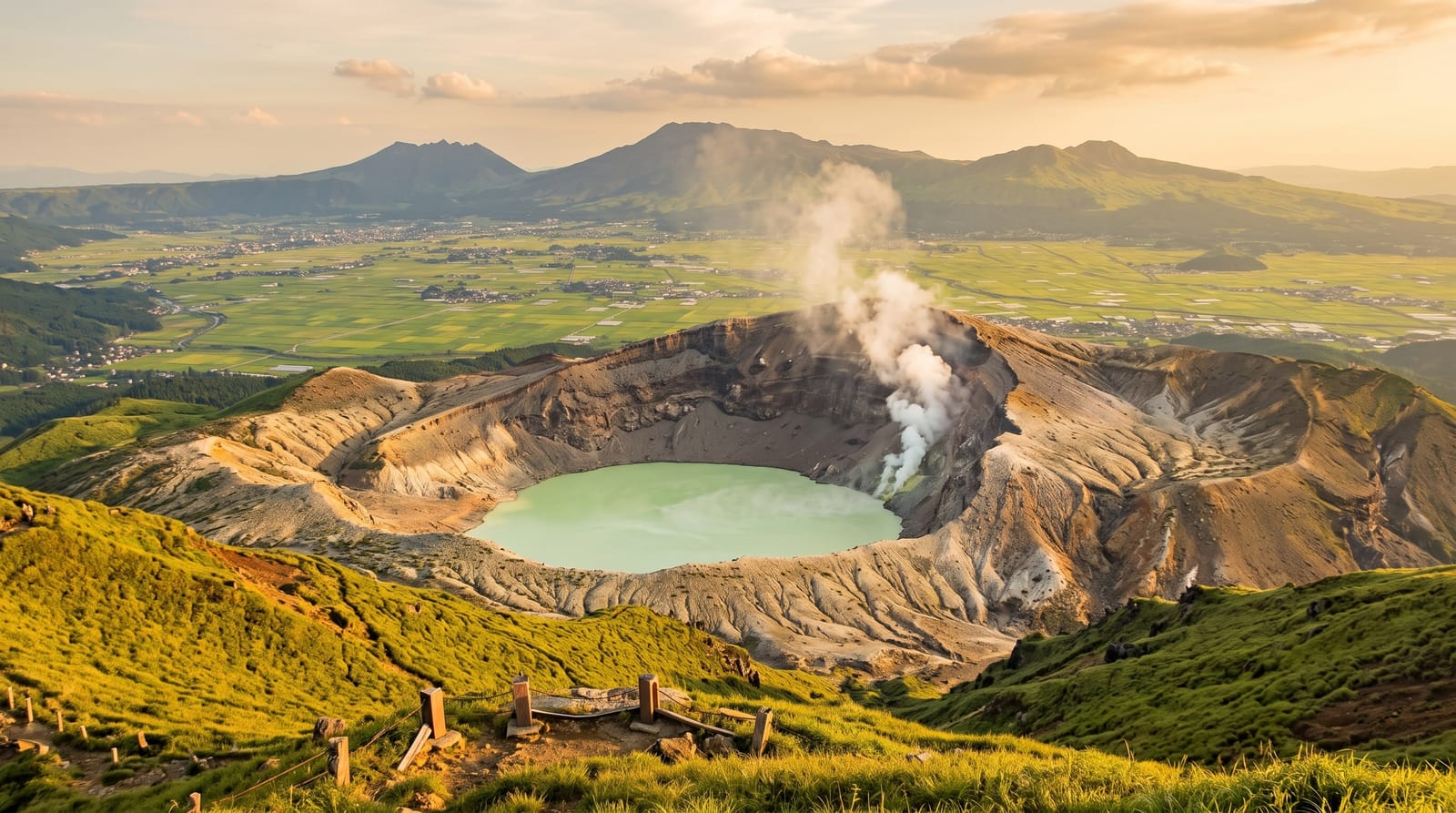
Aso is really two things at once. The caldera is enormous, roughly twenty-five kilometres across, and it is not empty: towns, rice fields, roads and a railway line sit on its floor, ringed by the old crater wall, which is the clearest way to grasp the scale. Inside it stands a group of newer cones, and one of them, Nakadake, is continuously active, with a milky green pool of acid water and a plume of sulphur dioxide rising straight out of a hole you can walk to the edge of. Around them lie Kusasenri, a grassy bowl with a shallow pond and grazing horses, and the small ash cone of Komezuka.
History
The caldera formed in four great eruptions, Aso 1 to 4, between about 300,000 and 90,000 years ago, when the emptied magma chamber collapsed; Mount Naka, one of the cones that grew afterwards, is still active, and a new eruption began on 20 October 2021. The welded tuff of Aso's pyroclastic flows was used for some 320 arched stone bridges in Kumamoto Prefecture (Wikipedia, Mount Aso).
What's there
- Nakadake crater rim - the active vent and its acid pool, when gas levels allow access.
- The caldera wall - viewpoints on the rim showing towns and fields on the crater floor.
- Kusasenri - a grassland bowl with a shallow pond and horses below the cones.
- Komezuka - a small, neatly formed ash cone with a dip in its top.
When to go
Spring green and autumn give the best conditions; the grasslands are burned off in early spring, which changes the look completely. Summer is humid and often clouded in. Winter can ice the crater road. Always check the day's alert level and gas readings before setting out, because access to the rim is decided at short notice.
Good to know
The crater closes without warning when sulphur dioxide rises, sometimes for weeks, and there is no compensation for a wasted trip; people with asthma or heart conditions are turned away even when it is open. The caldera floor is ordinary countryside rather than a spectacle. Weather shuts the upper area regularly, and public transport up the mountain is limited.
Nearby
The hot spring valleys of Kurokawa and Yufuin to the north, and Kumamoto city to the west.
Key facts
Source: Wikidata, item Q733710, read on 18 October 2026.
What to pack for Mount Aso
Chosen from what this place is for. Tap a kit for the full checklist.
- Broken-in walking shoes or boots - Grip and ankle support matter more than looks; never hike in brand-new boots. Find on Amazon
- Strong insect repellent - DEET or picaridin; the jungle is where bites and disease risk are highest. Find on Amazon
- Layers for big temperature swings - Warm sun by day, near-freezing at night, even near the equator. Find on Amazon
- Swimwear - Needed at most public thermal pools; some traditional baths are nude and single-sex. Find on Amazon
Some links on this page are Amazon affiliate links - if you buy through them we may earn a small commission at no extra cost to you.
All packing kitsPlan your trip
Where to start if Mount Aso is going on the list.
Booking links on this page are affiliate links - if you book through them we may earn a small commission at no extra cost to you. It never changes what we write about a place.
Opening times, ticket prices and seasonal closures change - check the official source before you go: official site.