Himeji Castle
The finest surviving castle in Japan - a dazzling white hilltop fortress of soaring gabled roofs, the elegant White Heron Castle, superbly preserved and a UNESCO treasure.
Updated 19 October 2026
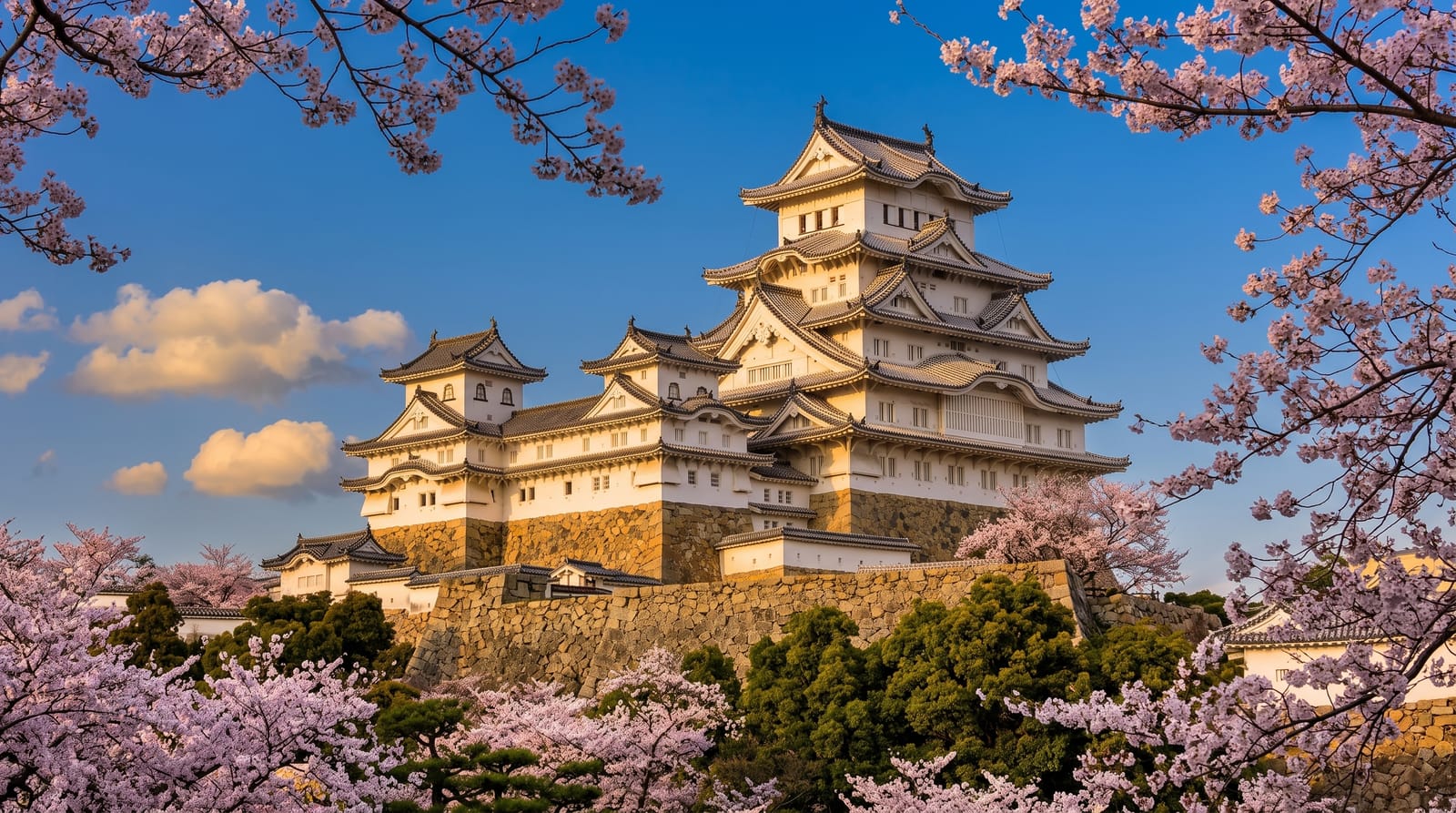
AI illustration
UNESCO World Heritage
Himeji Castle is the finest and best-preserved feudal castle in Japan, a dazzling white hilltop fortress of soaring, layered gabled roofs that seem to float like a bird in flight, giving it the name White Heron Castle. Dating largely from the early seventeenth century and never destroyed by war or fire, its brilliant white walls, maze of gates and defensive design make it a supreme example of Japanese castle architecture and a UNESCO treasure.
History
Akamatsu Norimura first fortified Himeyama hill in 1333, during the Genkō War, his son Sadanori replaced the fort with Himeyama Castle in 1346, and Kuroda Shigetaka remodelled it as Himeji Castle by 1561. Kuroda Yoshitaka gave it to Toyotomi Hideyoshi in 1580, who added a three-storey keep in 1581, and after the Battle of Sekigahara Tokugawa Ieyasu granted it to his son-in-law Ikeda Terumasa, who pulled down that keep and rebuilt and enlarged the whole castle from 1601 to 1609, with three moats, at an estimated 2.5 million man-days of labour; from 1617 Honda Tadamasa added buildings, among them the Dressing Tower for Princess Sen. Abandoned in 1871, when some corridors and gates were pulled down for army barracks, it came through the Second World War intact, as it did the Great Hanshin earthquake of 1995. On 11 December 1993 it became one of Japan's first World Heritage Sites, and after several years of restoration it reopened on 27 March 2015 (Wikipedia, Himeji Castle).
Highlights
- The white keep - the dazzling, many-roofed main tower.
- The defensive maze - the spiralling gates and walls designed to confuse attackers.
- The interior - the wooden floors and defences within the keep.
- The cherry blossom - the castle framed by blossom in spring.
When to go
Year-round; spring cherry-blossom season is the most beautiful and the most crowded. It is an easy stop on the bullet-train line between Osaka and Hiroshima, best in the morning before the crowds and heat.
Before you go
It is very popular, especially in blossom season, so go early to beat the crowds and the queues to climb the keep, which can be steep and slow inside. The keep's interior is bare wooden floors rather than furnished rooms. It is an easy bullet-train stop, seen in half a day.
Nearby
Kobe, Osaka and Kyoto are within reach; Hiroshima is further west on the bullet-train line.
Key facts
Source: Wikidata, item Q188754, read on 18 October 2026.
What to pack for Himeji Castle
Chosen from what this place is for. Tap a kit for the full checklist.
- Comfortable walking shoes - Sightseeing means kilometres of pavement and cobbles daily. Find on Amazon
- A slim anti-theft daypack - Zips that close properly; keep it in front in crowds and on transit. Find on Amazon
- A refillable water bottle - Many cities have public fountains; save money and plastic. Find on Amazon
- A light layer + compact umbrella - For museum air-con and a sudden shower. Find on Amazon
Some links on this page are Amazon affiliate links - if you buy through them we may earn a small commission at no extra cost to you.
All packing kitsPlan your trip
Where to start if Himeji Castle is going on the list.
Booking links on this page are affiliate links - if you book through them we may earn a small commission at no extra cost to you. It never changes what we write about a place.
Opening times, ticket prices and seasonal closures change - check the official source before you go: official site.