Hamarikyu Gardens
A shogun's duck-hunting garden whose pond rises and falls with Tokyo Bay, under a wall of office towers.
Updated 20 October 2026
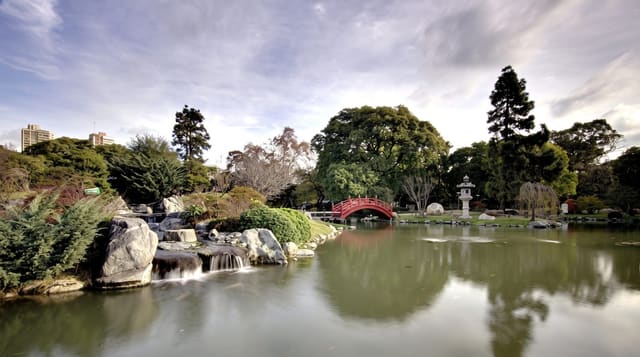
Hamarikyu was laid out in the seventeenth century as a shogunal villa and hunting ground on reclaimed land at the mouth of the Sumida, and its central pond is still connected to Tokyo Bay through sluice gates - it is tidal, the water level and the salinity shift through the day, and the fish in it are sea fish. That makes it the last surviving tidal garden of its kind in the city. A teahouse, Nakajima no Ochaya, sits on an island reached by wooden bridges and serves matcha with a sweet looking out over the water. The duck hunting grounds, where birds were lured into narrow channels and taken with nets, survive as earthworks. The setting is the other half of the effect: the Shiodome towers stand directly behind the trees, so the garden is always read against them. A water bus from Asakusa lands at a pier inside the grounds.
History
In 1654 Tokugawa Tsunashige, a son of the shogun Iemitsu, received permission to reclaim land from Edo Bay and built a villa and garden on it; his son Ienobu, later the 6th shogun, inherited it, and later shoguns used it as a second residence. After the Meiji Restoration it became the Hama Palace, a state guest house, where Ulysses S. Grant stayed for a month in 1879 (Wikipedia, Hama-rikyū Gardens).
The landscape
- A tidal pond - connected to the bay through sluices, with sea fish in it.
- The island teahouse - matcha served over the water, reached by wooden bridges.
- The duck grounds - earthwork channels from the shogunal hunting arrangement.
- Towers behind the trees - the Shiodome skyline framing the whole garden.
When to go
February to March for peonies and plum; autumn for cosmos. Two hours.
Things to know
It is smaller than it looks on a map and can be walked in an hour. The surrounding towers are unavoidable in every photograph. Entry is charged and it closes at five. The water bus needs separate booking and is often full.
Nearby
Tsukiji outer market is east; Ginza is north.
Key facts
Source: Wikidata, item Q1033333, read on 18 October 2026.
What to pack for Hamarikyu Gardens
Chosen from what this place is for. Tap a kit for the full checklist.
- Broken-in walking shoes or boots - Grip and ankle support matter more than looks; never hike in brand-new boots. Find on Amazon
- Layers + a waterproof shell - Mountain weather turns fast; a packable rain jacket saves the day. Find on Amazon
- Daypack with rain cover - 20-30 litres holds water, snacks, layers and a first-aid kit. Find on Amazon
- Offline maps + a power bank - Download the trail before you lose signal; carry backup charge. Find on Amazon
Some links on this page are Amazon affiliate links - if you buy through them we may earn a small commission at no extra cost to you.
All packing kitsPlan your trip
Where to start if Hamarikyu Gardens is going on the list.
Booking links on this page are affiliate links - if you book through them we may earn a small commission at no extra cost to you. It never changes what we write about a place.
Opening times, ticket prices and seasonal closures change - check the official source before you go: official site.