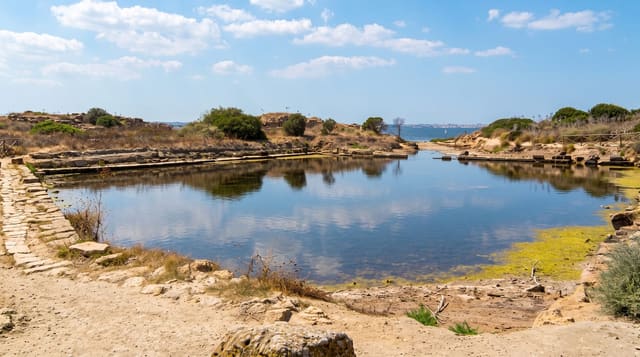
Tindari
A sanctuary on a cliff above lagoons that shift shape year by year as sand moves along the shore.
Updated 19 October 2026

AI illustration
Tyndaris was founded in 396 BC on a headland, and the Greek and Roman site holds a theatre reused by the Romans, a basilica and houses with mosaic floors. Above them stands the sanctuary of the Black Madonna, a wooden statue of uncertain date and origin whose dark colour has produced various explanations; a large modern church was built to house it in the 1950s. Below the cliff, the Marinello lagoons form and reshape continuously as currents move sand into a shallow spit, so their outline changes from year to year; a local legend attaches a child's rescue to the shifting sand.
History
Tyndaris was one of the last cities of Sicily with a purely Greek origin, founded by Dionysius the Elder in 396 or 395 BC on a commanding hill above the Tyrrhenian Sea, with views to Etna and the Lipari Islands. The poet Salvatore Quasimodo wrote Vento a Tindari about the place (Wikipedia, Tindari).
What to look for
- The Black Madonna - a dark wooden statue in a modern sanctuary church.
- The Greek theatre - a 4th-century BC auditorium reused by the Romans.
- The Marinello lagoons - shifting sand pools that change shape yearly.
- The mosaic houses - Roman floors in the excavated quarter.
When to go
April to October; pilgrim numbers peak around the September feast. The lagoons are reached by a path from the coast road below. The site closes some Mondays.
What to expect
The sanctuary is a modern building, not historic. The lagoon shape and access change with the sand. Parking above is limited with a shuttle in season.
Nearby
The Nebrodi mountains rise inland; Milazzo is east.
What to pack for Tindari
Chosen from what this place is for. Tap a kit for the full checklist.
- Reef-safe sunscreen - High SPF that will not bleach the coral you are swimming over. Find on Amazon
- Comfortable walking shoes - Sightseeing means kilometres of pavement and cobbles daily. Find on Amazon
- Modest clothing - Shoulders and knees covered - the single most common requirement. Find on Amazon
- Quick-dry towel - A microfibre towel packs small and dries in minutes. Find on Amazon
Some links on this page are Amazon affiliate links - if you buy through them we may earn a small commission at no extra cost to you.
All packing kitsPlan your trip
Where to start if Tindari is going on the list.
Booking links on this page are affiliate links - if you book through them we may earn a small commission at no extra cost to you. It never changes what we write about a place.
Opening times, ticket prices and seasonal closures change - check the official source before you go: official site.