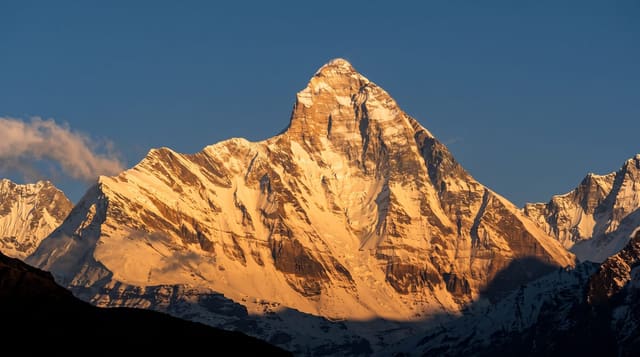
Valley of Flowers National Park
A high glacial valley in Uttarakhand that fills with alpine flowers for a few weeks after the monsoon arrives, reached only on foot.
Updated 18 October 2026
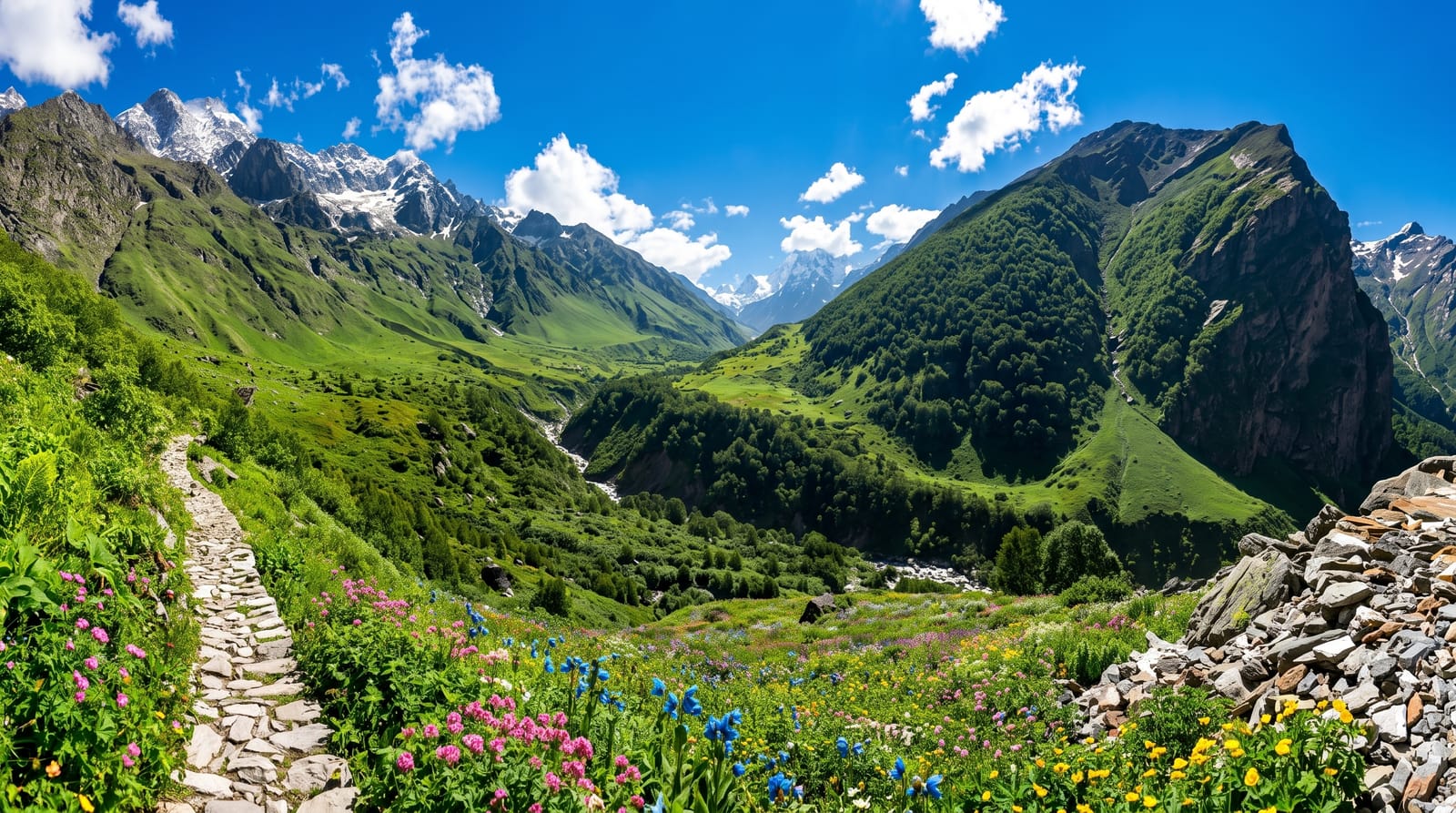
AI illustration
UNESCO World Heritage
The Valley of Flowers lies high in the upper Himalaya of Uttarakhand, a glacial valley that spends most of the year under snow and then, for a few weeks after the monsoon arrives, fills with alpine flowers. You reach it on foot: a steep climb from Govindghat to the village of Ghangaria, then a further walk into the park itself, which can only be visited as a day trip. The valley floor is a broad meadow crossed by a stream, banked by steep slopes and hanging glaciers, with primula, anemone, potentilla and blue poppy among hundreds of species that turn over week by week through the short season.
History
Colonel Edmund Smyth is recorded as finding the Pushpawati valley in 1862, but the place stayed little known until 1931, when the British mountaineers Frank Smythe, Eric Shipton and R. L. Holdsworth lost their way back from a successful climb of Kamet, came upon the valley in flower and named it the Valley of Flowers; Smythe later wrote a book of that name. In 1939 the botanist Joan Margaret Legge, sent by the Royal Botanic Gardens at Kew, slipped and died on a rocky slope here while collecting flowers, and her sister later put up a memorial near the spot. A government order of 1980 declared the valley a national park, whose establishment is also dated to 1982, and from 1993 the botanist Chandra Prakash Kala spent a decade studying it for the Wildlife Institute of India, recording 520 alpine plants. The park lies at 3,352 to 3,658 metres and covers 87.5 square kilometres, and in 2000 it was added to the Nanda Devi biosphere reserve as a second core zone (Wikipedia, Valley of Flowers National Park).
The landscape
- The flowering meadow - the valley floor carpeted with alpine species that shift through the season.
- The Pushpawati stream - the meltwater channel running the length of the valley.
- Snow peaks and hanging glaciers - the walls of the valley above the treeline.
- The climb from Ghangaria - a steep forested approach with waterfalls along the way.
When to go
The window is short. The park opens around the start of June, but flowers peak from mid-July to late August, which is also the wettest part of the monsoon. By September the bloom is fading and the valley closes in early October. Go with the rain rather than waiting for clear weather, because clear weather here usually means no flowers.
Good to know
It rains, often all day, and the trail turns to mud and slush. The trek is long and steep, altitude affects some people at Ghangaria, and there is no accommodation inside the park, so every visit means walking in and back out the same day. Ghangaria itself is a crowded, basic huddle of lodges. Landslides regularly close the road approach at short notice.
Nearby
The pilgrimage lake of Hemkund Sahib is a further steep climb from the same village.
Key facts
Source: Wikidata, item Q605897, read on 18 October 2026.
What to pack for Valley of Flowers National Park
Chosen from what this place is for. Tap a kit for the full checklist.
- Broken-in walking shoes or boots - Grip and ankle support matter more than looks; never hike in brand-new boots. Find on Amazon
- Binoculars - The single best wildlife tool - even a compact pair transforms a sighting. Find on Amazon
- Warm base layers - Merino or synthetic against the skin - never cotton, which chills when damp. Find on Amazon
- Strong insect repellent - DEET or picaridin; the jungle is where bites and disease risk are highest. Find on Amazon
Some links on this page are Amazon affiliate links - if you buy through them we may earn a small commission at no extra cost to you.
All packing kitsPlan your trip
Where to start if Valley of Flowers National Park is going on the list.
Booking links on this page are affiliate links - if you book through them we may earn a small commission at no extra cost to you. It never changes what we write about a place.
Opening times, ticket prices and seasonal closures change - check the official source before you go: official site.