Safdarjung's Tomb
The last great Mughal garden tomb, built in 1754 partly from stone stripped off an earlier one.
Updated 19 October 2026
AI illustration
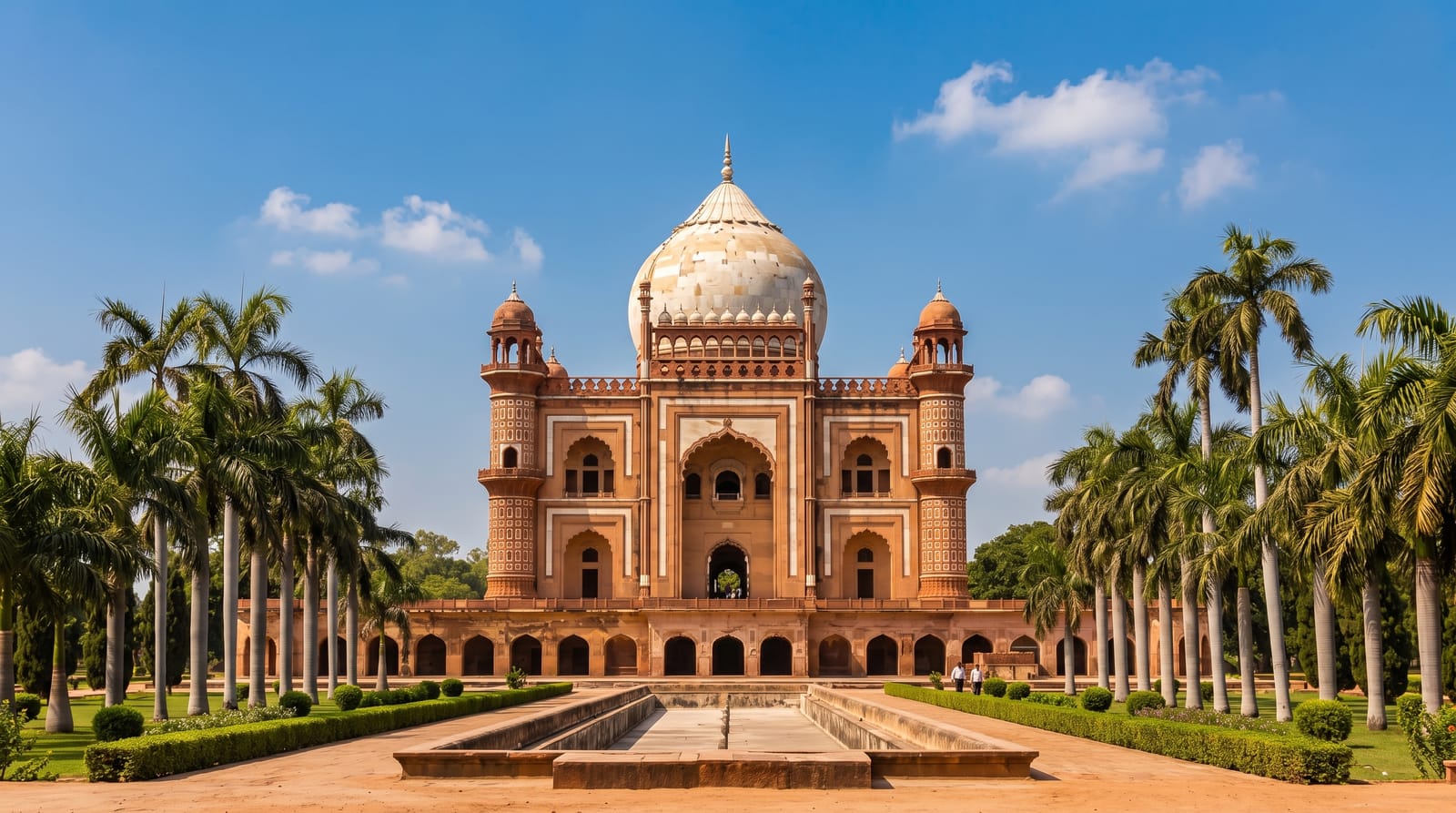
Built in 1754 for Safdarjung, a nawab of Awadh who served as vizier, this is generally counted the last of the great Mughal garden tombs, put up when the empire had little money left, which shows: marble for the facing was reportedly taken from the earlier tomb of Abdur Rahim Khan-i-Khanan, and the proportions are heavier and the detail coarser than at Humayun's Tomb, which it clearly imitates. It stands on a terrace in a charbagh garden with water channels, pavilions on the enclosing walls and a domed chamber over the cenotaph. It is one of the quietest monuments in central Delhi.
History
Safdar Jang, Nawab of Awadh, was made wazir, or prime minister, of the Mughal Empire when Ahmad Shah Bahadur came to the throne in 1748; he left Delhi in 1753 and died in Awadh in 1754. His son Shuja-ud-Daula asked the emperor's permission to build him a tomb in Delhi, and the tomb, designed by an Abyssinian architect, Bilal Muhammad Khan, at a cost of about three lakh rupees, was the first time someone outside the immediate imperial family built such a tomb and garden complex (Wikipedia, Tomb of Safdar Jang).
The main sights
- The domed tomb - a bulbous dome over the central chamber on a terrace.
- The charbagh - the four-part garden with channels and pathways.
- The wall pavilions - structures set into the enclosing walls.
- The quiet - far fewer visitors than the major Delhi monuments.
When to go
October to March for pleasant weather; the garden is at its best in the early morning or the hour before closing, when the light is low and warm on the sandstone.
What to expect
The visit is short, under an hour for most. The building is visibly less refined than its models, which some find disappointing. Facilities on site are minimal.
Nearby
Lodhi Gardens lies east; Humayun's Tomb is further east.
Key facts
Source: Wikidata, item Q375624, read on 18 October 2026.
What to pack for Safdarjung's Tomb
Chosen from what this place is for. Tap a kit for the full checklist.
- Comfortable walking shoes - Sightseeing means kilometres of pavement and cobbles daily. Find on Amazon
- A slim anti-theft daypack - Zips that close properly; keep it in front in crowds and on transit. Find on Amazon
- A refillable water bottle - Many cities have public fountains; save money and plastic. Find on Amazon
- A light layer + compact umbrella - For museum air-con and a sudden shower. Find on Amazon
Some links on this page are Amazon affiliate links - if you buy through them we may earn a small commission at no extra cost to you.
All packing kitsPlan your trip
Where to start if Safdarjung's Tomb is going on the list.
Booking links on this page are affiliate links - if you book through them we may earn a small commission at no extra cost to you. It never changes what we write about a place.
Opening times, ticket prices and seasonal closures change - check the official source before you go: official site.


