Jim Corbett National Park
India's first national park, in the Himalayan foothills, where the Ramganga river cuts through sal forest and open grassland.
Updated 19 October 2026
AI illustration
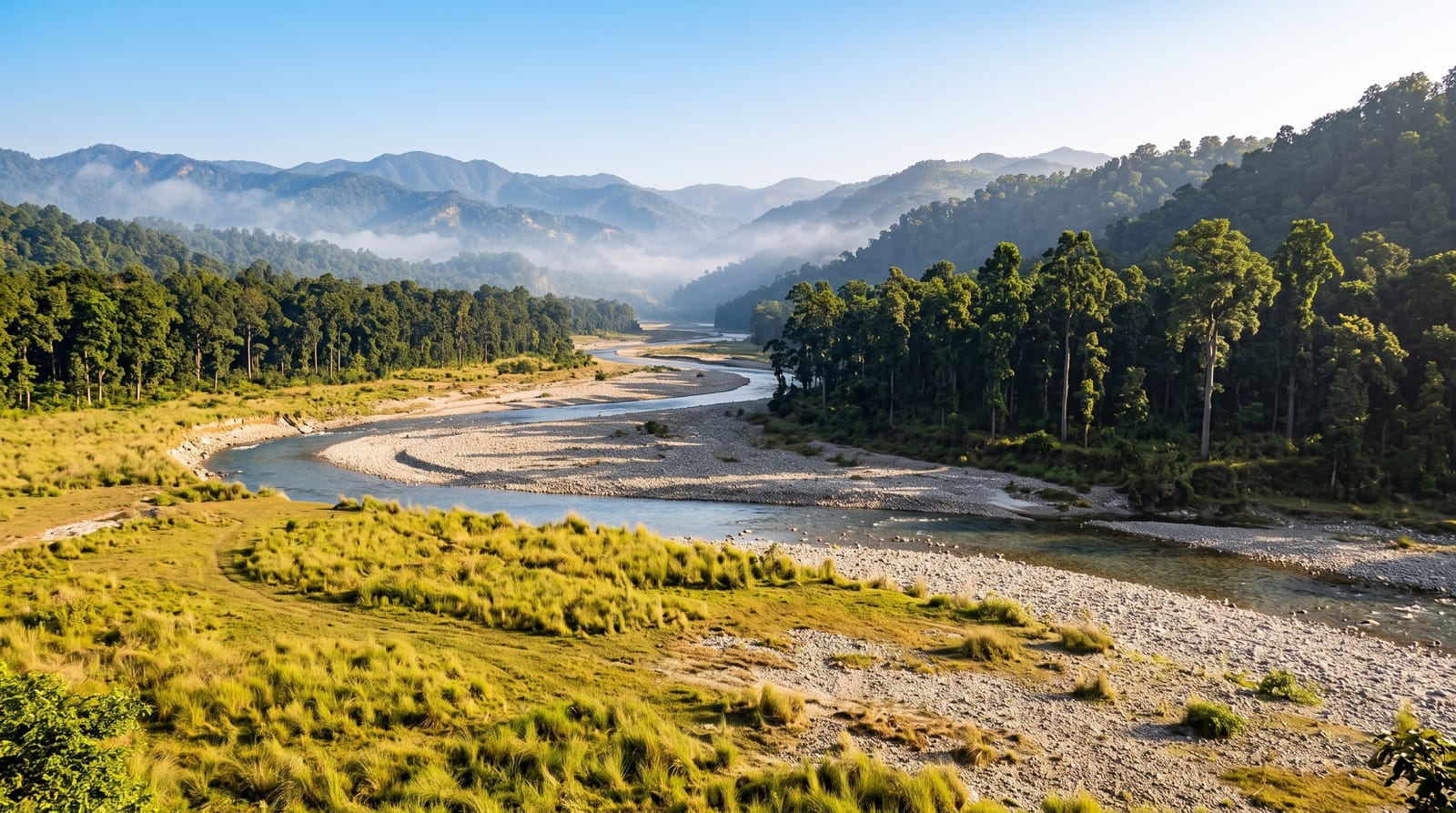
Corbett was India's first national park and is still one of its most varied, spread over the Himalayan foothills where the Ramganga river cuts through sal forest, grassland and wide shingle beds. The Dhikala zone, deep inside on a plateau above the reservoir, gives the widest views and the best chance of seeing wild elephant herds and tigers crossing open grass; the other zones are shorter day trips from Ramnagar. Beyond the big animals there are gharial and mugger crocodile in the river, otter, fishing eagles and hundreds of bird species along the water. The park is busy with domestic visitors, and permits are allocated by zone under strict daily quotas.
History
Efforts to protect these forests began in the 19th century under Major Ramsay, and in 1868 the British forest department took control of the land and banned cultivation and cattle stations. In the early 1900s E. R. Stevans and E. A. Smythies proposed a national park, and in 1936, under Governor Sir Malcolm Hailey, the Hailey National Park of 323.75 km2 became Asia's first national park; it was renamed Ramganga National Park in 1954-1955 and then Corbett National Park, after the author and naturalist Jim Corbett, who had played a leading role in its creation (Wikipedia, Jim Corbett National Park).
What you'll find
- The Dhikala grasslands - open chaurs above the reservoir where elephant and deer feed.
- The Ramganga river - shingle beds and pools with crocodile, otter and fishing eagles.
- Sal forest - the tall hardwood woodland covering most of the lower zones.
- Tigers and wild elephant - the animals most people come for, seen with luck rather than certainty.
When to go
Zones open roughly from mid-November, with Dhikala running until about mid-June and closing for the monsoon. Winter mornings are cold and misty but pleasant; March to June is hot and the best period for sightings as animals come down to water. Permits, especially for Dhikala, are released online months ahead and go quickly.
What to expect
Corbett is heavily visited and weekends bring convoys of jeeps, loud groups and traffic on the tracks. Accommodation just outside the gates has multiplied and much of it is resort-style rather than quiet. Zone permits are confusing, non-transferable and sell out; Dhikala requires an overnight stay in basic forest rest houses. Tiger sightings are less reliable here than in the central Indian parks.
Nearby
Nainital and the lake towns of Kumaon are two to three hours up into the hills.
Key facts
Source: Wikidata, item Q949297, read on 18 October 2026.
What to pack for Jim Corbett National Park
Chosen from what this place is for. Tap a kit for the full checklist.
- Broken-in walking shoes or boots - Grip and ankle support matter more than looks; never hike in brand-new boots. Find on Amazon
- Travel rod + reel - A packable multi-piece rod fits in a case and covers most holiday fishing. Find on Amazon
- Binoculars - The single best wildlife tool - even a compact pair transforms a sighting. Find on Amazon
- Strong insect repellent - DEET or picaridin; the jungle is where bites and disease risk are highest. Find on Amazon
Some links on this page are Amazon affiliate links - if you buy through them we may earn a small commission at no extra cost to you.
All packing kitsPlan your trip
Where to start if Jim Corbett National Park is going on the list.
Booking links on this page are affiliate links - if you book through them we may earn a small commission at no extra cost to you. It never changes what we write about a place.
Opening times, ticket prices and seasonal closures change - check the official source before you go: official site.