Fatehpur Sikri
A red sandstone Mughal capital built in the 1570s and abandoned within about fifteen years, left largely as it was.
Updated 18 October 2026
AI illustration
UNESCO World Heritage
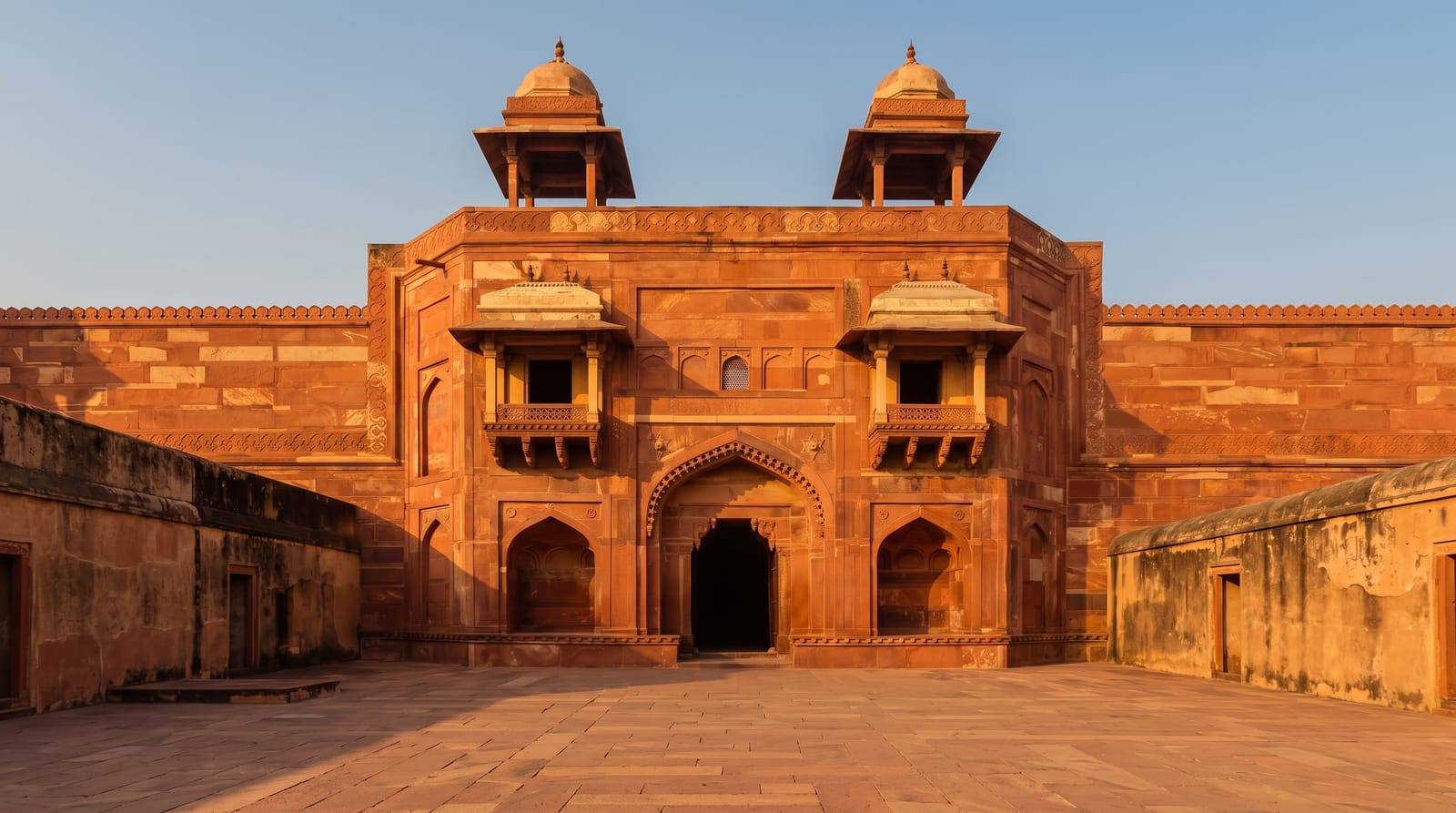
Akbar built a capital here in the 1570s and left it barely fifteen years later, water supply being the usual explanation, so what survives is a complete court complex that was never much altered afterwards. It is all red sandstone, laid out as courtyards and pavilions along a ridge: the five-storey Panch Mahal, each floor smaller than the one below it, a hall whose single central pillar spreads into a carved bracket platform, the residential blocks with their deep verandas, and a board set into the paving for a game once played with people as pieces. The mosque enclosure alongside is entered under an immense gateway and is still in use, with the marble tomb of Salim Chishti standing in its courtyard.
History
Excavations at Birchhabili Tila show a settlement here from the 6th century CE, with a Jain shrine and later a Jain temple, one of whose sculptures records its installation at Saikrikya, the old name of Sikri, in 1010; the Sikarwar Rajputs held the area until the Battle of Khanwa in 1527, and the temples were probably destroyed around 1300 under Alauddin Khalji, whose mosque still stands in the town. The khanqah of Sheikh Salim Chishti was already here, and Akbar's son Jahangir was born in the village; Akbar founded his new capital on the site in 1571 and ruled from it until 1585, when he left on a campaign in the Punjab, and the city was completely abandoned in 1610 (Wikipedia, Fatehpur Sikri).
What to look for
- Panch Mahal - the open five-storey pavilion, each level narrower than the one beneath.
- Diwan-i-Khas - the hall with a single central pillar opening into a carved bracket platform.
- The marble tomb of Salim Chishti - fine white screens in the middle of the mosque courtyard.
- Buland Darwaza - the huge gateway on the mosque's south side, reached up a long flight of steps.
When to go
October to March is dry and manageable; April to June on the plains is brutal and there is very little shade. Early morning is far quieter than the middle of the day, when tour coaches arrive from Agra. The sandstone reddens in the last hour of light, which is the best time for photographs of the palace courtyards.
Things to know
The mosque enclosure and the palace are separately managed, and the free side has the most persistent guides, offering-collectors and thread-sellers in the country. Shoes come off across a large hot courtyard. Access from the car park is by a shuttle bus you cannot avoid. The palace is unfurnished and empty, so it can feel repetitive without context.
Nearby
Agra with its fort and the Taj is an hour east, and the bird sanctuary at Bharatpur is a similar distance west.
Key facts
Source: Wikidata, item Q179046, read on 18 October 2026.
What to pack for Fatehpur Sikri
Chosen from what this place is for. Tap a kit for the full checklist.
- Comfortable walking shoes - Sightseeing means kilometres of pavement and cobbles daily. Find on Amazon
- Modest clothing - Shoulders and knees covered - the single most common requirement. Find on Amazon
- A slim anti-theft daypack - Zips that close properly; keep it in front in crowds and on transit. Find on Amazon
- A scarf or shawl - To cover the head or shoulders on entry; women especially at mosques. Find on Amazon
Some links on this page are Amazon affiliate links - if you buy through them we may earn a small commission at no extra cost to you.
All packing kitsPlan your trip
Where to start if Fatehpur Sikri is going on the list.
Booking links on this page are affiliate links - if you book through them we may earn a small commission at no extra cost to you. It never changes what we write about a place.
Opening times, ticket prices and seasonal closures change - check the official source before you go: official site.