Chanderi
A hill town of sultanate architecture whose weavers make a saree so fine it is described as woven air.
Updated 16 October 2026

AI illustration
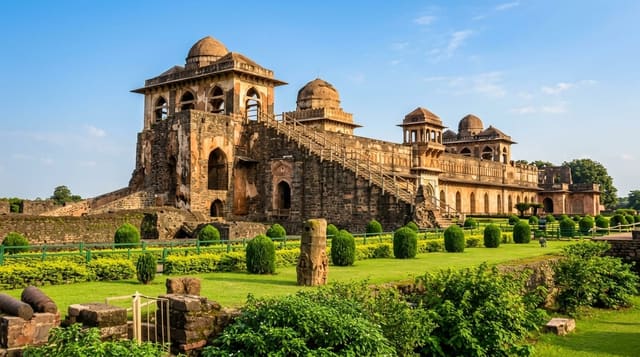
Chanderi sits below a hill fort in northern Madhya Pradesh and holds a scatter of fifteenth and sixteenth century sultanate buildings, among them the Koshak Mahal, a large palace begun on a seven-storey plan and left unfinished at two, and Badal Mahal Gate, a freestanding ceremonial arch. Its living tradition is weaving: the Chanderi saree, made on pit looms in cotton and silk with a characteristic sheer transparency, is produced in workshops through the town, with thousands of households involved. Jain and Hindu rock carvings and old stepwells lie around the hill, and the fort gives a view over the plain.
Background
The town lies among hills southwest of the Betwa River, at an average elevation of 456 metres, surrounded by lakes and forest. Its history reaches back to the 11th century, and the Persian scholar Alberuni mentions it in 1030. The surviving monuments date from the Malwa Sultanate and the Bundela Rajputs, and from 1646 the town was held by the family of Devi Singh Bundela. Chanderi is also known for ancient Jain temples, and Jain sites ring it: Khandargiri at 2 km, Gurilagiri at 7 km, Bhiyadant at 14 km, Bhamon at 16 km, Bithala at 19 km, Deogarh at 20 km, Thuvanji at 22 km and Aamanachar at 29 km. There is no railway in or near the town.
Source: Wikipedia, "Chanderi"
What you'll find
- The pit looms - weavers making sheer Chanderi cloth in household workshops.
- Koshak Mahal - a palace begun on seven storeys and stopped at two.
- Badal Mahal Gate - a freestanding ceremonial arch.
- The hill fort - walls and gates above the town with a plain view.
When to go
October to March; summers in this part of Madhya Pradesh are severe. Weaving workshops run on weekdays. The town is quiet and sees few foreign visitors.
Practical notes
Workshops expect purchase interest, and power-loom imitations are widely sold as handloom. Monuments are scattered with limited signage. Accommodation is basic.
Nearby
Orchha lies east; Gwalior is north.
What to pack for Chanderi
Chosen from what this place is for. Tap a kit for the full checklist.
- Comfortable walking shoes - Sightseeing means kilometres of pavement and cobbles daily. Find on Amazon
- Modest clothing - Shoulders and knees covered - the single most common requirement. Find on Amazon
- A slim anti-theft daypack - Zips that close properly; keep it in front in crowds and on transit. Find on Amazon
- A scarf or shawl - To cover the head or shoulders on entry; women especially at mosques. Find on Amazon
Some links on this page are Amazon affiliate links - if you buy through them we may earn a small commission at no extra cost to you.
All packing kitsPlan your trip
Where to start if Chanderi is going on the list.
Booking links on this page are affiliate links - if you book through them we may earn a small commission at no extra cost to you. It never changes what we write about a place.
Opening times, ticket prices and seasonal closures change - check the official source before you go: official site.