Capitol Complex, Chandigarh
Le Corbusier's government buildings in raw concrete, a UNESCO site visited only on a guided tour.
Updated 18 October 2026
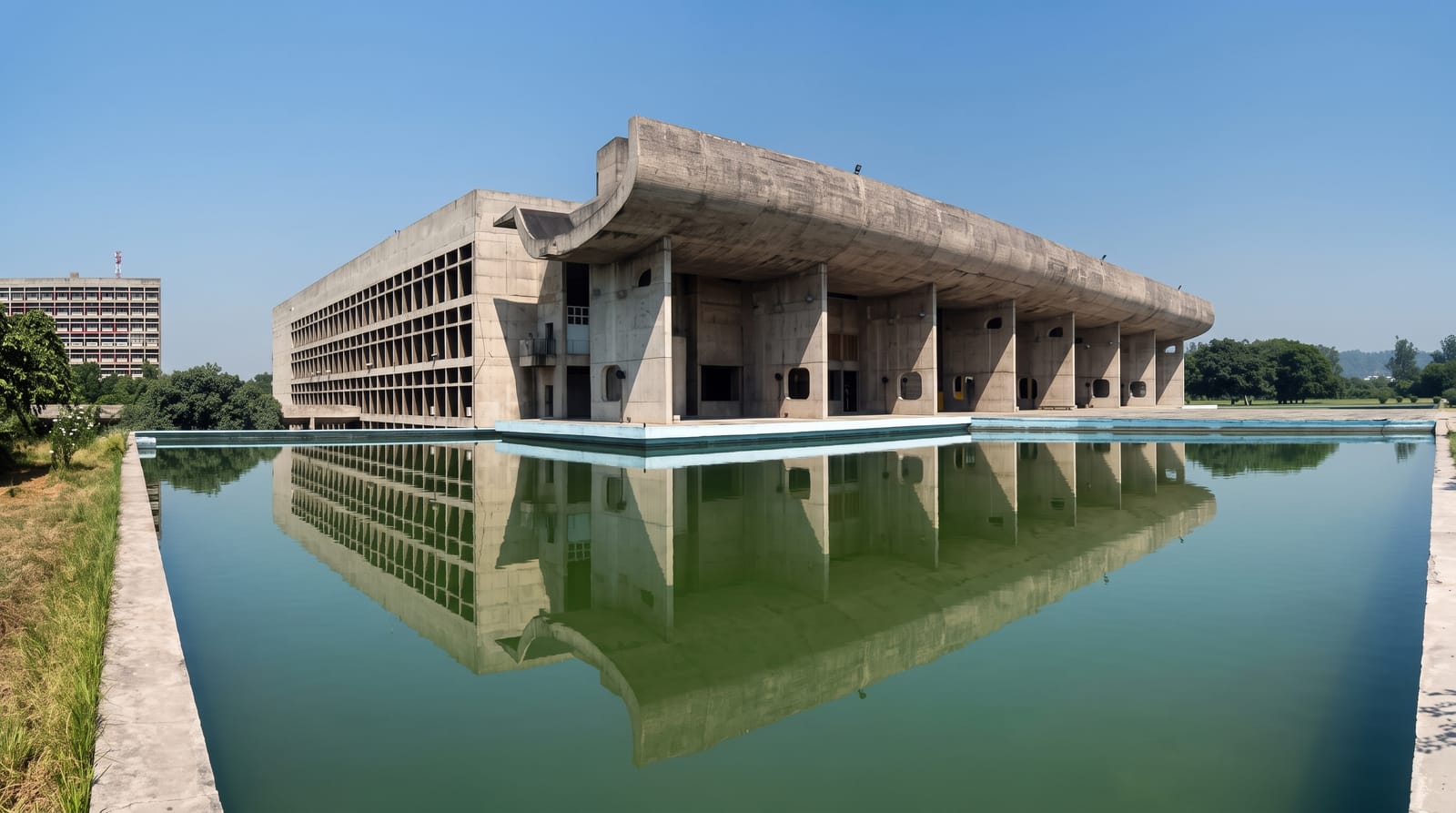
AI illustration
UNESCO World Heritage
When a new capital was needed for Punjab after 1947, Le Corbusier was brought in to plan Chandigarh, and the Capitol Complex at its head is the group he designed himself: the Secretariat, a long slab block; the Assembly, with a hyperbolic tower over the chamber and an enamelled door he painted; and the High Court, under a parasol roof with three coloured piers. Between them stand the Open Hand, a rotating sheet-metal sculpture, and the Tower of Shadows. The complex was inscribed by UNESCO in 2016 as part of Le Corbusier's transnational listing. Security means access is only on scheduled tours.
History
The Capitol Complex was conceived after the Partition of 1947, when Punjab's shared capital, Lahore, went to Pakistan, and Jawaharlal Nehru wanted the new capital to be a symbol of India's freedom. In 1950 the American architect Albert Mayer and his colleague Matthew Nowicki drew up a preliminary plan, but after Nowicki's death that year and Mayer's withdrawal, Le Corbusier took over in 1951 on condition that his cousin Pierre Jeanneret join as resident architect, with Maxwell Fry and Jane Drew; he replaced Mayer's radial plan with a grid in the form of a human body, putting the Capitol at the head, backed by the hills. The foundation stone of Chandigarh was laid on 1 November 1952, only three of the four main buildings were built, the Governor's Palace and a museum remaining unbuilt, and the complex is a World Heritage Site with sixteen other works by Le Corbusier (Wikipedia, Chandigarh Capitol Complex).
What to look for
- The Assembly - the hyperbolic tower and Corbusier's enamelled door.
- The High Court - the parasol roof over three coloured piers.
- The Open Hand - the rotating metal sculpture in its pit.
- The Tower of Shadows - the concrete structure built to test sun angles.
When to go
October to March for tolerable weather in the open concrete plaza. Tours run at set times, usually two or three a day, and require registering in advance with photo identification.
Before you go
Access is only on a guided tour with identification; independent walking is not allowed and foreign nationals need to register in advance. Interiors are generally not entered. The plaza is vast, exposed and hot.
Nearby
The Rock Garden lies south; Sukhna Lake is east.
Key facts
Source: Wikidata, item Q25931399, read on 18 October 2026.
What to pack for Capitol Complex, Chandigarh
Chosen from what this place is for. Tap a kit for the full checklist.
- Comfortable walking shoes - Sightseeing means kilometres of pavement and cobbles daily. Find on Amazon
- A slim anti-theft daypack - Zips that close properly; keep it in front in crowds and on transit. Find on Amazon
- A refillable water bottle - Many cities have public fountains; save money and plastic. Find on Amazon
- A light layer + compact umbrella - For museum air-con and a sudden shower. Find on Amazon
Some links on this page are Amazon affiliate links - if you buy through them we may earn a small commission at no extra cost to you.
All packing kitsPlan your trip
Where to start if Capitol Complex, Chandigarh is going on the list.
Booking links on this page are affiliate links - if you book through them we may earn a small commission at no extra cost to you. It never changes what we write about a place.
Opening times, ticket prices and seasonal closures change - check the official source before you go: official site.