Belur Math
A temple designed so that Hindu, Islamic, Buddhist and Christian architecture read as one building.
Updated 19 October 2026
AI illustration
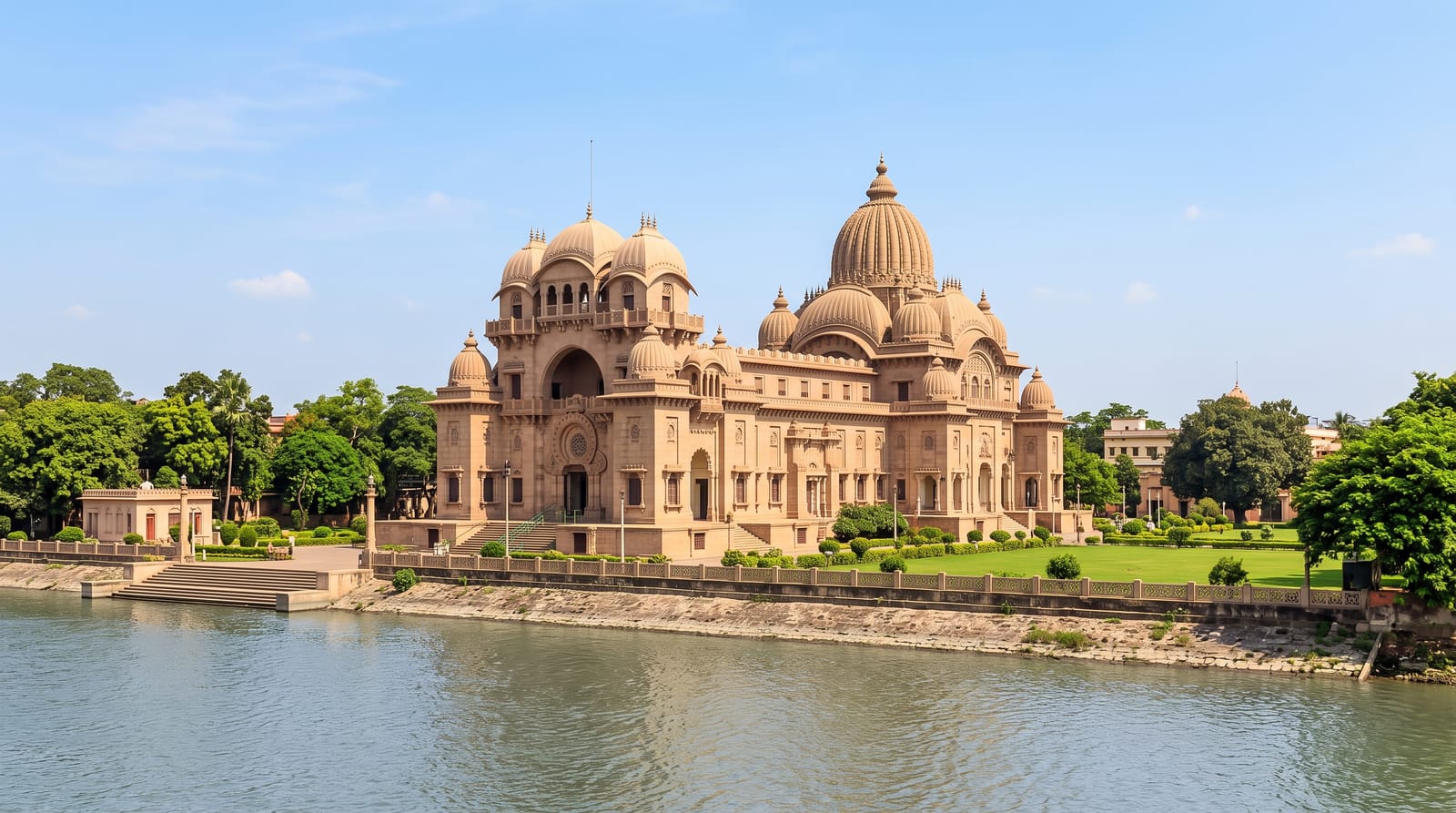
Belur Math is the headquarters of the Ramakrishna Math and Mission, founded by Vivekananda in 1897, and its main temple, completed in 1938, was designed to embody the movement's principle that religions are different paths to the same end: the entrance draws on South Indian gopuram forms, the upper structure on Rajput and Mughal work, the dome on Hindu temple and Islamic precedent, and the plan on a Christian church, so the building reads as one thing from a distance and resolves into several traditions up close. It stands in gardens on the Hooghly with shrines to Sarada Devi and Vivekananda alongside.
History
At the beginning of 1897 Swami Vivekananda arrived in Calcutta and founded two monasteries, one at Belur, which became the headquarters of the Ramakrishna Mission, and the Advaita Ashrama at Mayavati in the Himalayas. The main temple was designed by Swami Vijnanananda, a former civil engineer, to Vivekananda's ideas, drawing on monuments he had seen on his travels in India and abroad; the foundation stone was laid on 13 March 1929 and the building was carried out by Martin Burn & Co. (Wikipedia, Belur Math).
What to look for
- The composite temple - Hindu, Islamic, Buddhist and Christian forms in one design.
- The riverside gardens - lawns and paths along the Hooghly frontage.
- The subsidiary shrines - temples to Sarada Devi and Vivekananda.
- The museum - material on Ramakrishna, Vivekananda and the mission.
When to go
October to March; the complex closes in the middle of the day. Evening arati on the river side is the quietest and most atmospheric time. Kolkata summers are hot.
What to expect
Photography is prohibited inside the temple. The site closes for several hours at midday. Ferry timings from Dakshineswar are limited and the crossing is weather-dependent.
Nearby
Dakshineswar lies across the river; Howrah is south.
Key facts
Source: Wikidata, item Q816234, read on 18 October 2026.
What to pack for Belur Math
Chosen from what this place is for. Tap a kit for the full checklist.
- Comfortable walking shoes - Sightseeing means kilometres of pavement and cobbles daily. Find on Amazon
- Modest clothing - Shoulders and knees covered - the single most common requirement. Find on Amazon
- A slim anti-theft daypack - Zips that close properly; keep it in front in crowds and on transit. Find on Amazon
- A scarf or shawl - To cover the head or shoulders on entry; women especially at mosques. Find on Amazon
Some links on this page are Amazon affiliate links - if you buy through them we may earn a small commission at no extra cost to you.
All packing kitsPlan your trip
Where to start if Belur Math is going on the list.
Booking links on this page are affiliate links - if you book through them we may earn a small commission at no extra cost to you. It never changes what we write about a place.
Opening times, ticket prices and seasonal closures change - check the official source before you go: official site.