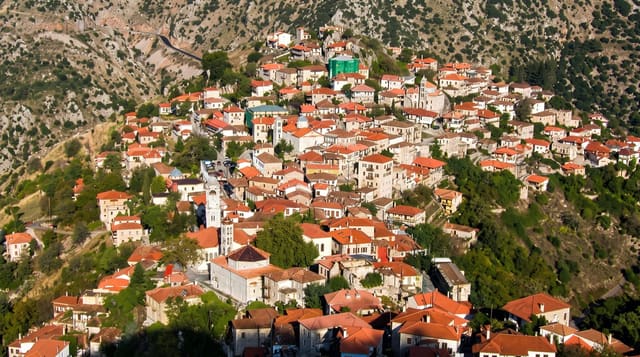
Temple of Apollo Epicurius at Bassae
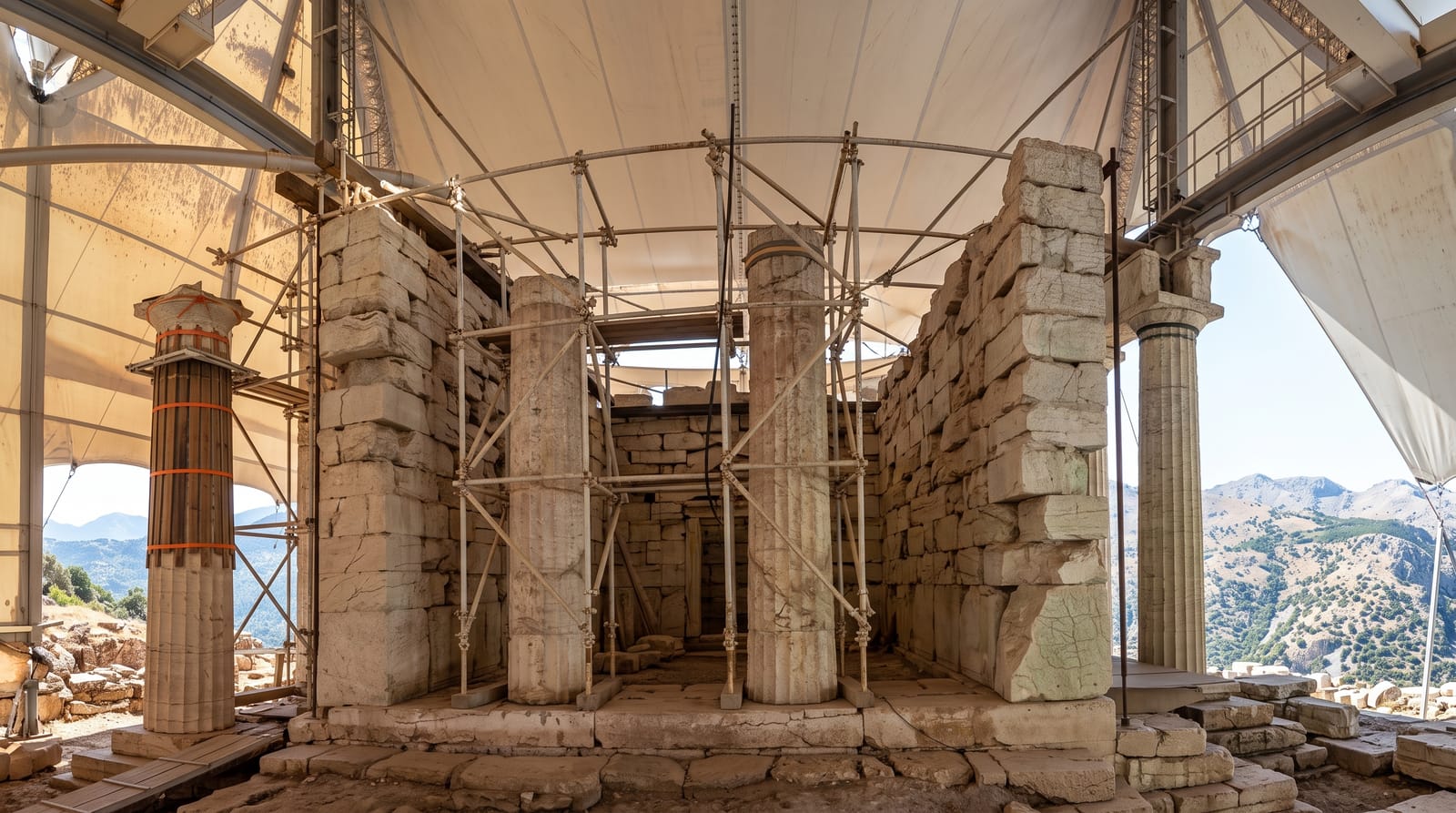
A fifth-century BC temple standing alone at 1,130 metres in the Arcadian mountains, sheltered under a great tent.
Updated 18 October 2026
AI illustration
UNESCO World Heritage
Bassae was built around 420 BC in a remote fold of the Arcadian mountains, and Pausanias credited it to Iktinos, one of the architects of the Parthenon. It is an oddity in every respect: aligned north-south rather than east-west, combining Doric, Ionic and the earliest known Corinthian capital in a single building, and set at 1,130 metres in country that had almost no population then or now. Its interior frieze was removed in 1812 and is in the British Museum. In 1986 it became the first Greek site inscribed on the UNESCO list, and since 1987 it has stood under an enormous white tent erected to protect the limestone from frost and rain while conservation continues, so visitors see a well-preserved temple in a strange, translucent indoor twilight.
History
In the 7th century BC the people of Phigaleia, having won back their land from the Spartans, set up a sanctuary to Apollo Epikourios, the helper in the evils of war, and the present temple is the last of four on the site, built between 450 and 400 BC, probably in thanks for help during the plague of 430 BC. Pausanias, who praised it as second only to the temple of Athena Alea at Tegea for the beauty of its stone, names the Parthenon's architect Iktinos as its designer, though modern scholars doubt this, since its Doric order, extremely similar to the Parthenon's, is in places old-fashioned though probably later. It stayed in use until pagan temples were closed in the 4th or 5th century AD, and its remoteness kept it unusually well preserved (Wikipedia, Bassae).
What you'll find
- The colonnade - a nearly complete fifth-century BC Doric temple.
- The protective tent - the vast white canopy that has covered it since 1987.
- The mixed orders - Doric outside, Ionic within, and an early Corinthian capital.
- The mountain setting - empty Arcadian ridges in every direction.
When to go
Late spring and early autumn; the road is high and can be snowbound in winter. Cloud often sits on the site in the morning, and afternoons are usually clearer.
Things to know
The tent dominates the experience: photographs of the temple in open landscape are impossible, and the interior light is dim and grey. The drive from any direction is long and winding. The famous frieze is in London.
Nearby
Andritsaina and its old library lie north; Ancient Olympia is about an hour and a half away.
Key facts
Source: Wikidata, item Q464923, read on 18 October 2026.
What to pack for Temple of Apollo Epicurius at Bassae
Chosen from what this place is for. Tap a kit for the full checklist.
- Comfortable walking shoes - Sightseeing means kilometres of pavement and cobbles daily. Find on Amazon
- Modest clothing - Shoulders and knees covered - the single most common requirement. Find on Amazon
- A slim anti-theft daypack - Zips that close properly; keep it in front in crowds and on transit. Find on Amazon
- A scarf or shawl - To cover the head or shoulders on entry; women especially at mosques. Find on Amazon
Some links on this page are Amazon affiliate links - if you buy through them we may earn a small commission at no extra cost to you.
All packing kitsPlan your trip
Where to start if Temple of Apollo Epicurius at Bassae is going on the list.
Booking links on this page are affiliate links - if you book through them we may earn a small commission at no extra cost to you. It never changes what we write about a place.
Opening times, ticket prices and seasonal closures change - check the official source before you go: official site.